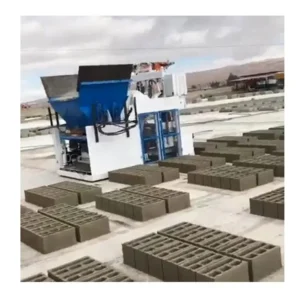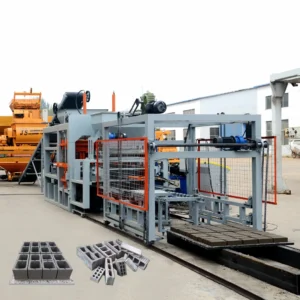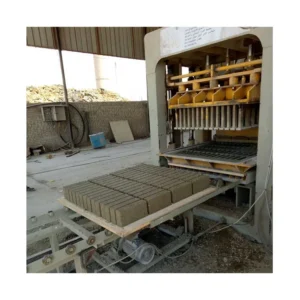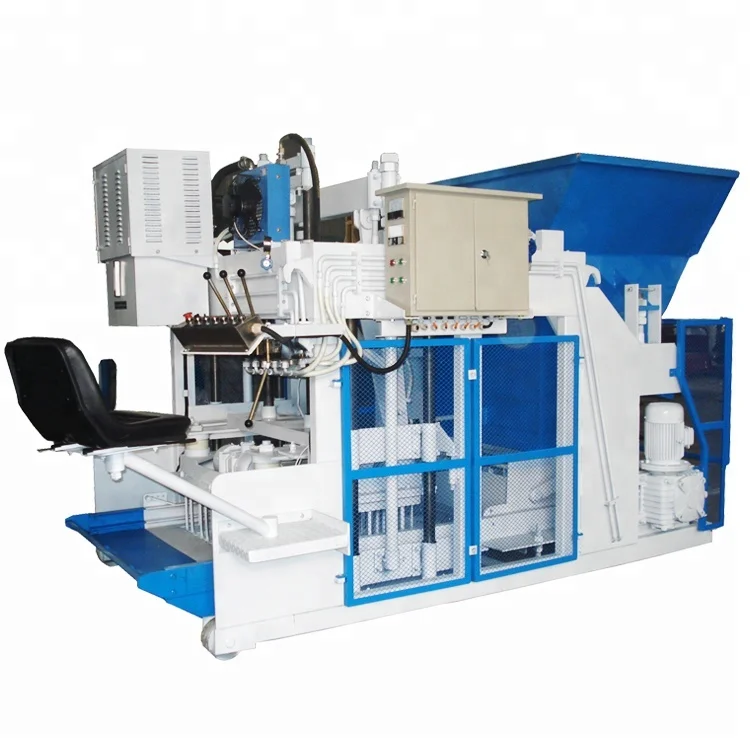
Line-matched block production — the QMY10-15 mobile press is specified alongside upstream mixing and downstream handling so the 15-second moulding cycle never starves for material or floor space.
Technical Specifications
| Parameter | Value |
|---|---|
| Model | QMY10-15 |
| Product Type | Moving Automatic Cement Hollow Block Machine |
| Overall Dimensions | 3150 × 1800 × 2400 mm |
| Hydraulic Method | Mould vibration |
| Demould Method | Hydraulic |
| Pressure | 21 MPa |
| Excitation Frequency | 4500 r/min |
| Total Power | 16 kW |
| Total Mass | 4500 kg |
| Moulding Cycle | 15 s |
| Mould Capacity | 10 pcs/mould (400 × 200 × 200 / 390 × 190 × 190 mm) |
| Output Capacity | 2400 pcs/h, 19200 pcs/day based on 400 × 200 × 200 mm hollow block, 8 h shift |
| Output Capacity | 3360 pcs/h, 26800 pcs/day based on 400 × 150 × 200 mm block, 8 h shift |
| Output Capacity | 3840 pcs/h, 30720 pcs/day based on 400 × 120 × 200 mm block, 8 h shift |
| Output Capacity | 4320 pcs/h, 34560 pcs/day based on 400 × 100 × 200 mm block, 8 h shift |
| Compatible Block Formats | 390 × 240 × 190 / 390 × 150 × 190 / 390 × 115 × 190 mm, custom sizes available |
| Raw Materials | Crushed stone, sand, cement, dust, coal fly ash, cinder, slag, gangue, gravel, perlite, other industrial wastes |
| Voltage & Frequency | 380 V, 3-phase, 50 Hz (customizable to buyer’s local voltage) |
| Machine Type | Mobile / egg-laying |
| Automation Level | Automatic |
| Warranty | 1 year (excluding wearing parts) |
| Assembly State | Fully assembled mobile unit |
Application Suitability
| Application | Material or Output |
|---|---|
| On-site hollow block production for construction contractors | Crushed stone, sand, and cement mixes laid directly on the ground without fixed pallets |
| First block plant for entrepreneurs | Fly ash, slag, or cinder blends with locally sourced fine aggregate |
| Building material producers expanding hollow block formats | Industrial waste materials including gangue and perlite with standard Portland cement |
What "2400 Pieces per Hour" Leaves Out When Supporting Equipment Is Missing
The press cycle means nothing when the mixer is still halfway through its batch.
When I matched a QMY10-15 mobile block machine to a contractor’s site in West Africa, the host unit sat idle for seconds at a time because the standalone mixer he sourced locally could not discharge fast enough. The block production line equipment around the press was never calculated against the 15-second moulding cycle, and daily output dropped noticeably below expectation. Every supporting equipment for block machine decision — mixer capacity, feeding belt length, curing area footprint — must be locked to the press rhythm before the line is built, not bolted on afterwards [NEED_CITE: typical output loss when upstream and downstream stations are not cycle-matched].
Upstream Stations That Must Feed the 15-Second Rhythm
The QMY10-15 completes one mould every 15 seconds, producing 10 hollow blocks per cycle based on the 400 × 200 × 200 mm format. A mixer that takes longer than this to discharge a batch forces the press into a waiting state that accumulates across an eight-hour shift. The mixer batch volume, discharge gate speed, and belt conveyor transfer time are all block production line equipment variables that must sum to less than 15 seconds per cycle to keep the press continuously fed.
Downstream Handling Without a Pallet Return System
Because the QMY10-15 is an egg-laying mobile unit, blocks are deposited directly onto the ground and the machine moves forward to the next position. This eliminates the need for a pallet return conveyor, but it shifts the burden to curing-area layout and forklift routing. The supporting equipment for block machine list here focuses on floor space planning, sprinkler systems for moisture retention during curing, and transport equipment to move set blocks to the stacking yard without damaging green product [NEED_CITE: mobile egg-laying block machine curing area planning guidelines].
Pressure, Vibration, and the Buyer’s Local Aggregate
The 21 MPa hydraulic pressure combined with 4500 r/min mould vibration is the force pair that compacts the mix into a dense, consistent block. However, those numbers only produce the rated block strength when the aggregate gradation and moisture content match the compaction energy. A coarse crushed-stone mix may require different vibration amplitude than a fine fly-ash blend, and the block production line equipment configuration must account for the raw material the buyer can actually source within a practical distance of the site.
Reading the Spec Sheet Against Your Actual Block Format
The moulding cycle stays at 15 seconds, but the hourly and daily output shifts depending on which block format the buyer runs. At 400 × 200 × 200 mm the QMY10-15 produces 2400 pieces per hour based on that specific format, while switching to a thinner 400 × 100 × 200 mm wall block raises the count to 4320 pieces per hour based on the 100 mm format and 10 cavities per mould. The vibration energy and demould force remain constant, so thinner blocks may need adjusted cycle timing or mix moisture to avoid cracking during hydraulic ejection. The 16 kW total power draw is shared across the vibration motor, hydraulic pump, and travel drive, meaning the electrical supply must sustain continuous peak load without voltage sag that would weaken vibration amplitude [NEED_CITE: effect of voltage drop on vibration motor output in block presses].
When the Mixer Batch Size and Press Cycle Fall Out of Sync
A mixer that is too small forces multiple discharge cycles per mould fill, introducing dead time that no amount of operator effort can recover. A mixer that is too large lets the mix sit and begin initial set before the press is ready for it, reducing block strength. The hidden cost is not the mixer price difference — it is the lost production hours and inconsistent block quality that show up only after the first week of operation, when the contractor realises the line was never balanced as a system [NEED_CITE: consequences of unmatched mixer and press capacities in concrete block production].
Why This Line Configuration Holds Up on Site
The QMY10-15 and every supporting station around it are specified as one matched set rather than assembled from separate catalogue pages. Raw material feed configuration is set against the buyer’s local aggregate and target mix design, so no costly material substitution is needed after arrival. Voltage, frequency, and control language are confirmed before production begins, preventing commissioning delays when the machine reaches site. Mould options cover the hollow block formats the buyer’s market actually sells, with custom drawings available. The mobile design arrives fully assembled, reducing on-site setup to ground preparation and electrical connection.
Documentation & Verification
- Line layout drawing with capacity calculation stating the 400 × 200 × 200 mm block format assumed
- Hydraulic and electrical schematic for local maintenance sourcing
- Voltage and control language written confirmation before production
- Factory test record on the buyer’s specified block format
- Wear parts and mould list with part numbers for first-year ordering
- Operation and maintenance manual with safety and lubrication schedules
Installation, Commissioning & Support
- Level compacted ground required; the 3150 × 1800 mm footprint needs clear travel lanes for forward movement
- Dedicated 3-phase circuit at confirmed voltage and frequency to sustain the 16 kW continuous load
- Machine ships fully assembled, eliminating on-site mechanical assembly of the main frame
- First-run parameter setting covers vibration duration and hydraulic demould speed for the buyer’s mix
- Operator training on mould change procedure and daily lubrication points
- Recommended spare mould and hydraulic seal kit sized for the first year of production
What We Need From You to Build the Line
Send us the block format and dimensions your market demands, the daily output you need based on an eight-hour shift, and a sample or description of the aggregate available near your site. Include your local voltage, phase, and frequency so the electrical panel is built correctly before dispatch. If you already own a mixer or forklift, share the model and capacity so we can confirm whether the supporting equipment for block machine stations will match the QMY10-15 cycle without gaps.
Frequently Asked Questions
Q: What supporting equipment does the QMY10-15 need upstream and downstream?
A: Upstream, you need a mixer with discharge speed matched to the 15-second cycle and a material feeder that delivers consistent batch volume. Downstream, the egg-laying design removes the pallet return system, but you need a planned curing area with sprinkler provision and a forklift sized to move set blocks to the stacking yard.
Q: How does the 15-second moulding cycle dictate mixer batch size?
A: The mixer must complete one full batch — including loading, mixing, and discharge — within or just under 15 seconds so the press never waits. Batch volume equals the mould cavity fill requirement for the chosen block format, and discharge gate speed must empty the drum before the next cycle begins.
Q: Does the mobile design eliminate pallet return systems entirely?
A: Yes. The QMY10-15 lays blocks directly on the ground and travels forward, so there are no pallets to collect, clean, or recirculate. The trade-off is that curing area floor space must be large enough to hold a full shift of green blocks before they are moved.
Q: How is voltage, frequency, and control language confirmed before shipment?
A: We request written confirmation of your site supply voltage, phase, and frequency during the quotation stage. Control panel labels and the operation manual language are agreed at the same point, so the electrical panel is wired correctly before the factory test.
Q: What wearing parts should I order with the machine for the first year?
A: The recommended first-year kit includes hydraulic seals, vibration motor bearings, and one spare mould for your primary block format. Exact part numbers are listed in the wear parts document provided with the quotation so you can reorder locally or from us.