
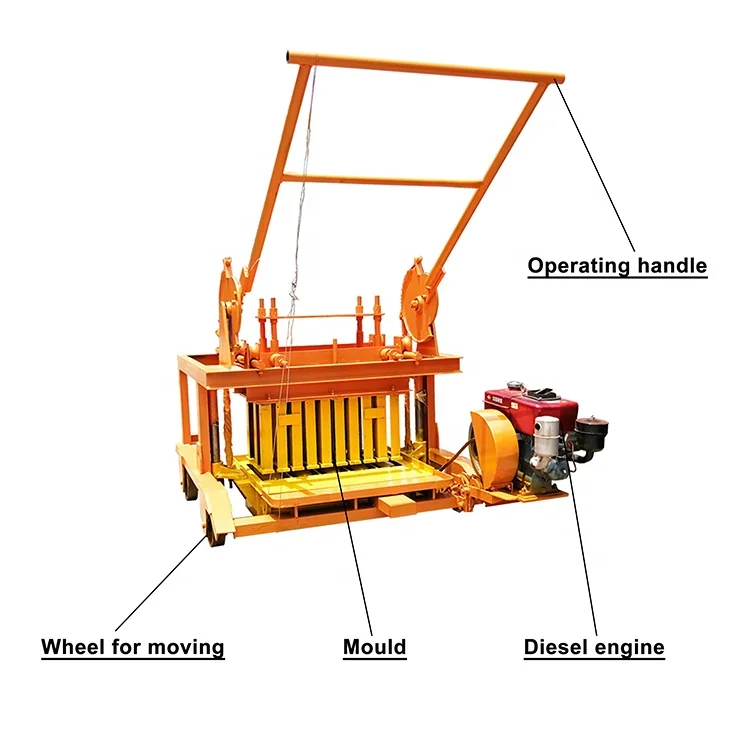
Single Focus Line Integration — the QMR4-45 is specified as the core of a matched small-scale mobile production setup, not an isolated press, ensuring mixing, laying, and curing workflow keep pace with its cycle.
Technical Specifications
| Parameter | Value |
|---|---|
| Model | QMR4-45 |
| Product Type | Mobile Egg Laying Block Making Machine |
| Overall Dimensions (L×W×H) | 2420 × 1320 × 1650 mm |
| Net Weight | 810 kg |
| Power Source | Diesel engine, 6 kW / 6–8 HP |
| Voltage & Frequency | 220 V or 380 V (frequency to be confirmed with manufacturer) |
| Moulding Cycle | 40–45 s (basis to be confirmed depending on block format and material) |
| Pallet Size | Not required (egg-laying operation) |
| Output Capacity | 3,000 pcs/day based on 400×200×200 mm hollow block, 4 pcs/mould, 8-hour shift (basis not stated in source for other formats) |
| Mould Formats Available | 400×200×200 mm (4 pcs/mould), 400×150×200 mm (5 pcs/mould), 400×120×200 mm (6 pcs/mould) |
| Automation Level | Manual / semi-automatic egg-laying mobile type |
| Assembly State | Skid-mounted, mobile |
| Stacking Method | Manual on concrete floor |
| Certification | CE (specific standard number to be confirmed) |
| Warranty | 1 year (whole machine) |
Application Suitability
| Application | Material or Output |
|---|---|
| On-site construction block production | Hollow blocks from crushed stone, sand, and cement at project locations |
| Housing development block supply | Multiple hollow block sizes laid directly on prepared concrete floors |
| Small-scale start-up block plant | Low-volume production with diesel power where grid electricity is unreliable |
| Contractor self-supply | 400×200×200 mm, 400×150×200 mm, and 400×120×200 mm hollow blocks |
Why "3,000 Pieces per Day" Means Nothing Without the Format
Output is only meaningful when tied to a specific block size, mould cavity count, and shift length.
Many buyers discover after delivery that the headline capacity assumed the largest block in the range, producing the fewest pieces per mould. When they switch to the smaller formats their market actually demands, the daily count shifts because cavity count and cycle behaviour change. I once watched a contractor plan a housing project around a quoted daily figure, only to find the real throughput for his specified block size fell noticeably short because the calculation had never named the format. This mobile egg laying block machine production line states the assumption up front: 3,000 pieces per day is based on 400×200×200 mm hollow blocks at 4 pieces per mould across an 8-hour shift [NEED_CITE: block output calculation methodology by format].
Matching the Mixer to the Press Cycle
A mobile block press does not operate alone. The QMR4-45 completes a moulding cycle every 40–45 seconds, which means the upstream mixer must deliver a fresh batch within that window or the press sits idle. I once saw a mobile brick machine sit unused for half the day because the pan mixer could only produce enough material for two cycles before needing to reload. Planning this mobile egg laying block machine production line means sizing the mixer drum capacity and batch time to the press rhythm, not treating each station independently.
Designing the Curing Area Around the Laying Path
Egg-laying machines deposit blocks directly on the concrete floor, so the curing area must be large enough to accommodate a full shift’s output without forcing the operator to lay blocks too close together. The QMR4-45 weighs 810 kg and moves on its own skid, which means the floor must be level and cured concrete to bear both the machine and the freshly formed blocks. Planning the workflow includes marking lanes for the machine travel path, leaving gaps for air circulation, and defining when the cured blocks can be stacked for dispatch [NEED_CITE: concrete block curing best practices for egg-laying machines].
Reading the Specs That Actually Matter
The 6 kW diesel engine is the defining spec for sites where grid power is absent or unstable, removing dependence on voltage and frequency confirmation altogether. The three available mould formats — 400×200×200 mm at 4 cavities, 400×150×200 mm at 5 cavities, and 400×120×200 mm at 6 cavities — mean that output per shift changes with each swap, since more cavities per mould produce more pieces per cycle. The 2420 × 1320 mm footprint determines how tight a space the machine can operate in and how much manoeuvring room the operator needs. Because no pallets are required, consumable cost stays low, but the trade-off is that floor quality directly affects block dimensional accuracy.
The Hidden Cost of Ignoring the Line Around the Press
Buying a mobile press without planning the raw material feed, mixing station, and curing footprint leads to a machine that cannot run at its stated cycle time. Operators end up waiting for mixed material, or they lay blocks on uncured sections of floor because the area is too small. I have seen contractors lose entire shifts to these bottlenecks, turning what should have been a straightforward production day into a stop-and-start operation that damages block consistency [NEED_CITE: production line bottlenecks in small-scale block making].
Why Buyers Source This Line Here
Block machinery is the sole product focus, so the QMR4-45 is never treated as a standalone item pulled from a catalogue. Configuration is set against the buyer’s local aggregate and target block format rather than a default setting. Mould design covers the formats the buyer’s market actually sells, including custom drawings if the standard three sizes do not match local demand. The line layout and capacity calculation state which block format each output figure assumes. Installation support includes operator training so the crew understands cycle timing and mould change procedure from day one.
Documentation & Verification
- Line layout showing mixer, press, and curing area positions with output stated per block format
- Machine specification sheet listing diesel engine rating and voltage options
- Mould drawing and format list covering all three hollow block sizes
- Factory test record on buyer’s specified block format before dispatch
- Operation and maintenance manual with wear parts list
- CE declaration documentation where applicable
Installation, Commissioning & Support
- Level cured concrete floor required to support 810 kg machine weight and freshly laid blocks
- Diesel engine eliminates electrical connection needs; confirm fuel grade for local climate
- Machine arrives skid-mounted for direct offloading and positioning on production floor
- First-run commissioning includes mould cycle timing verification against 40–45 second target
- Operator training covers mould change procedure across all three hollow block formats
- Wear parts list provided with recommended replacement intervals for vibration components
What to Share With Your Inquiry
To configure this mobile egg laying block machine production line for your project, provide the block format your market demands, the daily volume you need to hit, and whether your site has any grid electricity available. Include details on the local aggregate type and the concrete floor area you can dedicate to production and curing. If you already own a mixer or material handling equipment, share those specifications so the line can be balanced around them.
Frequently Asked Questions
Q: How is the 3,000 pieces per day figure calculated for the QMR4-45?
A: That figure is based on 400×200×200 mm hollow blocks at 4 pieces per mould, a 40–45 second moulding cycle, and an 8-hour shift. Output changes when switching to the 400×150×200 mm or 400×120×200 mm formats because cavity count differs. Always confirm capacity against your specific block format.
Q: Can the QMR4-45 run without any electrical supply?
A: Yes, the machine is powered by a 6 kW or 6–8 HP diesel engine, making it suitable for sites with unreliable or absent grid electricity. Voltage options of 220 V or 380 V apply if electric power is available for auxiliary equipment such as the mixer.
Q: What upstream equipment does the QMR4-45 need to avoid idle time?
A: A mixer with drum capacity and batch time matched to the 40–45 second moulding cycle is essential. If the mixer takes too long between batches, the press stops. Raw material feeding should also be organised so that aggregate and cement reach the mixer without delay.
Q: What floor conditions are required for egg-laying operation?
A: The production floor must be level, cured concrete capable of bearing the 810 kg machine and freshly formed blocks. The area must be large enough for a full shift’s output with spacing for air circulation during curing.
Q: How long does a mould change take on this machine?
A: Mould change time depends on operator familiarity and the specific format being installed. The QMR4-45 supports three standard hollow block moulds, and training during commissioning covers the change procedure to minimise downtime.


