
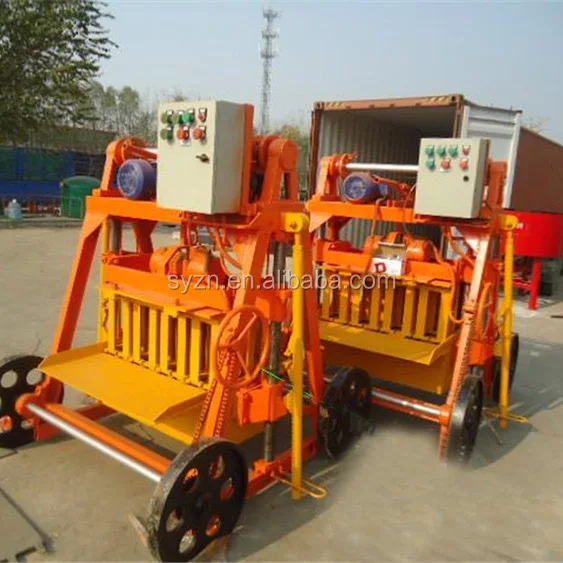
Matched Line Balance — mixer output and material feed rate are set against the 45 s moulding cycle so the press never sits idle waiting for concrete.
Technical Specifications
| Parameter | Value |
|---|---|
| Model | QMJ4-45 |
| Product Type | Mobile Egg Laying Block Making Machine |
| Rated Power | 7.4 kW |
| Voltage & Frequency | Configurable to buyer local supply (exact V/Hz confirmed before production) |
| Control System | Manual force control with jog control |
| Overall Dimensions (L×W×H) | 1550 × 1335 × 1580 mm |
| Net Weight | 1 T |
| Cycle Time | 45 s |
| Output Capacity | 2400 pcs / 8 h based on 400×200×200 mm hollow block, 4 pcs per mould |
| Output Capacity (Alt. Format) | 3200 pcs / 8 h based on 400×150×200 mm hollow block, 5 pcs per mould |
| Pallet Requirement | No pallets required (egg-laying type) |
| Mould Format | 400×200×200 mm / 400×150×200 mm hollow blocks; other shapes via mould change |
| Mould Change Method | Manual |
| Stacking Method | Blocks laid directly on ground |
| Raw Materials | Concrete, sand, cement, fly ash, lime, gypsum |
| Assembly State | Fully assembled machine body (basis not stated in source — confirm container loading method) |
| Hydraulic Pressure | Not stated in source — confirm whether hydraulic or mechanical vibration |
| Vibration Force | Not stated in source — confirm kN rating |
Application Suitability
| Application | Material or Output |
|---|---|
| On-site hollow block production at building projects | Crushed stone, sand, cement mixed on site |
| Small-scale block yard start-ups | Fly ash, sand, cement with manual batching |
| Road block and kerbstone formats | Concrete mix with aggregate up to 10 mm |
| Contractor-produced blocks for housing developments | Local sand and cement without fixed plant infrastructure |
Why "Pieces per Hour" Without a Format Assumption Is Useless
Capacity only means something when the block format is named beside it.
A mobile egg laying block machine production line quoted at a single output figure tells you nothing about what actually ends up on the curing ground. I have seen buyers receive a machine rated for one hollow block size, then switch to a smaller format their market demands and find the cycle time behaves differently because the mould cavity fill and vibration settling change. The QMJ4-45 states 2400 pieces per 8-hour shift on 400×200×200 mm blocks and 3200 pieces on 400×150×200 mm blocks — two different numbers for two different realities. When a supplier gives you only one number, ask which mould was in the press during the test. [NEED_CITE: block format assumptions in capacity quotations]
How the Supporting Stations Keep Pace with a 45-Second Cycle
A mobile egg laying block machine production line is only as fast as its slowest station. The QMJ4-45 completes a moulding cycle every 45 seconds, which means the mixer must deliver a fresh batch of workable concrete to the hopper within that window or the press stands still. We size the pan mixer and belt feeder so their combined throughput matches the press consumption rate, factoring in the walking speed of the machine between lay-down positions. The line is drawn as one flow diagram, not three separate equipment quotes stapled together.
Eliminating Pallets Changes the Entire Line Footprint
Because the QMJ4-45 lays blocks directly onto the ground, the supporting equipment list drops the pallet feeder, pallet return conveyor, and pallet storage racks that a stationary plant requires. This is not a minor detail — it reshapes the site layout. The mixer sits closer to the press travel path, the raw material stockpile feeds directly into the mixer hopper, and the curing area expands outward from wherever the machine last laid. For a contractor setting up on a building site with limited space, this simplified mobile egg laying block machine production line layout is the difference between a workable yard and one that needs a second plot of land. [NEED_CITE: egg laying versus stationary plant footprint comparison]
Reading the Specs That Actually Matter on Site
The 7.4 kW rated power is the figure you hand to your electrician to size the generator or dedicated circuit before the machine arrives — undersize it and the vibration motor stalls mid-cycle, leaving half-compacted blocks on the ground. The overall dimensions of 1550 × 1335 × 1580 mm determine the minimum travel corridor width between the material stockpile and the curing area; if your site has a narrow access path between existing structures, this machine width must clear it every time it repositions. The manual jog control means there is no PLC display language to configure, but it also means the operator controls the mould descent and vibration duration by hand, which demands consistent technique across shifts. Voltage and frequency are confirmed before the motor is wound and the panel is built, so a buyer in a 415 V / 50 Hz region does not receive a 380 V / 60 Hz machine that overheats on day one.
What Happens When the Mixer Is an Afterthought
Buyers who purchase the press alone and source a mixer locally often end up with a pan mixer whose discharge rate cannot keep up with the 45-second cycle. The press operator waits, the concrete in the hopper begins to stiffen, and block density drops because the material is no longer at its workable peak when it enters the mould. I once saw a yard where the mixer was positioned forty metres from the press with a wheelbarrow as the only transfer method — the mobile egg laying block machine production line was producing at roughly half its rated output because the material logistics were never planned as part of the system. [NEED_CITE: material logistics impact on block machine throughput]
Why We Configure the Line Before We Quote It
Block machinery is our single focus, which means the mixer, feeder, and press are specified as one matched system rather than assembled from separate supplier catalogues. We set the configuration against the buyer’s actual mix design and local aggregate, because a vibration force tuned for river sand behaves differently against volcanic scoria or crushed granite. Mould design covers the formats the buyer’s market actually sells, including custom drawings when the local demand runs to non-standard kerbstone profiles. Every line layout we issue states the block format assumed in the capacity calculation, so there is no argument about output after commissioning. Voltage and control specifications are confirmed on paper before production begins, not discovered when the container is opened.
Documentation & Verification
- Line layout drawing with mixer position and press travel path stated per block format
- Machine specification sheet with 7.4 kW power and configurable voltage noted
- Mould drawing package covering each format the buyer’s market requires
- Voltage and frequency confirmation sheet signed before motor winding begins
- Factory test record showing press, mixer, and feeder running together as a line
- Wear parts and mould list delivered with the machine at dispatch
Installation, Commissioning & Support
- Level compacted ground required across the press travel path with no soft spots under the 1 T machine weight
- Dedicated circuit sized for 7.4 kW continuous draw plus mixer and feeder motors on separate breakers
- Machine shipped fully assembled — confirm dismantling method if container door height is restricted
- On-site commissioning includes first-run test with buyer’s local aggregate and mix proportions
- Operator training covers jog control rhythm and mould change procedure for each format
- Wear parts list identifies vibration motor brushes and mould liner plates as first-replacement items
What We Need to Configure Your Line
Send us the block formats your market moves, the local aggregate type and source, and your site supply voltage and frequency. If you already have a mixer or material handling equipment on site, tell us the make and capacity so we can match the feed rate to the QMJ4-45 cycle. A site plan with curing area dimensions helps us lay out the press travel path before anything is built.
Frequently Asked Questions
Q: How is the 2400 pieces per 8 hours figure calculated and what does it assume?
A: That figure is based on the 400×200×200 mm hollow block format with 4 cavities per mould and a 45-second cycle time. Switch to the 400×150×200 mm format with 5 cavities and the output shifts to 3200 pieces per 8 hours. Both assume uninterrupted material supply from a matched mixer.
Q: What mixer capacity prevents the QMJ4-45 from waiting between cycles?
A: The mixer must discharge one full mould volume of workable concrete within the 45-second cycle window. We specify the pan mixer drum volume and discharge gate size so the feed rate aligns with press consumption, including the operator walking time between lay-down positions.
Q: How is the site laid out when no pallets are used?
A: The egg-laying design removes the pallet return conveyor and pallet storage area entirely. The mixer sits adjacent to the press travel corridor, raw materials feed directly into the mixer hopper, and blocks cure on the ground surface wherever the machine last deposited them.
Q: Which electrical details must be confirmed before production?
A: Exact voltage and frequency of your site supply must be signed off before the motor is wound and the control panel is assembled. The QMJ4-45 uses manual jog control with no PLC display, so language is not a factor, but motor winding and breaker sizing depend on your confirmed supply specification.
Q: How is the vibration system adjusted for different local aggregates?
A: The vibration force must match the particle size and density of the buyer’s aggregate. We request a raw material sample before finalising the line configuration, because a setup tuned for standard sand will produce weak blocks if the local material is volcanic scoria or coarse crushed stone.


