
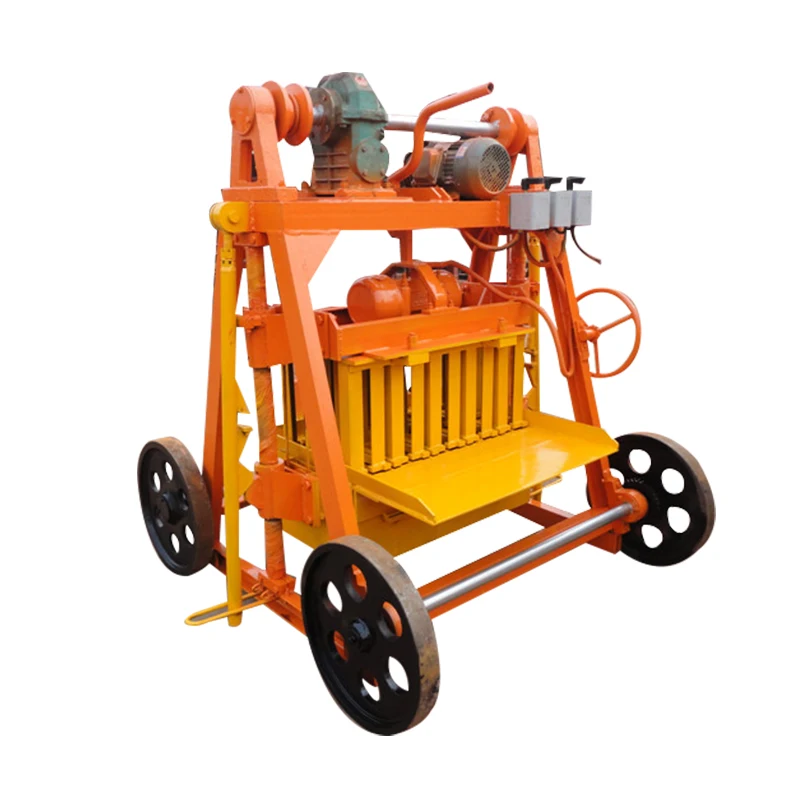
Single-Focus Line Design — The QMJ4-45 mobile egg layer block making machine is specified not as a standalone press, but as the centerpiece of a coordinated material feed, mixing, and curing-area workflow so the machine is never left idle waiting for the next batch.
Technical Specifications
| Parameter | Value |
|---|---|
| Product Type | Movable Manual Egg Layer Block Making Machine |
| Model | QMJ4-45 |
| Moulding Cycle | 30–45 seconds |
| Output Capacity | 2600 pcs/8hr (basis: 400×200×200mm hollow block, 4 pcs/mould) |
| Output Capacity | 3200 pcs/8hr (basis: 400×150×200mm hollow block, 5 pcs/mould) |
| Output Capacity | 4480 pcs/8hr (basis: 400×100×200mm hollow block, 7 pcs/mould) |
| Vibration System | Twice vibrations of molding core (modified from single vibration) |
| Automation Level | Manual (egg-laying type, mobile) |
| Pallet Requirement | Not required (egg-laying operation directly on ground) |
| Available Mould Formats | 400×200×200mm / 400×150×200mm / 400×100×200mm |
| Assembly State | Mobile, no fixed plant required |
| Control System | Manual operation |
| Standards | ISO9001:2000, CE |
Application Suitability
| Application | Material or Output |
|---|---|
| On-site construction block production | Hollow blocks laid directly on prepared ground without pallets |
| Small-scale block plant startup | 400×200×200mm hollow blocks at 2600 pcs per 8-hour shift |
| Housing project contractor supply | 400×150×200mm and 400×100×200mm hollow blocks for partition and infill walls |
| Remote or temporary site production | Mobile deployment with no fixed foundation or curing rack infrastructure |
Why "Cycles per Hour" Means Nothing Without the Block Format
Every output figure on this page is tied to a specific block size and mould cavity count — because a cycle rate alone tells you almost nothing about what you will actually produce.
I have watched buyers compare two mobile egg layer block making machines on paper, pick the one with the higher cycles-per-hour rating, and then wonder why their daily pallet count falls short. The problem is almost always the same: the quoted cycle assumed the smallest block in the catalogue, not the 200mm hollow block the buyer’s market actually demands. A 400×200×200mm block pulls four pieces per mould, while a 100mm wall pulls seven — same cycle, very different daily totals. Until the capacity calculation names the format, the number is [NEED_CITE: capacity disclosure norms in block machinery quotations].
How the Mixer Feeds the Press — Not the Other Way Around
The QMJ4-45 completes a moulding cycle every 30 to 45 seconds, which means the mixer upstream must deliver a fresh batch of concrete within that same window. If the mixer is undersized or the wheelbarrow run is too long, the press sits idle and the mobile egg layer block making machine production line loses output not because of the press, but because of the gap between stations. Matching mixer discharge rate to press consumption rate is the first calculation we run before confirming any line layout.
Ground Preparation and Curing Area as Part of the Line
Because an egg-laying machine deposits blocks directly on the ground, the production floor is effectively the curing yard. The surface must be level, compacted, and swept clean before each shift. Curing space needs to be planned so that freshly laid blocks are not walked over or driven past before initial set. The footprint of a mobile egg layer block making machine production line is therefore larger than the machine itself — it extends across every square metre of ground the machine will traverse during a shift [NEED_CITE: on-ground curing practices for egg-laying block production].
Vibration, Mould Count, and What They Mean for Block Density
The twice-vibration system on the molding core was modified from the earlier single-vibration design to improve compaction across the full depth of the mould box. On a 200mm hollow block with thin shell walls, a single vibration pulse often leaves the top face less dense than the base; the second pulse addresses that gradient. Combined with the mould cavity count — four for 200mm, five for 150mm, seven for 100mm — the vibration system must distribute force evenly across every cavity, otherwise outer blocks cure weaker than inner ones. The manual cycle time of 30 to 45 seconds gives the operator room to ensure the mould box is fully charged before each press, which matters more on a manually fed machine than on an automatic line where the feeder controls charge volume.
When the Supporting Line Is an Afterthought
The most common failure on a mobile egg layer block making machine production line is not mechanical breakdown — it is starvation. The press runs out of material because the mixer cannot keep pace, or the curing yard is full because no one planned where the next six hours of blocks will be laid. I have seen a contractor lose an entire afternoon because the only available ground space was still occupied by yesterday’s blocks that had not yet been moved. The cost of that lost shift is rarely included in the machine quotation, but it shows up in the project timeline [NEED_CITE: production bottlenecks in small-scale block operations].
Why Buyers Specify Line Equipment Here
Block machinery is our single focus, which means the QMJ4-45 is never quoted as a standalone press — the mixer capacity, material feed method, and curing area layout are addressed in the same proposal. The configuration is set against your actual mix design and local aggregate, not a generic catalogue default. Mould design covers the formats your market sells, and custom mould drawings are available when standard sizes do not match. Automation is selectable, so a buyer can start with manual egg-laying and move to a pallet-based line later. Installation support includes on-site commissioning and operator training so the first shift runs with supervision, not guesswork [NEED_CITE: equipment commissioning standards for block making machinery].
Documentation & Verification
- Line layout drawing showing mixer placement, machine travel path, and curing area dimensions matched to your site
- Capacity calculation sheet stating the exact block format and mould cavity count behind every output figure
- Mould drawing and format list confirming available sizes and mould change procedure
- Voltage and frequency confirmation sheet signed off before production begins
- Factory test record with the QMJ4-45 running under load before dispatch
- CE declaration and operation manual supplied with shipment
Installation, Commissioning & Support
- Level and compact the ground surface to serve as both production floor and curing yard for the egg-laying operation
- Confirm site voltage and frequency match the QMJ4-45 motor rating before first power-on
- Assemble and align the mould box on site; verify vibration core seating and mould change clearance
- Run the first production cycle with supervised operator training covering feed timing and cycle pace
- Stock initial mould wear parts and vibration components for the first replacement interval
- Establish a daily ground-sweeping and curing-area rotation schedule to maintain continuous output
Before You Request a Quote
To size a mobile egg layer block making machine production line accurately, share the block formats your market requires, the daily volume you need to hit, and the local aggregate and cement types you plan to use. Tell us the dimensions of the available production and curing ground area, and the voltage and frequency at your site. If you already own a mixer or material handling equipment, include those details so the line can be built around what you have rather than replaced from scratch.
Frequently Asked Questions
Q: How is daily output calculated and which block format does each figure assume?
A: Every output figure we quote names the block dimensions and the number of cavities per mould. The QMJ4-45 produces 2600 pieces per 8-hour shift for a 400×200×200mm hollow block at 4 cavities, 3200 pieces for a 400×150×200mm at 5 cavities, and 4480 pieces for a 400×100×200mm at 7 cavities. No single "up to" number is used.
Q: What ground preparation and curing area layout does an egg-laying line require?
A: The ground must be level, compacted, and clean before each shift. Curing area is planned so freshly laid blocks are not disturbed before initial set. Total footprint extends across every metre the machine travels during a shift, which we map in the line layout before dispatch.
Q: How do raw material feed and mixing connect to the QMJ4-45 so the press is not left waiting?
A: We match the mixer discharge rate to the 30–45 second moulding cycle so concrete arrives before the next press. The line layout specifies mixer position, feed method, and travel distance to eliminate idle gaps between mixing and moulding stations.
Q: What voltage and frequency options are available for the target market?
A: Voltage and frequency are confirmed against your site supply before production begins. A confirmation sheet is signed off so the motor and any control components match local standards on arrival, avoiding commissioning delays from electrical mismatches.
Q: How is mould change handled on-site and how long does a format switch take?
A: Mould formats are switched by removing and replacing the mould box on the machine frame. The procedure is covered during on-site operator training, and the mould drawing pack supplied with shipment details alignment points and fastening sequence for each available format.


