
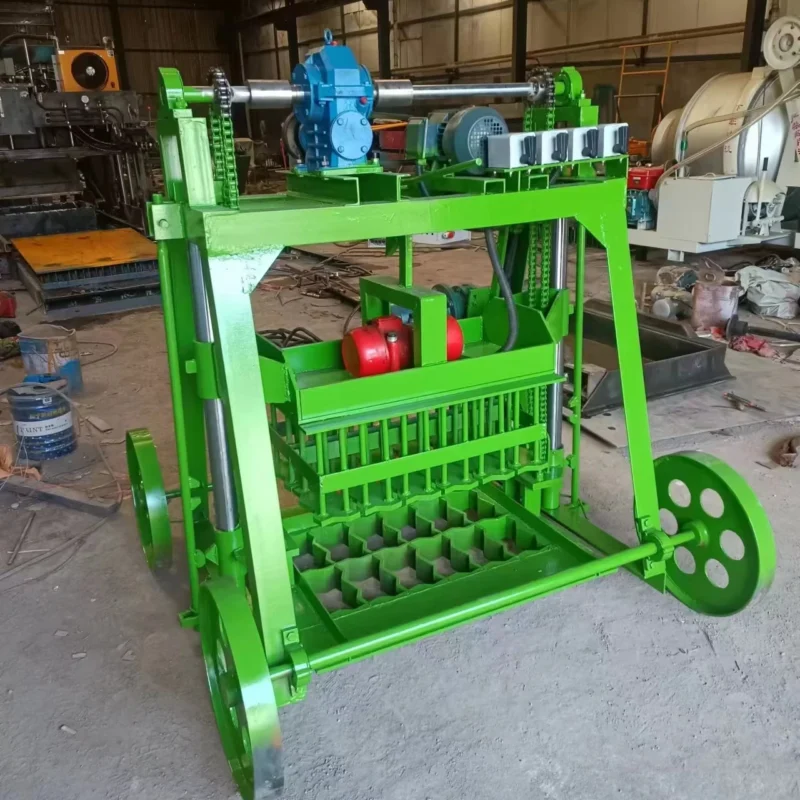
Matched-Line Design — the QMJ4-45 press, mixer and feed stations are sized together so the 45-second moulding cycle runs without upstream starvation on your project site.
Technical Specifications
| Parameter | Value |
|---|---|
| Product Type | Mobile Egg-Laying Block Making Machine |
| Model | QMJ4-45 |
| Machine Power | 7.4 kW |
| Molding Cycle | 45 s |
| Output Capacity | 2400 pcs / 8 h (based on 400×200×200 mm hollow block, 4 pcs/mould); 3200 pcs / 8 h (based on 400×150×200 mm block, 5 pcs/mould) |
| Pallet Requirement | None (egg-laying type) |
| Overall Dimensions | 1550 × 1335 × 1580 mm |
| Machine Weight | 1 T |
| Guidance Mechanism | Four-pole orientation with ultralong orientation bearing |
| Automation Level | Semi-automatic with jog control |
| Raw Materials | Concrete, sand, cement, fly ash, lime, gypsum |
| Voltage | Configured to buyer’s local standard |
Application Suitability
| Application | Material or Output |
|---|---|
| Housing project on-site hollow block production | Crushed stone, sand and cement mixed locally |
| Remote site solid block manufacturing | Fly ash, lime and gypsum blends |
| Kerb and road block production for infrastructure contractors | Dense aggregate concrete with format mould change |
| First-plant entrepreneur setup with minimal infrastructure | Standard cement-sand mixes without pallet inventory |
What "2400 Blocks per Day" Leaves Out About Your Mobile Line
Stated capacity only holds when the mixer batch time and material feed rate are matched to the press cycle.
Quoted output figures on mobile block machines often assume a continuous rhythm that upstream equipment cannot sustain. I have stood on sites in the Gulf where the press sat idle for minutes between cycles because the pan mixer was still batching the next load. A mobile block making machine production line only delivers its rated throughput when every station — water supply, aggregate feeding, mixing and press — is timed as one system, not specified in isolation [NEED_CITE: line balancing principles for concrete block production].
Sizing the Mixer to the 45-Second Press Rhythm
A 45-second moulding cycle means the press demands a fresh batch roughly every three to four cycles when producing standard hollow blocks. The upstream mixer must complete its blend, discharge and begin the next batch within that window. When planning a mobile block making machine production line, the mixer volume and batch time are the real gatekeepers of daily output.
Eliminating Pallet Handling From the Site Layout
The egg-laying design deposits blocks directly on the ground and moves forward to the next position. This removes pallet feeding, pallet return conveyors and curing rack handling from the line entirely. The curing zone simply becomes a section of the site floor cordoned off for block curing, which reduces both the equipment list and the footprint your crew needs to manage on a busy construction site [NEED_CITE: egg-laying block machine site layout requirements].
Reading the Specs That Actually Matter on Site
The 7.4 kW machine power drives both vibration and hydraulic pressure through the four-pole guidance system. This orientation mechanism keeps the mould aligned during each cycle even when the machine sits on compacted but uneven ground — a common condition on project sites where a poured concrete foundation is not available. The semi-automatic jog control means the operator triggers each stage manually, which keeps the control system simple and reduces the electrical components that can fail in hot, dusty environments. Voltage and frequency must be confirmed against your site supply before dispatch, because swapping a motor or rewiring a control panel on arrival wastes days you may not have.
When Upstream Stations Are Not Part of the Conversation
Ordering the press alone and sourcing the mixer, conveyor and water pump separately is where mobile lines lose their promised output. A mixer that is too small forces the press to wait between cycles. A water supply without metering produces inconsistent mix moisture, which changes block density and strength across the same batch. When these stations are not planned together, the contractor blames the press for an output shortfall that was never the press’s fault [NEED_CITE: concrete block production line station synchronization].
Why a Matched Mobile Line Protects Your Project Schedule
Equipment is specified against your actual mix design and local aggregate, not a generic catalogue default. The mixer capacity, feed rate and press cycle are calculated together so the mobile block making machine production line sustains its rhythm from first batch to last. Voltage, frequency and control language are confirmed before production begins, so commissioning starts on arrival rather than after a language pack swap. Mould options are matched to the block formats your local market actually purchases, and custom mould design is available when standard formats do not cover your specification.
Documentation & Verification
- Line layout drawing showing mixer position, material stockpile and curing zone relative to the press travel path
- Capacity calculation sheet stating the block format and mould configuration behind each output figure
- Voltage and control language confirmation document signed off before production begins
- Mould drawing and format list covering hollow, solid and paving block options available for the QMJ4-45
- Factory test record on your specified block format before dispatch
Installation, Commissioning & Support
- Site ground must be compacted and level within tolerance for the 1550 × 1335 mm machine footprint to ensure four-pole guidance tracks correctly
- 7.4 kW power requirement needs a dedicated circuit matching confirmed voltage and frequency at your project location
- Machine ships as a single unit; on-site assembly limited to mould fitting and electrical connection
- First-cycle parameter setting covers vibration duration and jog control timing for your specific mix consistency
- Operator training on mould change procedure and daily bearing inspection for the ultralong orientation mechanism
- Wear parts list and mould maintenance schedule provided at commissioning for your block format
What We Need to Size Your Mobile Line
To prepare a line layout that matches your project reality, share the block formats and dimensions you plan to produce, the daily output you need to sustain, and the local aggregate and cement types available on your site. We also need your site voltage and frequency, the floor area available for the press travel path and curing zone, and whether you have an existing mixer or material handling equipment that should be factored into the plan.
Frequently Asked Questions
Q: How is daily output verified when the press cycle and mixer batch time must stay in sync?
A: We calculate the line capacity by matching the 45-second press cycle to the mixer discharge rate. The output figure we quote states the block format, mould cavity count and shift length behind it, so you can see exactly what upstream equipment must deliver to sustain that number.
Q: What upstream equipment is needed to keep the QMJ4-45 running at stated capacity?
A: A pan mixer with batch volume and cycle time matched to the press demand, a water supply with basic metering, and manual or belt-fed material loading to keep aggregate and cement flowing to the mixer. We specify each station so the press is never left waiting for a fresh batch.
Q: Which block formats work on-site without pallets, and how does curing affect output?
A: Hollow blocks, solid blocks and paving formats can all be laid directly on compacted ground. The curing zone must be large enough to hold at least one full day’s production undisturbed. We include curing area dimensions in the line layout so your site plan accounts for this space from the start.
Q: How is voltage and motor specification confirmed before shipment?
A: We confirm your site voltage, frequency and phase during the quotation stage and lock these values into the production order. The motor and control panel are built to that specification and tested at those values before the machine leaves the factory.


