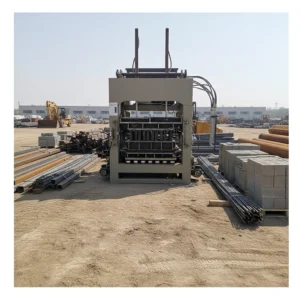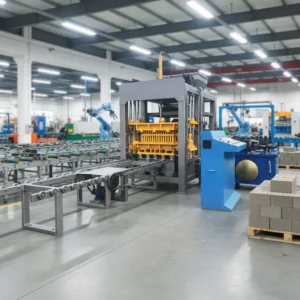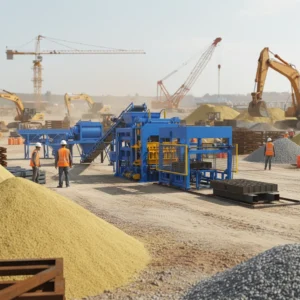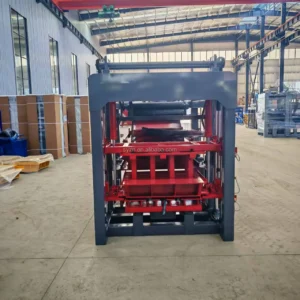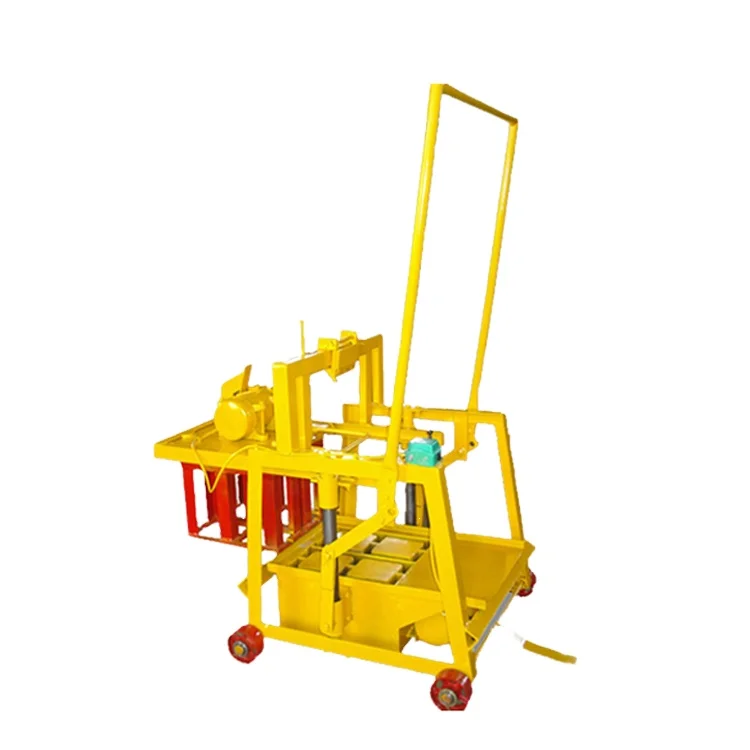
Matched line pacing — Every supporting station around the QMJ2-45 mobile egg laying block machine is sized to the 45-second molding cycle so the press never waits for material or curing space.
Technical Specifications
| Parameter | Value |
|---|---|
| Model | QMJ2-45 |
| Product Type | Mobile Egg Laying Block Machine |
| Rated Power | 1.5 kW |
| Molding Cycle | 45 s |
| Output Capacity | 1280 pcs / 8 hours (basis not stated in source — confirm block format) |
| Raw Material | Concrete, sand, cement |
| Net Weight | 150 kg |
| Overall Dimensions (L×W×H) | 920 × 800 × 1258 mm |
| Vibrators per Mould | 2 pcs |
| Voltage & Frequency | Configured to buyer’s local supply |
| Control System | Manual / semi-automatic operation |
| Automation Level | Semi-automatic, manual movable, egg-laying type |
| Mould Format | Hollow block mould included |
| Pallet Requirement | None — lays blocks directly on ground |
Application Suitability
| Application | Material or Output |
|---|---|
| On-site hollow block production for building contractors | Concrete and sand mixes laid directly on prepared ground |
| First-time block plant setup by entrepreneurs | Low-capital entry using cement, sand, and local aggregate |
| Remote or temporary project supply by distributors | Mobile production relocated across job sites as needed |
Why the Mixer Often Bottlenecks the Mobile Egg Laying Block Machine Production Line
The press cycle is fixed at 45 seconds — if the mixer cannot deliver a fresh batch within that window, every subsequent cycle starts late.
I once watched a Middle East contractor pair an egg-laying machine with a small drum mixer rated well below the press demand. The mixer discharged slowly, and the operator stood idle for several seconds each cycle waiting for concrete. Over an eight-hour shift, those lost seconds accumulated into hundreds of missing blocks against the planned daily tally [NEED_CITE: mixer-to-press output matching for small block lines]. The QMJ2-45 itself never stopped working — it was the material feed station that decided real throughput.
Mapping Each Station Around the Press
A complete mobile egg laying block machine production line starts well before the press. Raw material storage, a proportioning method, and a mixer must deliver a consistent concrete batch at a rate the 45-second cycle demands. If the mixer takes 60 seconds to discharge a batch that the press consumes in 45 seconds, the press loses 15 seconds every cycle — and no amount of operator speed recovers that time.
Planning the Curing Ground Before the Machine Arrives
Because the QMJ2-45 lays blocks directly on the ground, the curing area must be prepared before production begins. A flat, swept concrete floor or compacted sand bed prevents block breakage during the critical first hours. The available ground area sets a hard ceiling on daily output: once the nearest blocks are still too green to move, the machine must stop or walk further out [NEED_CITE: curing time requirements for cement blocks in varying climates]. Planning the curing footprint against the target daily volume is as important as sizing the mixer.
Reading the Specs That Actually Matter
The 1.5 kW rated power means the QMJ2-45 can run on a modest site generator, which matters for contractors working where grid power is unreliable or unavailable. Two vibrators per mould deliver bed-mould vertical vibration while the upper mould applies compression vibration — this dual action is what produces uniform density across the block cross-section rather than a hard shell with a weak core. The 920 × 800 × 1258 mm footprint and 150 kg net weight mean one person with a hand truck can reposition the machine across a job site as the curing area fills up. Voltage and frequency are configured to the buyer’s local supply before shipment, so the motor and vibrators match the site power without needing an external transformer on arrival.
What Happens When Line Stations Are Mismatched
When a buyer focuses only on the press price and ignores the supporting equipment, the consequences appear on the first production day. A mixer that is too small forces the operator to wait between cycles, cutting real output well below expectations. An unprepared curing surface causes freshly laid blocks to crack or tilt, turning output into waste [NEED_CITE: common causes of block breakage during early curing]. And if the local voltage was never confirmed with the supplier, the motor may overheat or fail to start — a problem that surfaces only after the machine has crossed an ocean.
Why Sourcing the Full Line Here Reduces On-Site Surprises
Block machinery is our single focus, so the QMJ2-45 is specified alongside its mixer, material feed method, and curing requirements as one matched system rather than a standalone press. We set the configuration against the buyer’s actual mix design and local aggregate, not a catalogue default. Mould design covers the hollow block formats the buyer’s market sells, and additional format moulds can be reviewed at the inquiry stage. Voltage, frequency, and control language are confirmed before production begins. Factory testing runs the press through actual molding cycles so the dispatch record reflects real performance, not a bench specification.
Documentation & Verification
- Line layout showing mixer placement and curing area sized to the QMJ2-45 cycle
- Machine specification sheet confirming vibration force and 1.5 kW power rating
- Mould drawing and format list for hollow block dimensions available
- Voltage and frequency confirmation matched to buyer’s site supply before dispatch
- Factory test record with actual cycle runs before shipment
Installation, Commissioning & Support
- Flat, level curing ground prepared to match the 920 × 800 mm machine footprint
- Power supply verified against confirmed voltage and frequency before first start
- Machine arrives assembled — position on curing ground and connect power
- First-run cycle timing adjusted against actual concrete mix consistency
- Operator training covers mould handling and vibration timing for uniform block density
- Wear parts list provided for vibrators and mould contact surfaces
What to Include in Your Inquiry
To configure the mobile egg laying block machine production line around the QMJ2-45, share your target block format and dimensions, daily output target, and the local sand or aggregate type you plan to use. Confirm your site voltage and frequency, and describe the curing ground area available. If you already own a mixer or material handling equipment, include its model and output rate so we can check station pacing.
Frequently Asked Questions
Q: How should I verify the 1280 pcs / 8 hours output claim for the QMJ2-45?
A: That figure appears in theoretical capacity tables referencing a 300×150×100 mm block format at two pieces per mould. Ask the supplier to provide a capacity calculation that states the exact block format, wall thickness, and concrete mix assumed. Real output also depends on mixer feed rate and curing ground availability across a full shift.
Q: What mixer output rate keeps the QMJ2-45 running without idle gaps?
A: The press completes a cycle every 45 seconds, so the mixer must discharge a usable batch within that same window. A mixer that takes longer forces the operator to wait each cycle, and those seconds accumulate into significant lost volume over an eight-hour shift. Match mixer batch size and discharge speed to the press cycle during line planning.
Q: How much curing ground does an egg-laying machine require?
A: Each block stays on the ground until the concrete sets enough to handle, which depends on ambient temperature and mix design. Calculate the floor area by multiplying blocks per cycle by cycles per shift, then allow spacing between blocks. The curing area must expand throughout the production day as new rows are laid beside earlier ones.
Q: What electrical details must be confirmed before the QMJ2-45 ships?
A: Voltage and frequency must match your site supply exactly — a mismatch can damage the 1.5 kW motor and vibrators on first start-up. Confirm these values during the inquiry stage so the supplier configures the electrical system before production. Also specify whether you need a particular control language or labeling standard for your market.