
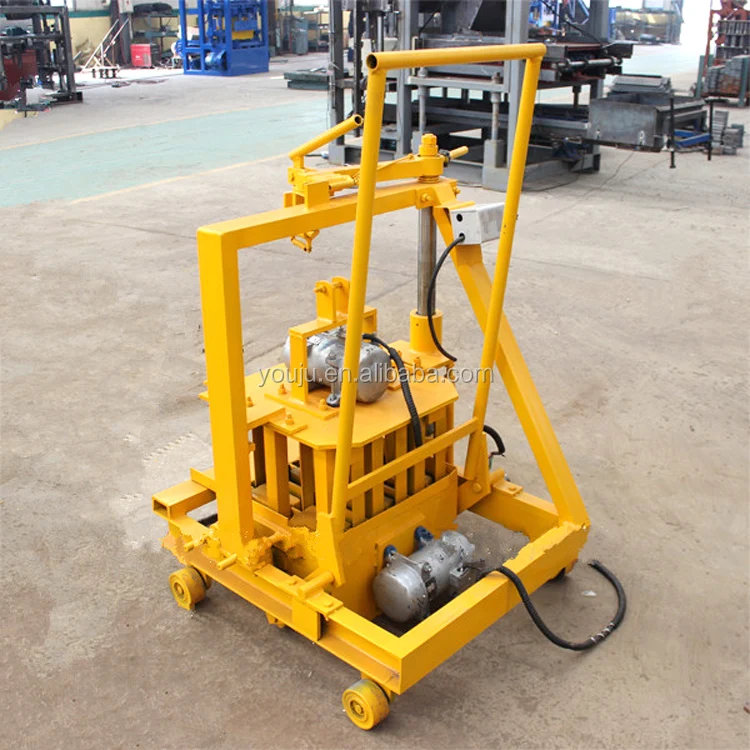
Matched Mobile System — the QMJ2-45 is specified as one coordinated line with engine, moulds, and ground-curing workflow, avoiding the on-site mismatch that occurs when mobile machines arrive without supporting equipment defined.
Technical Specifications
| Parameter | Value |
|---|---|
| Model | QMJ2-45 |
| Product Type | Mobile / egg-laying block making machine |
| Power Source | Diesel engine |
| Hydraulic System | Engine-driven hydraulic |
| Mould Change System | Manual swap across hollow brick formats |
| Cycle Time | 25–30 seconds (basis not stated in source) |
| Pallet Requirement | None (pallet-free egg-laying design) |
| Automation Level | Manual / semi-manual operation |
| Labor Requirement | 1 to 3 workers |
| Output Capacity | 160 pcs/h based on 400×200×200mm hollow brick, 2 pcs per mould |
| Output Capacity | 240 pcs/h based on 400×150×200mm hollow brick, 3 pcs per mould |
| Output Capacity | 320 pcs/h based on 400×100×200mm hollow brick, 4 pcs per mould |
| Mould Heat Treatment | Carburization technology |
| Steel Construction | High quality steel |
| Standards | ISO9001:2000, CE |
Application Suitability
| Application | Material or Output |
|---|---|
| On-site hollow brick production | Crushed stone, sand, and cement mix laid directly on ground |
| Remote housing project block making | Hollow bricks produced without grid power dependency |
| Small-scale rural block production | Multiple hollow brick formats from a single machine footprint |
| Contractor self-supply block yard | Daily hollow brick volumes matching crew consumption rate |
What "1280 Blocks per Shift" Actually Means on a Real Site
Capacity figures only matter when the assumed block format, cycle time, and mix design are stated together.
Manufacturers quote a single pieces-per-hour number, but a mobile block making machine production line behaves differently across formats. The QMJ2-45 produces 160 pieces per hour on a 400×200×200mm hollow brick, yet shifts to 320 pieces per hour on a 400×100×200mm brick. That is a doubling of throughput on paper, but the smaller block uses less material per piece and cures differently on the ground. When a project contractor orders a machine expecting the higher figure while their market demands the larger hollow block, daily output falls short by half. The mismatch compounds when local aggregate gradation slows the vibration compaction or forces longer cycle times. [NEED_CITE: block format assumptions in manufacturer capacity quotations]
How the Pallet-Free Design Changes Line Planning
A conventional block plant requires pallets, pallet return conveyors, and curing racks. The QMJ2-45 removes all of that by laying blocks directly on prepared ground, which fundamentally changes what the surrounding line must supply. Instead of budgeting for pallet handling stations, the line planner focuses on raw material feeding rate, mixer output, and ground preparation area. The mobile block making machine production line becomes a simpler loop: mix, feed, press, move forward, repeat. This suits project sites where capital is constrained and the production area is an open yard rather than a covered factory floor.
Matching Mixer Output to Press Cycle
The press completes a cycle every 25 to 30 seconds, but that number assumes the operator has a fresh batch of mix ready. If the mixer takes longer to prepare each batch, the press sits idle and the stated cycle time becomes irrelevant. Planning the supporting mixer capacity around the press rhythm ensures the mobile block making machine production line delivers its rated output in practice, not just in a factory test. On remote sites, water supply rate also enters the calculation, since insufficient water flow between batches forces the crew to slow the entire rhythm. [NEED_CITE: mixer-to-press synchronization in mobile block production]
Reading the Specification Sheet Against Real Site Conditions
The diesel engine removes grid dependency, but it introduces fuel consumption and engine maintenance into the operating cost. The hydraulic system is engine-driven, meaning hydraulic pressure output tracks with engine RPM rather than a fixed electric motor speed. Operators must learn to hold a consistent throttle position during the compaction phase to achieve uniform block density. The carburization-treated moulds resist wear from abrasive aggregate, but mould life still depends on the stone hardness at the project site. A specification sheet that lists mould steel quality without naming the aggregate it was tested against leaves the buyer guessing about replacement intervals.
When the Wrong Supporting Equipment Reaches the Site
Contractors who focus on the press price often discover that the mixer, water tank, and ground levelling tools were never included in the quotation. The mobile block making machine production line then relies on borrowed or undersized support equipment, and the press runs below its designed rhythm. Blocks laid on uneven ground crack during curing, and the manual mould change takes longer than expected because the right tools were not packed. These hidden costs do not appear on any invoice, but they consume the margin the project was supposed to deliver. [NEED_CITE: hidden costs in mobile block production line setup]
Why Specifying the Whole Line Matters Here
Block machinery is our single focus, so the QMJ2-45 is quoted alongside the mixer, water supply arrangement, and ground preparation guidance as one matched system. Configuration is set against the buyer’s actual local aggregate and target block format, not a catalogue default. Mould design covers the hollow brick sizes the buyer’s market actually sells, with custom drawings available. The automation level starts manual, and the buyer can add supporting equipment later without replacing the press. Installation support includes on-site operator training so the crew understands engine-driven hydraulic behaviour and manual mould swap procedure. [NEED_CITE: line integration approach for mobile block machines]
Documentation & Verification
- Line layout with capacity calculation stating assumed block format and cycle time
- Mould drawing and format list confirming included hollow brick sizes
- Engine and hydraulic specification sheet with power and pressure rating
- Factory test record on buyer’s target hollow brick format before dispatch
- Operation manual with mould change procedure and engine maintenance schedule
- Packing photographs and customs documentation support for shipment
Installation, Commissioning & Support
- Level compacted ground area required, with drainage for water runoff from curing
- Diesel fuel supply and storage arranged locally before engine start-up
- Machine arrives assembled; moulds ship separately in protective crating
- First-cycle commissioning includes engine-driven hydraulic pressure verification
- Operator training covers throttle control during compaction and manual mould swap
- Wear parts list for carburization-treated moulds based on local aggregate hardness
Before You Request a Quotation
A mobile block making machine production line quotation should reflect your actual site conditions, not a generic template. Share your target hollow brick format and daily volume requirement so the capacity calculation matches your project schedule. Provide your local aggregate type and gradation report so the mould and vibration settings are configured before dispatch. Confirm the language you need on instrumentation and the operation manual so your crew can commission the machine without translation delays.
Frequently Asked Questions
Q: How is daily output calculated for the QMJ2-45, and which block format does it assume?
A: Daily output depends on the block format loaded in the mould. The machine produces 160 pieces per hour based on 400×200×200mm hollow brick, or 320 pieces per hour based on 400×100×200mm hollow brick. Cycle time is stated at 25 to 30 seconds, but actual rhythm depends on mixer readiness and crew speed. We provide a capacity table listing each format separately so your project plan uses the correct figure.
Q: What raw material mix does the QMJ2-45 require, and will it work with my local aggregate?
A: The engine-driven hydraulic system compacts standard cement-aggregate mixes for hollow bricks. However, local stone gradation and fines content affect block density and cycle time. Share your aggregate sieve analysis and we configure the mould clearance and vibration duration to match. This step prevents the common problem where a machine arrives on site but the local material produces weak or crumbling blocks.
Q: How long does a mould change take, and what do we need on site?
A: Mould change is manual and requires basic hand tools. The carburization-treated moulds are heavier than standard steel, so two workers are recommended for safe handling. We provide a step-by-step procedure in the operation manual and cover the swap process during on-site training. Keeping a dedicated tool kit near the machine avoids the delays that occur when crews search for spanners mid-shift.
Q: What supporting equipment must I arrange to complete the mobile production line?
A: The QMJ2-45 handles pressing and ground-laying, but you need a mixer matched to the press cycle, a reliable water supply, and prepared ground area for curing. We specify the mixer output volume and water flow rate so these items are sized correctly before the machine ships. This prevents the bottleneck where the press waits idle because the mixer or water source cannot keep up with the 25 to 30 second cycle.
Q: What spare parts and mould wear items should I stock for a typical project?
A: Carburization-treated moulds resist wear, but abrasive local aggregate shortens their service life. We provide a wear parts list based on your aggregate report, including recommended mould replacement intervals and hydraulic seal kits for the engine-driven system. Stocking these items on site before the project starts avoids production stoppages when the first replacement is due in a remote location.


