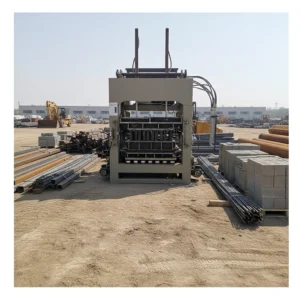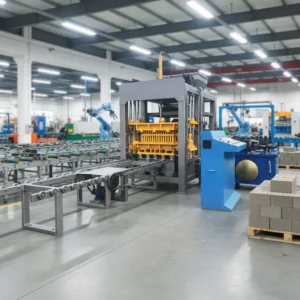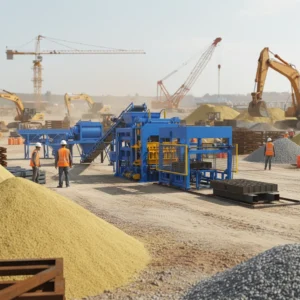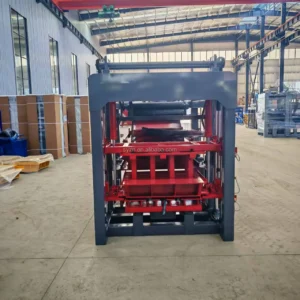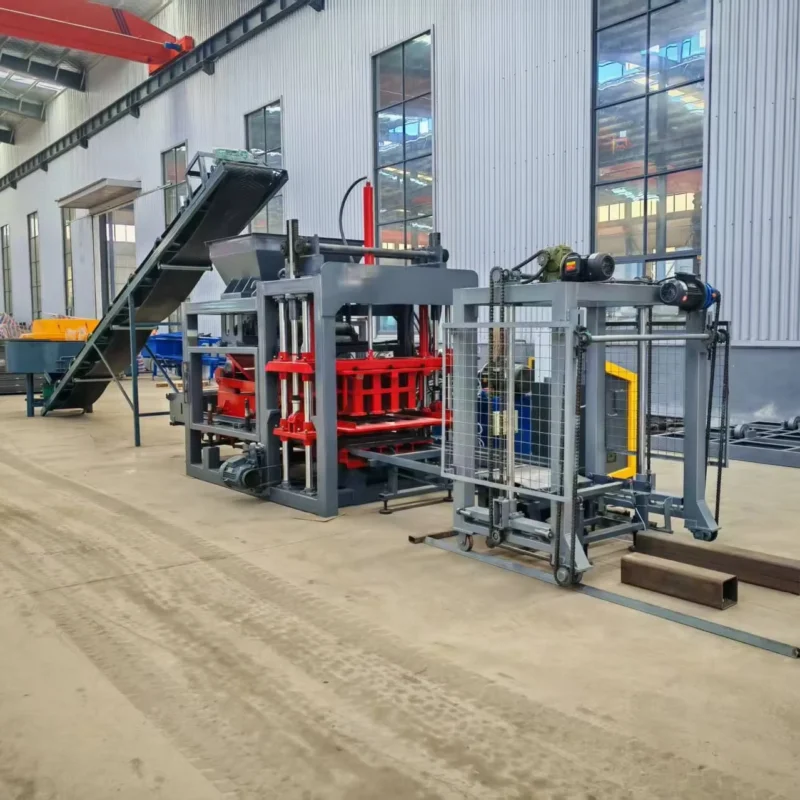
Single-Focus Block Machinery — The QT4-18 block production line equipment is specified as a coordinated system where press, mixer, pallet handling, and stacking stations share matched cycle times to prevent upstream or downstream bottlenecks.
Technical Specifications
| Parameter | Value |
|---|---|
| Model | QT4-18 |
| Product Type | Hydraulic Concrete Block Making Machine |
| Overall Dimensions (L×W×H) | 3900×1600×2300 mm |
| Total Weight | 3T |
| Rated Power | 24 kW |
| Vibration Force | 40–50 kN |
| Molding Cycle | 15–25s |
| Pallet Size | 850×550×25 mm |
| Mixer Model | JQ350 |
| Output Capacity | 9600–13440 pcs/8hr (basis: 400×200×200mm hollow block) |
| Output Capacity | 14400–19200 pcs/8hr (basis: 400×150×200mm hollow block) |
| Output Capacity | 16200–19440 pcs/8hr (basis: 240×115×53mm solid brick) |
| Applied Products | Paver, solid block, hollow block, curbstone |
| Raw Materials | Crushed stones, sand, cement, dust, fly ash |
| Automation Level | Semi-automatic |
| Hydraulic Station | Equipped (high pressure, stable operation) |
| Assembly State | Nude packing in 20GP container |
| Standards | CE |
Application Suitability
| Application | Material or Output |
|---|---|
| Hollow block production for building walls | Crushed stone, sand, cement mix on 850×550 mm pallets |
| Solid brick manufacturing for load-bearing structures | Cement, fly ash, and fine aggregate blends |
| Paver and curbstone forming for roads and landscaping | Coarse aggregate with cement binder at high vibration force |
| On-site block production by construction contractors | Locally sourced sand and stone with portable pallet inventory |
| First block plant setup by entrepreneurs | Full semi-automatic line from JQ350 mixer through stacking station |
What "15-25 Seconds per Cycle" Means for Your Actual Daily Output
The molding cycle is only one station — if your mixer cannot feed fast enough or your pallets are not returning in time, the press sits idle and real output drops well below the rated figures.
Buyers often receive a quotation quoting cycles per hour and assume that translates directly into daily production. In practice, the press cycle of 15–25 seconds must be supported by a synchronized feeding conveyor, a mixer batch time that keeps up, and a pallet return loop that never starves the press. When supporting equipment for block machine lines is underspecified, the press waits — and the quoted capacity becomes a ceiling the line never reaches. [NEED_CITE: line synchronization principles in concrete block production]
Matching Every Station to the Press Rhythm
The QT4-18 block production line equipment is built around the principle that each station must complete its task within the press cycle window. The JQ350 mixer delivers batch volumes timed to the 15–25 second molding cycle, while the raw material feeding conveyor is set to refill the hopper before the next press stroke. This coordination means the operator never has to pause the press waiting for upstream material.
Pallet Circulation as the Hidden Bottleneck
Pallet size at 850×550×25 mm determines not only the block layout per cycle but also how many pallets must circulate through the curing area and back to the press. A curing yard that is too small or a forklift that cannot handle the loaded pallet weight will cause pallets to queue at the stacking station. Planning pallet inventory — typically 300 to 500 pieces for continuous operation — is part of the line design, not an afterthought. [NEED_CITE: pallet circulation planning for semi-automatic block plants]
Reading the Specifications That Matter on Site
The vibration force of 40–50 kN works together with the hydraulic station pressure to compact the mix into the mould cavity. Higher vibration alone does not guarantee denser blocks; the hydraulic pressure must hold the mould head firmly against the material during vibration to prevent bounce-back. On the QT4-18, both systems are factory-matched so that the compaction energy is fully transferred into the block rather than absorbed by mechanical play. The 24 kW rated power covers the press motor, hydraulic pump, and vibration system simultaneously, meaning a dedicated circuit at the plant must account for peak draw during startup. Pallet thickness at 25 mm is specified to withstand repeated impact loading over the curing cycle without warping, which would cause uneven block heights across the run.
The Cost of Specifying the Press Without the Line
When a buyer purchases only the press and sources the mixer, conveyor, and pallet handling separately, cycle time mismatches appear at commissioning. The mixer may batch too slowly, forcing the operator to idle the press between cycles. The conveyor may deliver material unevenly, causing incomplete mould fills. These problems do not show up in the quotation — they show up on the first production day, when output falls noticeably short of the quoted figure and the contractor blames the machine. [NEED_CITE: common commissioning failures in block production lines]
Why Specifying the Line Together Matters Here
Each piece of supporting equipment for block machine operations is selected against the QT4-18 press cycle, not from a generic catalogue. The mixer capacity, conveyor speed, pallet dimensions, and stacking method are confirmed as a set before production begins. Voltage, frequency, and PLC display language are locked in before the line is built — not discovered at the container door. Factory testing runs the full sequence from raw material feed through stacking so that station-to-station timing is verified before the equipment is dismantled for 20GP container loading. Pallet specification includes material and quantity recommendation matched to the buyer’s curing area layout. The semi-automatic configuration leaves a clear upgrade path: as production volume grows, automatic pallet feeding and cubing stations can be added without replacing the press.
Documentation & Verification
- Line layout drawing showing station spacing and pallet flow path for the QT4-18
- Capacity calculation stating the block format assumed for each output figure
- Pallet specification sheet with material grade and quantity recommendation
- Voltage, frequency, and PLC display language confirmation record before production
- Factory test record covering full cycle from mixing through stacking
- Hydraulic and electrical schematic for on-site maintenance reference
Installation, Commissioning & Support
- Foundation pad sized to 3900×1600 mm footprint with vibration isolation for the 3T press
- Dedicated 24 kW circuit with voltage and frequency confirmed to local grid before wiring
- Nude packing in 20GP container requires on-site reassembly of hopper, conveyor, and hydraulic lines
- First-run commissioning includes cycle time verification between JQ350 mixer and press stations
- Operator training covers mould change procedure and pallet return loop management
- Wear parts list covering hydraulic seals, vibration springs, and mould liners
What to Prepare Before Requesting a Quotation
To size the block production line equipment correctly, share the block formats you plan to produce, the daily output target per format, and your local raw material type with any available test data. Specify the curing area dimensions and the forklift capacity already on site so pallet quantity and material can be matched. Confirm your local voltage, frequency, and the language you need on the PLC display so the control panel is configured before the line ships.
Frequently Asked Questions
Q: What supporting equipment is included beyond the press itself, and what is optional?
A: The QT4-18 line includes the JQ350 mixer, raw material feeding conveyor, pallet feeding mechanism, and semi-automatic stacking station as standard. Optional additions include automatic cubing systems and curing rack handling equipment. Each station is selected to match the 15–25 second press cycle, so the line runs without idle time between stations.
Q: How does the pallet size relate to my existing curing area and forklift?
A: The 850×550×25 mm pallet is chosen to fit standard curing yard layouts and common forklift tine spacing. Before production, we confirm your curing area dimensions and forklift load rating so the pallet material, thickness, and recommended quantity of 300–500 pieces align with your site infrastructure.
Q: What is the realistic daily output for each block format, and what assumptions does it rest on?
A: Output is stated per format: 9600–13440 pieces per 8 hours based on 400×200×200mm hollow blocks, 14400–19200 pieces per 8 hours based on 400×150×200mm hollow blocks, and 16200–19440 pieces per 8 hours based on 240×115×53mm solid bricks. These figures assume synchronized upstream feeding and pallet return.
Q: Can I start with semi-automatic stacking and upgrade to full automatic later?
A: Yes. The QT4-18 semi-automatic configuration is designed so that automatic pallet feeding, stacking, and cubing stations can be added as production volume grows. The press, hydraulic station, and mould system remain unchanged — only the downstream handling equipment is expanded.
Q: How do mixer capacity and conveyor speed match the press cycle so the line does not bottleneck?
A: The JQ350 mixer batch volume and the conveyor feed rate are calculated against the QT4-18 press cycle of 15–25 seconds. This means each batch is ready and delivered to the hopper before the next press stroke begins, preventing idle time at the moulding station.