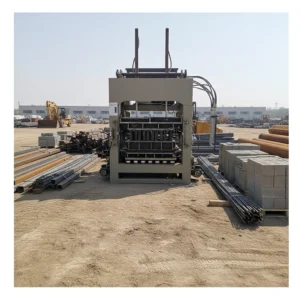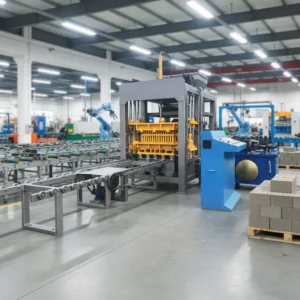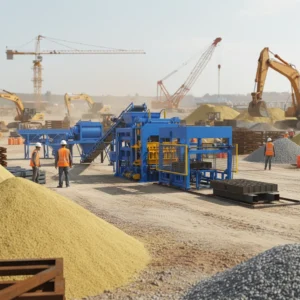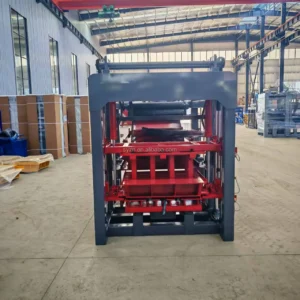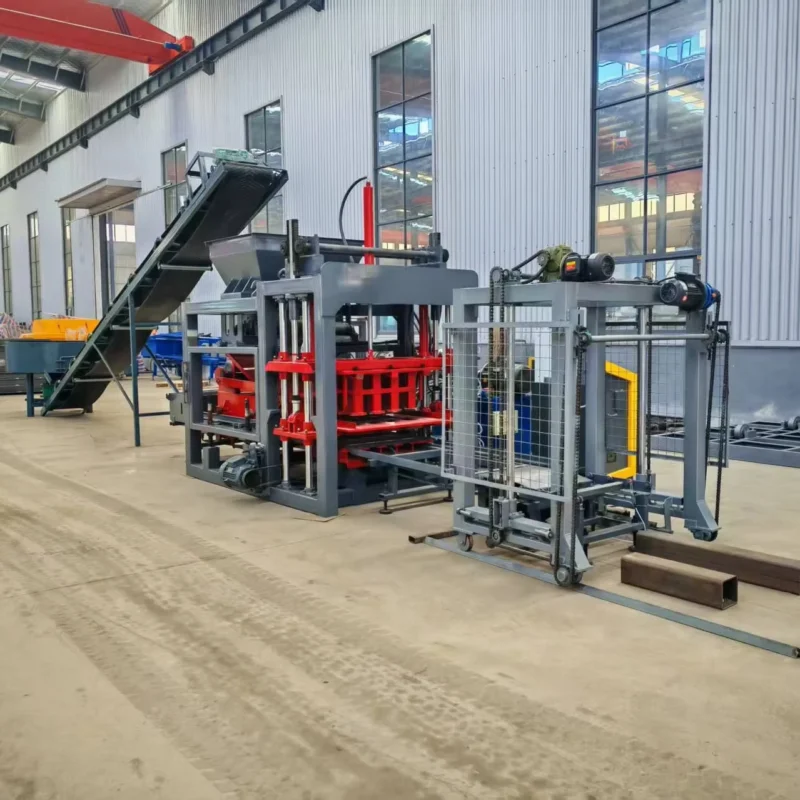
Matched System Sizing — the QT4-18 block making machine production line is specified from mixer through stacker so every station aligns with the press cycle and no bottleneck forms upstream or downstream.
Technical Specifications
| Parameter | Value |
|---|---|
| Product Type | Semi-Automatic Hydraulic Concrete Block Making Machine |
| Model | QT4-18 |
| Overall Dimensions (L×W×H) | 3900×1600×2300 mm |
| Total Weight | 3 T |
| Rated Power | 24 kW |
| Vibration Force | 40-50 kN |
| Molding Cycle | 15-25 s |
| Pallet Size | 850×550×25 mm |
| Mixer Model | JQ350 |
| Hydraulic Station | Integrated hydraulic station for high pressure and stable operation |
| Vibration System | Bed mould vertical vibration + upper mould compression vibration |
| Automation Level | Semi-automatic |
| Applicable Products | Hollow block, solid block, paver, curbstone (via mould change) |
| Raw Materials | Crushed stones, sand, cement, dust, fly ash |
| Output Capacity (400×200×200 mm hollow block) | 1200-1680 pcs/h (basis: 4 pcs/mould, 15-20 s cycle) |
| Output Capacity (400×150×200 mm hollow block) | 1800-2400 pcs/h (basis: 15-20 s cycle) |
| Output Capacity (240×115×53 mm solid brick) | 3240 pcs/h (basis: 15-20 s cycle) |
| Daily Output (8 hr, 400×200×200 mm hollow block) | 9600-13440 pcs |
| CE Compliance | Referenced in documentation (verify per unit) |
Application Suitability
| Application | Material or Output |
|---|---|
| Small to medium block and paver production plants | Hollow and solid blocks from crushed stone, sand, and cement |
| Construction contractors producing on-site | Pavers and hollow blocks for housing and infrastructure projects |
| Entrepreneurs establishing a first block plant | Semi-automatic production with manual pallet handling flexibility |
| Concrete product manufacturers adding formats | Curbstones and interlocking pavers via mould change on one platform |
Why "Pieces per Hour" Misleads Without a Block Format Attached
Every capacity figure on this page is tied to a specific block dimension, mould cavity count, and cycle time range.
When buyers compare block making machine production line quotations, the headline number often omits which format it assumes. A machine rated at thousands of pieces per hour for small solid bricks may deliver a fraction of that volume when switching to large hollow blocks with longer cure demands. This mismatch surfaces only after installation, when the daily tally falls short of the business plan and the buyer is left questioning whether the press is underperforming or the quotation was simply incomplete [NEED_CITE: capacity calculation transparency in block machinery quotations].
Line Station Alignment From Raw Feed to Stacking
The JQ350 mixer feeds a belt conveyor that delivers the batch to the QT4-18 host machine hopper at a rate timed to the 15-25 second molding cycle. If the mixer batch size or conveyor speed lags behind the press demand, the host sits idle between cycles and daily output drops regardless of the press rating.
Downstream, the automatic stacker collects filled pallets and the trolley system transfers them to the curing area. Each station in this block making machine production line is specified so that the press is never left waiting for material and filled pallets never pile up on the line floor blocking the next cycle.
Curing Area Transfer and Pallet Circulation
A semi-automatic configuration means pallets return from the curing area to the line via trolley or forklift rather than an automatic return conveyor. The 850×550×25 mm pallet size must match the curing rack spacing and the forklift tine width the buyer already operates [NEED_CITE: pallet sizing standards for block curing racks].
If pallet quantity is undersized, production halts while cured blocks are stripped and pallets cycled back. We recommend a pallet pool sized against the curing duration and daily output so the block making machine production line runs continuously through an eight-hour shift without pallet shortage interruptions.
Pressure, Vibration, and Block Density
The integrated hydraulic station delivers the pressing force while the dual vibration system — bed mould vertical vibration combined with upper mould compression vibration — compacts the mix from both directions. Vibration force in the 40-50 kN range works with hydraulic pressure to achieve uniform density across the block cross-section.
The 850×550 mm pallet area determines how many cavities fit per mould, which directly sets the pieces-per-cycle figure. Pallet thickness at 25 mm absorbs vibration without cracking under repeated loading. Mould change between hollow block, solid block, paver, and curbstone formats shifts the cavity count and cycle time, so the realistic output must be recalculated per format rather than assumed constant.
When Line Stations Are Missing From the Quotation
Buyers who receive a quotation covering only the host press often discover that pallets, the stacker, the mixer, and the trolley system are priced separately or omitted entirely. The result is a production floor where blocks are stacked by hand, cycle times stretch because raw material arrives in wheelbarrows, and the actual daily output is a fraction of what the standalone press rating suggested [NEED_CITE: incomplete block line quotations and hidden equipment costs].
The 24 kW rated power of the QT4-18 assumes the host machine alone; adding a mixer and conveyor shifts the total installed load, which must be calculated before confirming the site electrical supply and dedicated circuit capacity.
Why Procurement Starts With Your Actual Mix and Site
Every line we configure is set against the buyer’s local aggregate, cement type, and target block format rather than a catalogue default. The JQ350 mixer capacity and batch time are verified against the raw material density and moisture content the buyer will actually feed.
The pallet size is confirmed against the curing area dimensions and existing forklift fleet before production begins. Voltage, frequency, and control language are locked in during the quotation stage so commissioning is not delayed by electrical incompatibility on arrival. Factory testing runs the complete block making machine production line through a cycle sequence using the buyer’s confirmed mould set before dispatch.
Documentation & Verification
- Line layout drawing showing station spacing and pallet flow path for your site dimensions
- Capacity calculation sheet stating block format, cavity count, and cycle time for each output figure
- Pallet specification covering material grade, dimensions, and recommended quantity against your curing time
- Voltage, frequency, and control language confirmation record signed before production release
- Mould drawing and format list detailing included block sizes and optional add-on moulds
- Factory test record on your specified block format before dispatch
Installation, Commissioning & Support
- Foundation plan based on 3900×1600 mm host footprint and 3 T total weight distribution
- Electrical supply specification for 24 kW rated power plus mixer and conveyor auxiliary loads
- Machine arrives partially assembled with hydraulic station and vibration system pre-mounted
- First-run commissioning includes cycle timing verification with your confirmed block format mould
- Operator training covers mould change procedure, vibration force adjustment, and daily maintenance checkpoints
- Wear parts list identifies hydraulic seals, vibration springs, and pallet replacement intervals
What We Need to Configure Your Line
To size the block making machine production line accurately, share your target block formats with dimensions, the daily output you need per format, and the raw materials available locally including aggregate type and cement grade. Provide your site voltage and frequency, the curing area dimensions, and whether you have existing forklifts or pallet racks that the pallet size must accommodate.
Frequently Asked Questions
Q: How is daily output calculated for different block formats on this line?
A: Each output figure assumes a specific block dimension, mould cavity count, and cycle time. The 400×200×200 mm hollow block at four pieces per mould with a 15-20 second cycle yields 9600-13440 pieces over eight hours. Switching to a smaller solid brick increases cavity count and changes the per-hour rate entirely. Always confirm which format underlies any quoted capacity.
Q: Which line stations are included versus optional in a standard quotation?
A: The standard line configuration includes the JQ350 mixer, belt conveyor, QT4-18 host machine, automatic stacker, trolleys, and a starting set of pallets. Items like additional moulds, extra pallet quantity beyond the baseline, and curing rack systems are quoted separately. Confirm station inclusion before comparing quotations from different suppliers.
Q: How does pallet size affect my curing area and forklift requirements?
A: The 850×550×25 mm pallet must fit your curing rack spacing and match your forklift tine width. Undersized pallets waste rack space; oversized ones may not clear rack uprights. Pallet material and thickness affect load capacity and vibration absorption. Confirm these dimensions against your existing equipment before placing the order.
Q: What pallet quantity do I need for continuous eight-hour production?
A: Pallet quantity depends on cycle time and curing duration. If blocks cure for 24 hours before stripping, you need enough pallets to cover a full day of output plus a buffer. For the QT4-18 producing large hollow blocks, this typically means several hundred pallets in circulation. We calculate the exact number once your format and curing time are confirmed.
Q: Can the semi-automatic configuration be upgraded to higher automation later?
A: The semi-automatic setup leaves space for adding an automatic pallet return conveyor, a cubing system, or an upgraded batching station without replacing the host press. The hydraulic station and vibration system remain the same; the upgrade adds stations around the press. Plan the initial line layout with upgrade clearance in mind.