
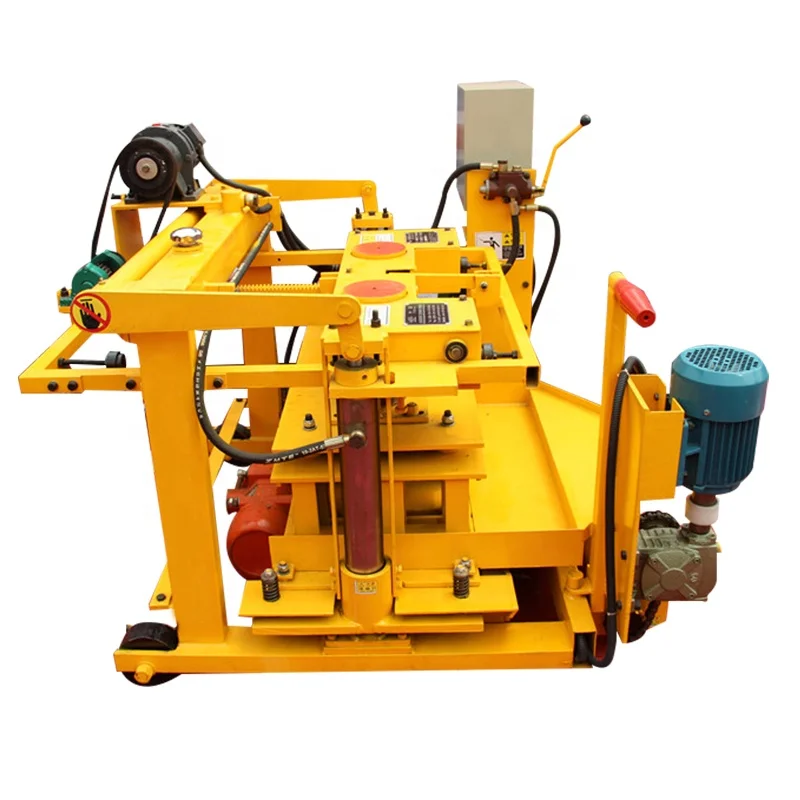
Egg-laying mobility — the QMY4-30 lays blocks directly on the ground, removing pallet costs and handling bottlenecks that stall other mobile block machine production line equipment setups.
Technical Specifications
| Parameter | Value |
|---|---|
| Model | QMY4-30 |
| Product Type | Mobile Hydraulic Block Making Machine |
| Total Power | 5.95 kW |
| Hydraulic Method | Mold Vibration |
| Exciting Power | 28.6 kN |
| Excitation Frequency | 4500 r/min |
| Overall Dimensions | 1300 × 1500 × 1000 mm |
| Net Weight | 950–1000 kg |
| Molding Cycle | 30 s |
| Capacity | 3000 pcs/day (8 hours) (basis not stated in source — confirm block format / material / thickness) |
| Raw Materials | Concrete, sand, cement, fly ash, slag, construction waste, river sand, stone dust |
| Automation | Manual operation with hydraulic assist |
Application Suitability
| Application | Material or Output |
|---|---|
| Remote job-site walling block production | Crushed stone, cement, and local river sand |
| Small-scale paving and kerbstone runs | Fly ash, lime, and gypsum mixes |
| On-site housing project blocks | Construction waste, slag, and coal gangue |
| Individual entrepreneur startup plants | Sandrock, mine tailings, and porcelain granule |
Why the Ground Matters More Than the Machine
A flat, cured surface is the real foundation of every mobile block machine production line equipment deployment.
I have watched operators struggle with freshly laid blocks because the ground was uneven or still soft from rain. The egg-laying cycle assumes a prepared bed; without it, the 28.6 kN vibration force transfers into soft soil instead of compacting the concrete mix. This is where most first-time buyers underestimate site prep [NEED_CITE:site preparation standards for mobile block laying].
How the Line Moves Without a Conveyor
The QMY4-30 advances manually after each 30-second moulding cycle, laying the block directly where it will cure. There are no pallets to feed, collect, or store. This eliminates the pallet handling loop that often becomes the bottleneck in stationary plants. For contractors, it means the mobile block machine production line equipment footprint expands as the machine walks the site, leaving a trail of curing blocks behind it. The supporting equipment here is the ground itself, plus a simple mixer positioned nearby to feed fresh concrete within the cycle window.
Matching Raw Material to the Vibration System
The hydraulic mould vibration at 4500 r/min works across a wide material spectrum — from fine fly ash to coarse construction waste. However, the mix design must match that frequency. I recall a job where high-clay river sand absorbed vibration energy, producing blocks that crumbled when handled [NEED_CITE:aggregate grading effects on vibration compaction]. Testing your local material before committing to a production schedule prevents this failure. The machine accepts whatever you feed it, but the output quality depends entirely on how well the aggregate grading complements the 28.6 kN exciting power.
What the Cycle Time Actually Means on Site
A 30-second moulding cycle sounds fast until you account for the manual steps: moving the machine into position, feeding the hopper, waiting for vibration to complete, then advancing again. Realistic daily throughput depends on crew coordination, mixer proximity, and how far the machine must travel between positions. The 5.95 kW total power keeps energy demand low enough for portable generators, which matters when grid power is unreliable or absent. Specifying this mobile block machine production line equipment for a remote site requires confirming that generator capacity matches both the machine and the mixer simultaneously.
The Cost of Skipping Voltage Confirmation
Arriving on site to discover the local grid runs 60 Hz when the motor was wound for 50 Hz turns a delivery day into a multi-week delay. Rewinding or replacing a motor on location is expensive and slow. I have seen entire commissioning schedules collapse because voltage and frequency were never confirmed during the order stage [NEED_CITE:voltage and frequency standards by export market]. The QMY4-30’s 5.95 kW motor must match the destination grid exactly, and this is a detail that belongs in the purchase conversation, not the installation manual.
Why Buyers Choose This Configuration
Block machinery as a single focus means the mould, hydraulic system, and vibration parameters are specified together rather than assembled from separate suppliers. The QMY4-30 is configured against your actual mix design and local aggregate, not a catalogue default. Custom mould drawings ensure the block format matches what your market actually buys. Automation level remains selectable — you can start with this manual-hydraulic unit and move to a semi-automatic or fully automatic line later without discarding what you learned about your material and market. Installation support includes operator training on your specific raw material behaviour.
Documentation & Verification
- Factory test record showing cycle times on your specified block format
- Mould drawing and format list confirming dimensions match your market
- Hydraulic and electrical schematic for local maintenance teams
- Voltage and control language confirmation document before shipment
- Operation and maintenance manual with wear parts identification list
Installation, Commissioning & Support
- Ground flatness tolerance verified before first egg-laying cycle begins
- Power supply confirmed at 5.95 kW with dedicated circuit for motor start surge
- Machine arrives fully assembled; position on prepared ground and connect power
- First-run moulding cycle supervised with parameter adjustment to your mix
- Operator trained on manual advance technique and hopper feed timing
- Wear parts list provided for hydraulic seals and mould contact surfaces
What to Include in Your Inquiry
Send your target block format and dimensions, the daily output you need, and a sample description of your locally available raw materials. Include your site’s voltage and frequency, the curing area dimensions you can prepare, and whether a concrete mixer already exists on site. This information allows a complete mobile block machine production line equipment proposal that accounts for every station, not just the press.
Frequently Asked Questions
Q: How is the 3,000 pcs/day capacity calculated and which block format does it assume?
A: The quoted figure assumes an 8-hour shift, but the specific block format, wall thickness, and material density behind that number must be confirmed for your application. Capacity varies noticeably between a standard hollow block and a thinner paving format. Requesting a capacity calculation tied to your exact block drawing ensures the daily figure reflects reality, not a catalogue default.
Q: What raw material mix designs are compatible with this machine?
A: The QMY4-30 handles concrete, fly ash, construction waste, river sand, slag, and several other aggregates. However, the mix must be graded to work with the 28.6 kN vibration at 4500 r/min. High-clay or poorly graded sand can absorb vibration energy and weaken the block. A material test before production confirms compatibility.
Q: What site preparation is required before the machine arrives?
A: The egg-laying design requires a flat, compacted surface where blocks will be laid and left to cure. You also need space for the machine to advance after each cycle and room for a mixer positioned within the feeding radius. Ground flatness directly affects block dimensional consistency and stacking stability during curing.
Q: Which voltage and frequency options are available for export markets?
A: The motor must be wound to match your destination grid exactly — typically 380V/50Hz, 440V/60Hz, or other regional standards. Confirming voltage and frequency during the inquiry stage prevents costly rewinding or replacement after arrival. This detail is part of the standard configuration confirmation before production begins.
Q: How does the egg-laying cycle work in daily practice?
A: The operator positions the machine, fills the hopper, activates the hydraulic mould vibration for 30 seconds, then manually advances the unit forward to the next position. The block stays on the ground to cure. Realistic output depends on crew speed, mixer proximity, and how many format changes occur during the shift.


