
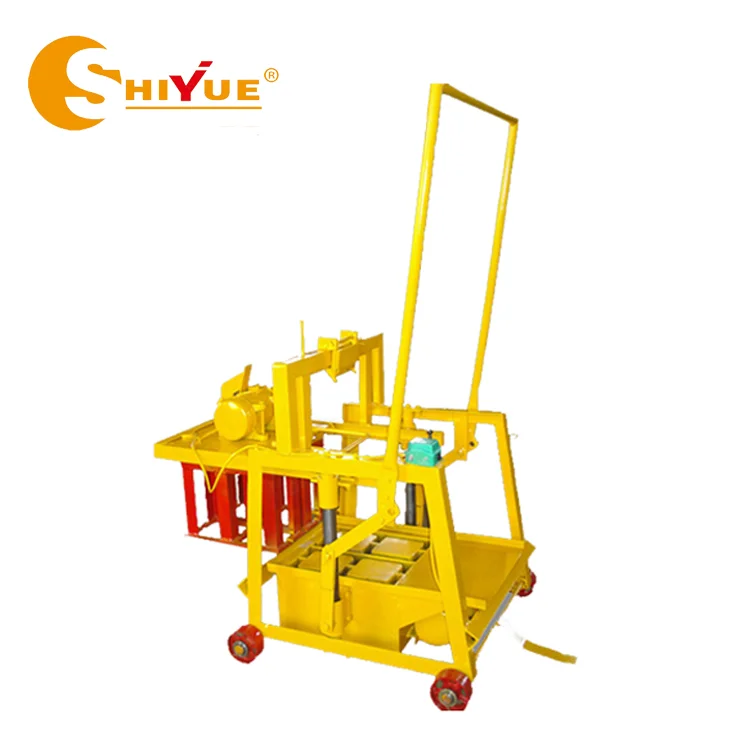
Single-Focus Block Line Engineering — Every station from mixer to curing rack is matched to the QMJ2-45 mobile block making machine so the press never waits for material or space.
Technical Specifications
| Parameter | Value |
|---|---|
| Model | QMJ2-45 |
| Product Type | Mobile Block Making Machine |
| Operation Mode | Manual egg-laying (no pallet required) |
| Power Source | Manual hydraulic (no external electric or diesel dependency) |
| Cycle Time | 25–30 seconds per mould |
| Output Capacity | 160 pcs/h based on 400×200×200mm hollow block, 2 pcs/mould |
| Output Capacity | 240 pcs/h based on 400×150×200mm hollow block, 3 pcs/mould |
| Output Capacity | 320 pcs/h based on 400×100×200mm hollow block, 4 pcs/mould |
| Daily Output (8 hr) | 1,280 pcs based on 400×200×200mm hollow block |
| Daily Output (8 hr) | 2,560 pcs based on 400×100×200mm hollow block |
| Mould Format Range | 400×200×200, 400×150×200, 400×100×200mm hollow brick |
| Mould Change Method | Full mould replacement |
| Pallet Requirement | None |
| Labor Requirement | 1 to 3 workers |
| Automation Level | Manual |
| Control System | Not applicable |
| Voltage & Frequency | Not applicable |
Application Suitability
| Application | Material or Output |
|---|---|
| On-site hollow block production for building contractors | Crushed stone, sand, cement, water mix laid directly on prepared ground |
| Small-scale block supply for housing projects | 400×100×200 to 400×200×200mm hollow brick formats from one machine |
| First-stage block plant for entrepreneurs | Low-capital setup with no pallet inventory or fixed curing racks |
| Remote construction sites with limited power | Manual hydraulic operation independent of grid voltage or generator capacity |
What a Mobile Block Making Machine Production Line Must Cover Beyond the Press
A mobile press that runs at full cycle rate still loses output when the mixer, feeding station, and curing area are not sequenced to match.
In field setups across Latin America, I have watched crews stand idle because the pan mixer finished its batch ninety seconds after the press was ready for the next cycle. The QMJ2-45 completes a mould every 25 to 30 seconds, so the upstream mixing and material feed must deliver fresh concrete at that rhythm. When the line is planned as isolated equipment purchases rather than a connected mobile block making machine production line, the bottleneck simply shifts from the press to whatever station was specified last [NEED_CITE: line balancing principles for small-scale concrete product plants]. Ground surface preparation and curing space are equally part of the line — egg-laying machines deposit blocks directly on the floor, so the curing area is the floor, and its dimensions dictate how many hours you can run before running out of space.
Removing the Pallet Loop from the Production Flow
The most visible difference a mobile block making machine production line introduces is the elimination of pallets. In a stationary plant, pallets travel from the press to the curing rack, then back to the press in a continuous loop that requires rack handling equipment, forklifts, and pallet return conveyors. The QMJ2-45 lays blocks directly onto a level concrete floor and moves forward to the next position. This means the line layout has no pallet return path to design around, and capital that would have gone into pallet inventory — often several hundred boards for a full shift — stays in the project budget. The trade-off is that floor quality becomes a process parameter: uneven ground produces uneven blocks.
Sequencing Mixing, Feeding, and Manual Pressing
Because the QMJ2-45 is manually operated, the line rhythm depends on how quickly workers move material from mixer to mould. A typical mobile block making machine production line at this scale pairs the press with a small pan mixer positioned within one wheelbarrow run of the machine [NEED_CITE: small-scale block plant material flow layouts]. One worker mixes, one feeds the mould, and one operates the press lever and walks the machine forward. If the mixer batch size is too small, the press waits. If the batch is too large, concrete begins to set before it reaches the mould. Matching batch volume to the 25–30 second cycle across two to four moulds per batch is the core line-balancing calculation.
Reading the Specs That Decide Line Output
Three specifications on the QMJ2-45 directly shape how the surrounding line must be configured. First, cycle time of 25 to 30 seconds per mould sets the maximum pace that upstream mixing and downstream curing must sustain. Second, the manual hydraulic operation means there is no motor load to calculate for generator sizing — but it also means pressing force is limited to what a worker can apply through the lever, making mix consistency critical to achieving block density. Third, the available mould formats — from 400×200×200mm down to 400×100×200mm — change the pieces-per-cycle count from two to four, which alters both the line throughput and the speed at which curing floor space fills up. A 400×100×200mm format fills floor area roughly twice as fast as a 400×200×200mm format at the same cycle rate, so curing area planning must track the specific block format you intend to produce.
The Hidden Cost of Treating the Press as a Standalone Purchase
When buyers source the QMJ2-45 without planning the rest of the line, the most common gap is curing space. Egg-laying machines produce blocks that cure where they are laid, so a full eight-hour shift at 320 pcs/h on 400×100×200mm blocks requires a smooth, covered concrete floor long enough to hold that volume plus walking clearance around each block. Contractors who discover this after delivery end up producing only until the available floor is full, cutting actual daily output well below the quoted figure [NEED_CITE: on-site block curing space planning guidelines]. A second frequent gap is the mixer: an undersized pan mixer forces the press into a stop-start rhythm that no amount of operator effort can overcome, because concrete setting time in the wheelbarrow becomes the real cycle limiter.
Why Sourcing the Line Together Matters
Block machinery as a single focus means the QMJ2-45 is specified alongside its mixer capacity, material feed method, and curing layout rather than shipped as an isolated press. Configuration is set against the buyer’s actual mix design and local aggregate, so the manual pressing force and vibration — or lack of powered vibration on this model — are evaluated against the concrete the machine will actually receive. Mould design covers the hollow brick formats the buyer’s local market sells, including custom mould drawings where standard sizes do not match. Automation level is selectable across the wider product range, so a buyer starting with a manual mobile press has a defined upgrade path to semi-automatic stationary lines without changing suppliers. Documentation for the QMJ2-45 includes line layout with capacity calculation that states the block format assumed, so the daily output figure on paper corresponds to the block you intend to produce [NEED_CITE: equipment documentation standards for concrete block machinery exports].
Documentation & Verification
- Line layout showing mixer placement, material feed path, and curing area sized to your chosen hollow block format
- Capacity calculation sheet stating output per specific 400×200×200, 400×150×200, or 400×100×200mm format
- Mould drawing and format list confirming which hollow brick sizes are included in the shipment
- Machine specification sheet with cycle time stated per block format rather than a single generic rate
- Raw material feed configuration document matching your local aggregate and cement type to the manual press rhythm
Installation, Commissioning & Support
- Level concrete floor required as both pressing surface and curing area; dimensions depend on target format output and shift length
- No electrical connection needed for the QMJ2-45 manual hydraulic press; mixer power is the only site utility to confirm
- Machine arrives assembled; mould change involves unbolting the current mould and fitting the replacement by hand
- First-day commissioning includes adjusting mix water content to suit manual pressing force and local aggregate absorption
- Operator training covers mould change sequence, cycle pacing with the mixer, and curing floor rotation schedule
- Wear parts list provided with mould wear surfaces and hydraulic seal kit identified for first reorder
What to Include in Your Inquiry
To configure a mobile block making machine production line around the QMJ2-45, share the hollow block format your market requires, the daily volume you need to sustain, and the local aggregate and cement type available on your project site. Floor space dimensions and whether a covered curing area exists will determine how many hours the line can run continuously. If you already own a mixer, provide its batch capacity so we can confirm it matches the press cycle rate.
Frequently Asked Questions
Q: How is daily output calculated and which block format is it based on?
A: Daily output on the QMJ2-45 is calculated from the cycle time of 25–30 seconds per mould multiplied across an eight-hour shift, but the pieces-per-cycle count changes with the mould. A 400×200×200mm hollow block yields 1,280 pieces per day, while a 400×100×200mm format yields 2,560. Always confirm the output figure is tied to the format you will actually produce.
Q: What mixing and feeding setup keeps the QMJ2-45 running without idle time?
A: The press cycles every 25–30 seconds, so the pan mixer must deliver a fresh batch within that window. For a three-worker crew, one mixing and one feeding by wheelbarrow, batch size should cover two to four mould fills. If your mixer batch is too small, the press waits; too large and concrete begins setting before it reaches the mould.
Q: Which mould formats are available and can custom moulds be designed?
A: Standard moulds cover 400×200×200, 400×150×200, and 400×100×200mm hollow brick. Custom mould design to buyer drawings is available for formats your local market demands. Confirm dimensions, wall thickness, and block weight targets so the mould is engineered for your aggregate and manual pressing force.
Q: How does an egg-laying machine handle curing and stacking?
A: The QMJ2-45 lays blocks directly on the ground, so curing happens in place and stacking occurs only after blocks reach sufficient strength. This removes pallet costs but requires a smooth, level concrete floor large enough to hold a full shift’s output with walking clearance between blocks for curing airflow.
Q: What site conditions does the QMJ2-45 need to operate effectively?
A: The machine needs a flat, firm concrete surface for both pressing and curing, enough covered space to hold daily output, and one to three workers. No electrical supply is required for the press itself, though the mixer will need power. Ground levelness directly affects block dimensional consistency.


