
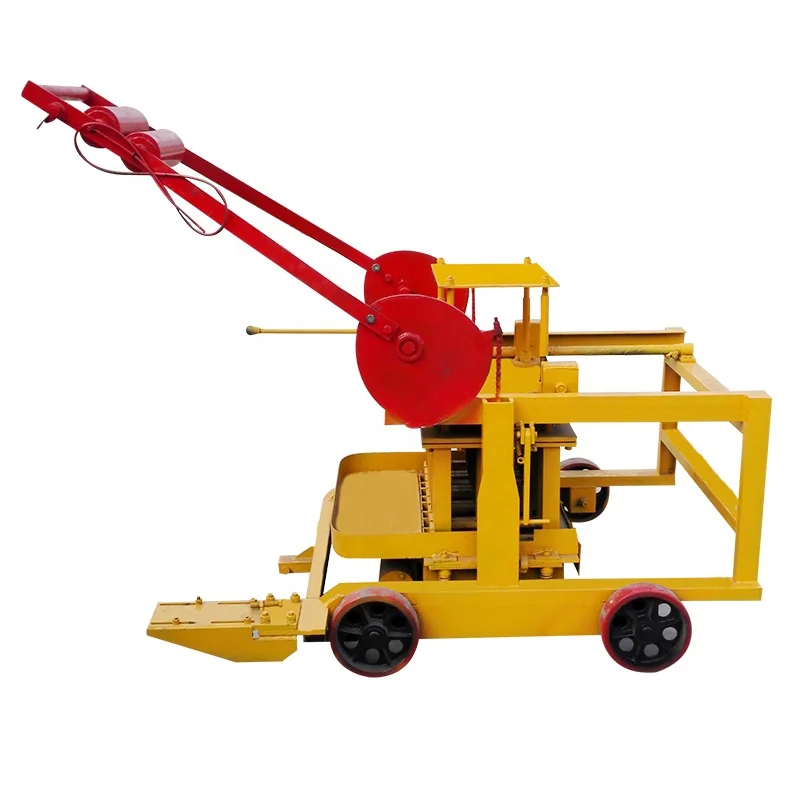
Line Rhythm Matched Before Dispatch — every mixer, press and trolley in this mobile block making machine production line is calculated against the QMR4-45 cycle so stations never starve or pile up on site.
Technical Specifications
| Parameter | Value |
|---|---|
| Model | QMR4-45 |
| Product Type | Mobile Block Making Machine |
| Power Source | Diesel / Petrol Engine / Electric (configurable) |
| Overall Dimensions (L×W×H) | 1100 × 950 × 2100 mm |
| Net Weight | 810 kg |
| Molding Cycle | 30–45 s |
| Output Capacity | 2560 pcs/day (basis not stated in source — confirm block format / material / thickness) |
| Pallet Requirement | No pallet required |
| Mobility | Movable / mobile design |
| Basic Equipment Included | JZC350 Diesel Concrete Mixer or JQ350 Electric Mixer with Generating Unit; Trolley |
| Brick Types Supported | Paver brick, hollow block, concrete block, solid brick, fly ash brick |
| Control System | Manual operation |
| Automation Level | Manual / semi-manual |
| Warranty | 1 Year |
Application Suitability
| Application | Material or Output |
|---|---|
| On-site housing project block production | Concrete and fly ash hollow / solid blocks laid directly on prepared ground |
| Remote infrastructure masonry supply | Paver bricks and concrete blocks produced off-grid with diesel power |
| Small-scale block yard start-up | Hollow blocks and solid bricks for local building material distribution |
| Project-based contractor supply | Concrete blocks moved between sites as construction phases progress |
Why "Pieces per Day" Means Nothing Without the Block Format
Daily output only becomes real once you pin down the exact block dimensions, wall thickness and mix design the machine will actually run.
A mobile block making machine production line quoted at a single daily figure hides the fact that a 400×200×200 mm hollow block and a 200×100×60 mm paver brick demand completely different cycle times, vibration durations and demoulding speeds. I once watched a contractor in West Africa base his entire project schedule on a brochure number, only to discover on site that switching from hollow blocks to pavers cut his daily volume by more than half. The mixer kept running, but the press could not keep up, and cured blocks sat on the ground waiting for space [NEED_CITE: block format impact on daily output verification].
Matching Mixer Output to Press Cycle on a Mobile Line
The QMR4-45 is supplied here with either a JZC350 diesel mixer or a JQ350 electric mixer plus generating unit, along with a trolley for material transfer. The reason this matters is that the 30–45 second molding cycle sets a fixed demand rate on the mixer; if mixing capacity falls behind, the press sits idle between batches and daily output drops regardless of how fast the machine itself can cycle. Specifying the mixer and press together as one mobile block making machine production line prevents that bottleneck before the equipment leaves the factory.
Pallet-Free Moulding and What It Removes from the Line Layout
Blocks are laid directly on the ground, which eliminates pallet purchase, pallet return conveyors and curing rack infrastructure from the setup entirely. For a contractor producing on a remote site or a first-time block yard entrepreneur, this removes one of the largest hidden capital items in small block plants. The trade-off is that ground preparation and curing area planning become critical: the surface must be level, compacted and large enough to hold a full day’s output without forklift traffic damaging freshly moulded units [NEED_CITE: ground preparation standards for pallet-free block curing].
Reading the QMR4-45 Specifications Against Real Production Conditions
The 810 kg net weight keeps the machine movable by hand or small loader between production zones, but it also means vibration force is inherently lower than a fixed hydraulic press, so block density depends heavily on mix proportioning and aggregate grading rather than machine pressure alone. The 1100 × 950 mm footprint defines the turning radius on site, which directly influences how much cured block area you need to allocate before relocating the unit. Manual control keeps the electrical system simple and field-serviceable, though it places molding consistency in the operator’s hands — training on cycle timing and feed volume becomes the quality control mechanism rather than a PLC program. Diesel, petrol or electric power options mean the voltage and frequency question must be settled before production begins, especially for electric configurations where a mismatch delays commissioning for weeks [NEED_CITE: voltage and frequency standards by export market].
The Hidden Cost of Sourcing Line Equipment Separately
When a buyer purchases the press, mixer and material trolley from three different suppliers, nobody is responsible for the cycle-time match between them. The result on site is a mixer that finishes a batch too early or too late for the press rhythm, forcing operators to either rush moulding or let mixed concrete sit and begin setting. Material waste climbs, block strength becomes inconsistent, and the daily output the project schedule depends on never materialises. This is the single most common failure pattern I see in small mobile block making machine production line installations where line rhythm was never calculated as a system [NEED_CITE: equipment mismatch impact on small block plant productivity].
Why Line Planning Starts Here Rather Than at the Press
Block machinery is our single focus, so the press, mixer, trolley and moulds are specified as one matched system rather than assembled from separate catalogue pages. Configuration is set against the buyer’s actual mix design, local aggregate availability and target block format, not a default brochure setting. Mould design covers the formats the buyer’s local market actually sells, with custom drawings available when standard options do not match. Automation level is selectable, so a buyer starting with manual operation can add semi-automatic pallet handling later without replacing the press. Installation support includes on-site commissioning and operator training focused on cycle discipline and mix consistency.
Documentation & Verification
- Line layout drawing showing mixer, press and trolley positions with curing area dimensions
- Capacity calculation sheet stating the exact block format assumed for daily output figures
- Mould drawing and format list confirming which brick types the included moulds cover
- Voltage, frequency and power source confirmation record signed before production begins
- Factory test record with photographs of blocks produced during pre-dispatch run
- Packing photographs and customs documentation for container loading reference
Installation, Commissioning & Support
- Level compacted ground required across the curing area to match pallet-free moulding footprint
- Diesel or electric power source confirmed against site utility conditions before machine build
- Mixer and trolley assembled and cycle-matched to the QMR4-45 press on arrival
- Mould change procedure and cycle timing trained with operators using buyer’s actual mix
- Wear parts and mould list supplied with first replacement schedule mapped out
- Daily maintenance checklist covering vibration mechanism, engine fluids and mixer drum condition
What We Need to Size Your Line Correctly
To build a mobile block making machine production line that actually delivers on site, we need your target block format with dimensions, the daily volume your project or market requires, and the raw materials available locally including aggregate type and cement grade. Please also confirm site power conditions — grid voltage and frequency, or whether diesel generation is required — so the correct power source and mixer configuration are locked in before production starts.
Frequently Asked Questions
Q: How is the 2560 pcs/day output verified, and which block format does it assume?
A: That figure is published without a stated block format, material or wall thickness, so it cannot be used for project planning as-is. We provide a capacity calculation sheet that recalculates daily output for your specific block dimensions and mix design, giving you a verified number tied to the product you will actually sell.
Q: Diesel vs. electric — how do I choose the right power source for my site?
A: If grid supply is stable and matches standard industrial voltage, the JQ350 electric mixer with generating unit reduces fuel cost and maintenance. For remote sites, unreliable grids or projects moving between locations, the JZC350 diesel mixer keeps production independent of utility infrastructure. We confirm voltage and frequency before building the electric configuration.
Q: What supporting line equipment is included, and what do I still need to provide?
A: The line ships with the QMR4-45 press, your choice of diesel or electric mixer, and a material trolley. You provide water supply, a level compacted curing area sized to hold a full day’s output, and raw materials — aggregate, cement and any fly ash or additives specified in your mix design.
Q: Pallet-free operation — what ground preparation and curing space does the setup require?
A: The surface must be flat, compacted and free of standing water so freshly moulded blocks settle evenly without tilting. Curing area size depends on your daily output and block format; we calculate the required footprint during line layout so blocks are not stacked on top of each other before initial set.
Q: How are mixing capacity and press cycle matched so the mixer does not become the bottleneck?
A: The QMR4-45 molding cycle of 30–45 seconds sets a fixed demand rate on the mixer. We specify the JZC350 or JQ350 mixer output against that cycle so a fresh batch is ready each time the press completes a moulding, preventing idle time and mixed concrete sitting too long before pressing.


