
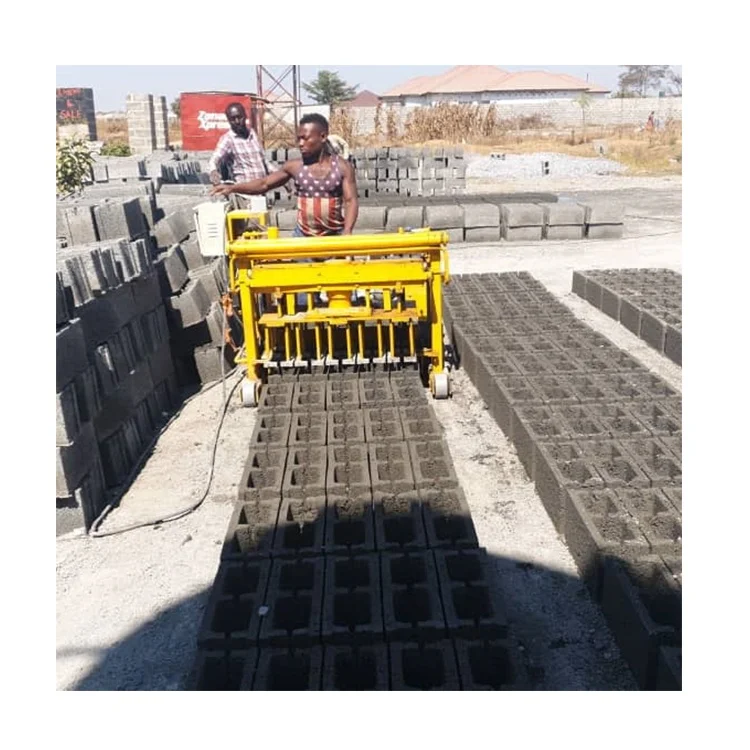
Integrated line configuration — every QMY4-30 unit is specified alongside its mixer, feeding arrangement and curing workflow so the press never sits idle waiting for concrete.
Technical Specifications
| Parameter | Value |
|---|---|
| Model | QMY4-30 |
| Product Type | Mobile Concrete Block Making Machine |
| Rated Power | 5 kW |
| Overall Dimensions (L×W×H) | 1200×1200×1100 mm |
| Net Weight | 950 kg |
| Molding Cycle Time | 30 seconds |
| Output Capacity (400×200×200 mm hollow block, 4 pcs/mould) | 480 pcs/h, 3840 pcs/8h |
| Output Capacity (400×150×200 mm hollow block, 5 pcs/mould) | 600 pcs/h, 4800 pcs/8h |
| Output Capacity (400×100×200 mm hollow block, 7 pcs/mould) | 840 pcs/h, 6720 pcs/8h |
| Mould Format Options | Hollow block, solid brick |
| Automation Level | Manual / low-investment mobile operation |
| Assembly State | Mobile, egg-laying type, no fixed plant required |
| Raw Materials | Cement, sand, crushed stones, slag |
| Pallet Size | Not applicable (egg-laying / mobile type) |
| Voltage & Frequency | To be confirmed before shipment |
| Control System | To be confirmed (PLC or relay) |
| Hydraulic Pressure | To be confirmed |
| Vibration Force | To be confirmed |
| Warranty | One year |
Application Suitability
| Application | Material or Output |
|---|---|
| On-site hollow block production | Crushed stone, sand and cement mixes for masonry walls |
| Solid brick manufacturing for job-site use | Cement and fine aggregate blends |
| Startup block plant with minimal infrastructure | Low-volume hollow block and solid brick from locally sourced aggregates |
| Housing project block supply | 400×200×200 mm and 400×150×200 mm hollow blocks laid directly on cured ground |
What Buyers Miss When They Only Look at Press Output
The QMY4-30 mobile block machine production line only delivers its rated capacity when the mixer keeps pace with the 30-second cycle.
A contractor I worked with bought a mobile press rated for several hundred blocks per hour, yet his workers spent half the shift standing around. The mixer fed too slowly, and the press waited between every cycle. The machine itself was fine — the gap was in the feeding loop that nobody had checked before shipping [NEED_CITE: mobile block line feeding and mixing workflow integration]. For a mobile concrete block making machine, the surrounding equipment determines whether you actually hit the numbers on the spec sheet.
How the Mobile Line Stays Fed
The press completes a moulding cycle every 30 seconds. If the mixer cannot deliver a fresh batch within that window, throughput drops proportionally. A pan mixer sized to match the QMY4-30 hopper volume, paired with a belt or screw feeder for cement and aggregate, keeps the cycle continuous. On smaller sites where a full batching setup is not practical, a gravity-fed hopper with pre-weighed material bags can sustain shorter production runs without bottlenecking the mobile block machine production line.
Curing Workflow Without a Fixed Rack System
Since the QMY4-30 lays blocks directly on the ground, the curing area becomes part of the line itself. You need flat, compacted surface that can hold an entire day’s output without stacking blocks on top of each other before initial set [NEED_CITE: concrete block curing methods for egg-laying mobile machines]. Water spraying frequency and covering materials influence final compressive strength as much as the mix design does. Planning the curing footprint before the machine arrives prevents a situation where freshly laid blocks are disturbed by site traffic or weather.
Reading the Specifications in Context
The 5 kW rated power draw means the QMY4-30 mobile concrete block making machine can run on a standard site generator without demanding a dedicated transformer — a practical advantage on remote job sites. The 950 kg weight and 1200×1200×1100 mm footprint allow repositioning with a forklift or small crane as the build progresses. The 30-second cycle time is consistent across all listed mould formats, meaning output differences come from the number of cavities per mould rather than speed changes. The raw material range — cement, sand, crushed stones, slag — covers most locally available aggregates, though the exact proportions and aggregate grading should be confirmed against the target block strength before production begins.
What Happens When the Line Is Not Matched
Ignoring the mixing and feeding loop turns a mobile block machine production line into an expensive press that idles between cycles. The operator ends up hand-feeding the hopper, which introduces inconsistency in fill depth and compaction. On the curing side, insufficient ground preparation leads to cracked or uneven blocks that fail strength tests at delivery [NEED_CITE: common causes of block strength failure in mobile production]. These problems do not appear on the first day — they surface after a week when output quality drifts and rework costs overtake the savings from choosing a low-investment setup.
Why This Is Where the Line Comes Together
Block machinery is the single focus here, so the QMY4-30 is specified as part of a matched system rather than a standalone press. The configuration is set against the buyer’s actual mix design and local aggregate, not a catalogue default. Mould options cover the hollow block formats that match the buyer’s market, and custom drawings are available. Automation level is selectable — a buyer can start with manual pallet handling and add supporting equipment later. Installation support includes on-site commissioning and operator training so the crew understands the full workflow, not just the press controls.
Documentation & Verification
- Line layout showing mixer, feeder and QMY4-30 positions with curing area dimensions
- Capacity calculation sheet stating block format and cycle assumptions per mould
- Mould drawing and format list for hollow block and solid brick options
- Voltage and control language confirmation record before production begins
- Factory test record on the buyer’s specified raw material mix
- Operation and maintenance manual with wear parts and mould replacement intervals
Installation, Commissioning & Support
- Ground surface must be flat and compacted to support 950 kg machine weight without settling
- Power supply matched to confirmed voltage and frequency, with a dedicated circuit for the 5 kW motor
- Machine arrives assembled; repositioning between sites requires a forklift or crane rated for the net weight
- First production run supervised to calibrate cycle timing with mixer feed rate and crew workflow
- Operator training covers mould change procedure, hopper feeding rhythm and basic troubleshooting
- Wear parts list provided at delivery with recommended replacement intervals for vibration components
Before You Send the Inquiry
Share the block formats you plan to produce and the daily volume you need so the line can be sized around your actual output target. Include your local voltage, frequency and preferred control language so the QMY4-30 mobile concrete block making machine arrives ready for commissioning. If you already have a mixer or material handling setup on site, describe it so we can confirm whether it matches the press cycle or needs adjustment.
Frequently Asked Questions
Q: How is the daily output calculated for the QMY4-30?
A: The 3840 pieces per 8-hour shift figure assumes 400×200×200 mm hollow blocks with 4 cavities per mould and a 30-second cycle. Switching to the 400×100×200 mm format with 7 cavities yields 6720 pieces per shift under the same cycle. Actual output depends on mixer feed speed and crew workflow keeping the press running continuously.
Q: What supporting equipment keeps the mobile press from waiting?
A: A pan mixer sized to the QMY4-30 hopper volume and a feeding arrangement for cement and aggregate are essential. Without them, the 30-second cycle breaks between every batch. The mixer capacity and feed method should be confirmed alongside the press order to avoid idle time on the job site.
Q: What voltage and control options are available?
A: Voltage, frequency and control type are confirmed with each buyer before production. This prevents commissioning delays caused by mismatched site power or an unreadable control display. Specify your local supply standard and preferred language when placing the order.
Q: How does mobile curing affect block strength?
A: Blocks laid on the ground cure differently from those on racks in a fixed plant. Flat ground preparation, water spraying schedule and covering materials all influence final compressive strength. The curing area must be planned to hold a full day’s output without disturbing blocks before initial set is achieved.
Q: What mould formats fit the QMY4-30 and how long does a change take?
A: Available moulds cover 400×200×200 mm, 400×150×200 mm and 400×100×200 mm hollow blocks plus solid brick. Mould change time on site is confirmed at order stage. Choosing the formats your market actually buys avoids paying for flexibility you will not use on a daily production schedule.


