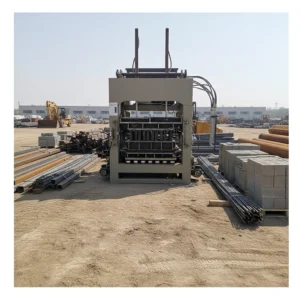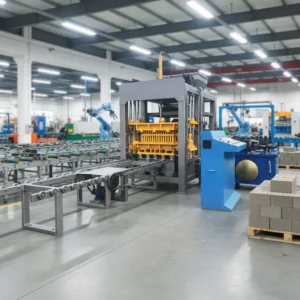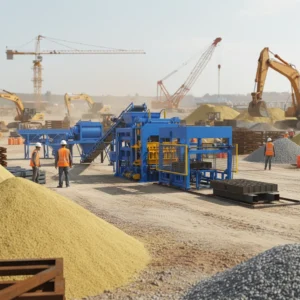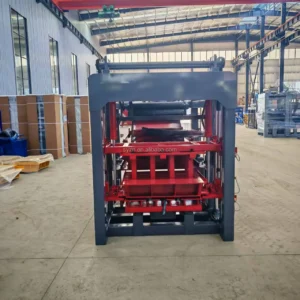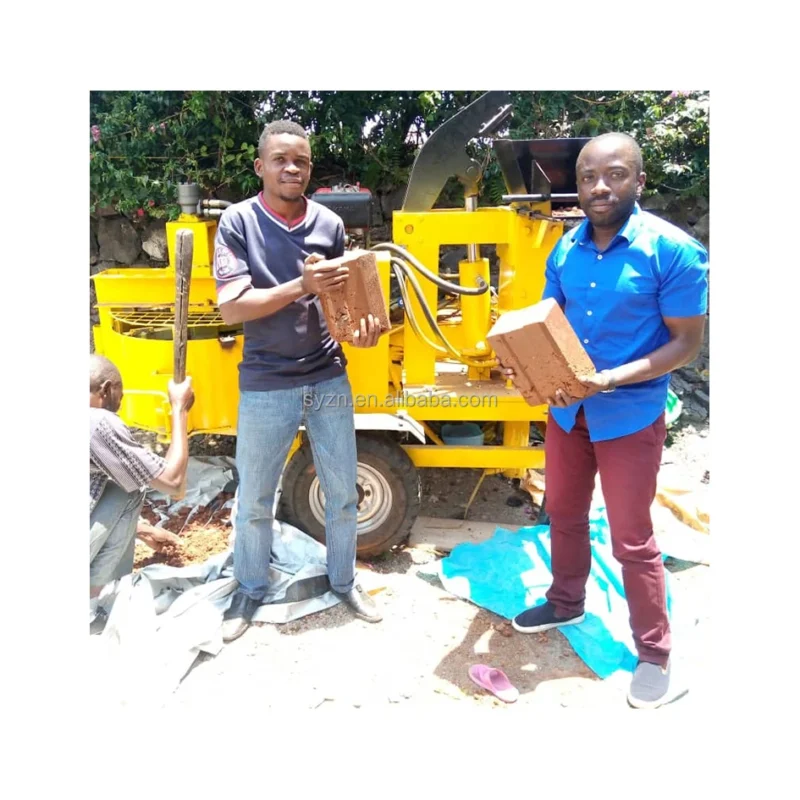
Integrated Press-Line Thinking — The M7MI is specified here as the centre of a connected mobile block production setup, with mixer output, feeding rhythm and curing-area handling matched to its 15–20 s cycle rather than quoted as a standalone machine.
Technical Specifications
| Parameter | Value |
|---|---|
| Model | M7MI |
| Product Type | Mobile Hydraulic Clay Interlocking Block Making Machine |
| Engine Type | Diesel Engine |
| Rated Power | 7.5 kW (source value — verify against manufacturer catalog) |
| Hydraulic Pressure | 16 MPa |
| Molding Cycle | 15–20 s |
| Output Capacity (300×150×100 mm interlocking block) | 1,600 pcs / 8 hr based on 20 s cycle, 1 pc per mould |
| Output Capacity (general) | 2,200 pcs / day (basis not stated in source — confirm block format, material and thickness) |
| Mould Quantity per Cycle | 1 pc (300×150×100 mm interlocking format) |
| Block Format | Interlocking block, mould-changeable |
| Raw Material Compatibility | Clay, soil, concrete |
| Overall Dimensions (L×W×H) | 3,200 × 1,100 × 1,500 mm |
| Total Mass | 1,100 kg |
| Assembly State | Mobile, trailer-mounted |
Application Suitability
| Application | Material or Output |
|---|---|
| On-site interlocking block production for contractors without a fixed plant | Locally sourced clay or soil mixed with cement |
| Rural or off-grid building projects | Diesel-powered operation where grid electricity is unavailable |
| Small-scale housing and development projects | Interlocking bricks in 300×150×100 mm format, with mould-changeable options |
| Earth-block production using available site soil | Clay-soil mix design matched to 16 MPa hydraulic pressure |
What "2,200 Pieces per Day" Actually Requires Upstream and Downstream
The press will only cycle as fast as the slowest station around it — mixer discharge, material feed and cured-block removal must all land inside the 15–20 s window.
Catalogues often quote a daily figure without naming the block format or the cycle time behind it. On a mobile clay interlocking block making machine production line, I have seen mixers sized for a longer cycle leave the press idling for several seconds between strokes, cutting actual daily output well below the quoted number. The feeder, mixer, press and curing area form one chain; every station must be calculated against the same block format and the same cycle assumption. [NEED_CITE: typical mobile block production line station matching requirements]
How the Material Feed Must Keep Pace with a 15–20 s Press Cycle
The M7MI completes a stroke every 15–20 seconds, producing one 300×150×100 mm interlocking block per cycle. That means the mixer must discharge a fresh batch into the feed hopper well within that window, or the press waits. When sizing the mobile clay interlocking block making machine production line, the mixer capacity and discharge height should be confirmed against the M7MI hopper opening and feed angle.
Diesel Power and What It Means for Line Equipment
Running on a diesel engine removes the dependency on grid electricity, which matters on rural building sites and development projects without a stable power supply. However, the supporting stations — mixer, conveyor, any vibrating screen — also need a power plan. Matching the auxiliary equipment to the same off-grid constraint is part of the line configuration, not an afterthought. [NEED_CITE: off-grid construction site power supply planning for block production]
Reading the Specs That Decide Block Strength and Output
Hydraulic pressure at 16 MPa is the force that compacts the clay-soil mix into an interlocking block with sufficient compressive strength. This pressure value must be read alongside the cycle time: a shorter cycle with insufficient pressure yields a weaker block, while a longer cycle wastes capacity. The single-mould-per-cycle layout means format changes are the primary lever for product variety, so mould-change procedure and time directly affect how many different block profiles a site can realistically produce in one shift. Raw material compatibility with clay, soil and concrete gives the operator flexibility, but the mix design — moisture content, cement ratio, aggregate grading — must be set against that 16 MPa figure to achieve consistent density block after block.
When Supporting Equipment Is Left out of the Quotation
A mobile press quoted without its feeding and curing handling leaves the buyer sourcing mixers and pallet carts locally. The result is usually a mismatch: a mixer too small to feed the press on time, or a curing area too far from the press for one worker to move blocks before the next cycle completes. I have visited sites where the M7MI-type machine sat idle for a third of the shift because the upstream mixer could not keep a continuous supply of prepared clay. Those lost hours compound across a project timeline. [NEED_CITE: impact of auxiliary equipment mismatch on mobile block line daily output]
Why Specifying the Whole Line Here Avoids Field Surprises
Configuration is set against the buyer’s actual clay source, target interlocking profile and site conditions, not a catalogue default. The M7MI sits inside a production layout where mixer discharge rate, feeding method and curing rack distance are calculated together. Mould drawings and format lists are supplied so the buyer confirms which interlocking profiles are included before production. Diesel engine rating and auxiliary equipment power requirements are confirmed as one package, avoiding voltage or fuel-consumption surprises on arrival. Every output figure in the proposal states the block format and cycle time it assumes. [NEED_CITE: block machinery line specification best practices for export buyers]
Documentation & Verification
- Line layout drawing showing M7MI placement relative to mixer, feeder and curing zone
- Capacity calculation sheet stating block format and cycle time for each output figure
- Mould drawing and interlocking profile list included with the quotation
- Hydraulic and diesel engine specification sheet with confirmed pressure and power ratings
- Factory test record run on the buyer’s specified clay-soil mix before dispatch
Installation, Commissioning & Support
- Trailer-mounted M7MI requires level compacted ground; no fixed foundation needed for the press itself
- Diesel engine commissioning includes fuel line bleeding, cold-start check and governor adjustment on site
- Mixer and feeder positioned and anchored to match the M7MI hopper feed height of the trailer chassis
- Mould installed and first run of interlocking blocks checked for dimensional tolerance against drawings
- Operator training covers mould change procedure, hydraulic pressure verification and daily greasing points
- Wear parts list provided with recommended stock quantities for hydraulic seals and mould liners
What to Include in Your First Inquiry
Send the target interlocking block format, the clay or soil source available at your project site, and the daily output you need to sustain. If the site has no grid power, confirm that so the full mobile clay interlocking block making machine production line can be specified around diesel operation, including auxiliary equipment.
Frequently Asked Questions
Q: How is daily output calculated and which block format does the 2,200 pcs/day figure assume?
A: The 2,200 pcs/day figure appears in source material without a stated block format, material or cycle time. For a 300×150×100 mm interlocking block at a 20 s cycle with one piece per mould, the calculated rate is 1,600 pcs per 8-hour shift. Any proposal from us states the exact format and cycle behind every output number.
Q: How must the mixer be sized so the M7MI press is never left waiting between cycles?
A: The mixer must discharge a full batch of prepared clay or soil into the feed system within the 15–20 s molding window. We calculate mixer drum capacity, discharge height and feed method against the M7MI hopper dimensions so the press cycles continuously without idle gaps.
Q: What curing area and handling does a mobile interlocking block line need?
A: Interlocking blocks require a flat, shaded curing zone close enough to the press for one or two workers to move freshly pressed blocks before the next cycle. We include curing rack layout and handling equipment in the line proposal, matched to the M7MI output rate and the site’s available space.
Q: Can the M7MI run on locally sourced clay and what does 16 MPa pressure assume?
A: The machine is compatible with clay, soil and concrete mixes. The 16 MPa hydraulic pressure must be matched to your specific mix design — moisture content, cement ratio and aggregate grading — to produce interlocking blocks with consistent compressive strength. We request a sample or soil report before finalising the configuration.