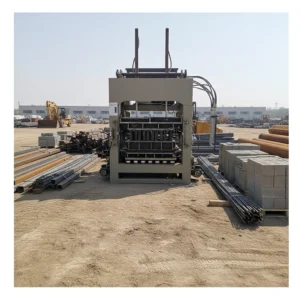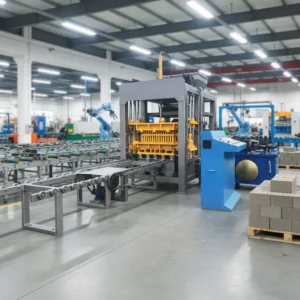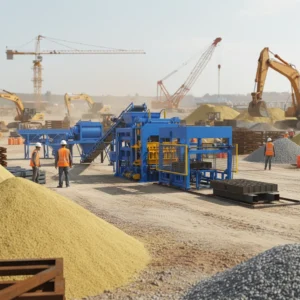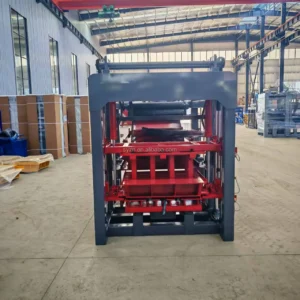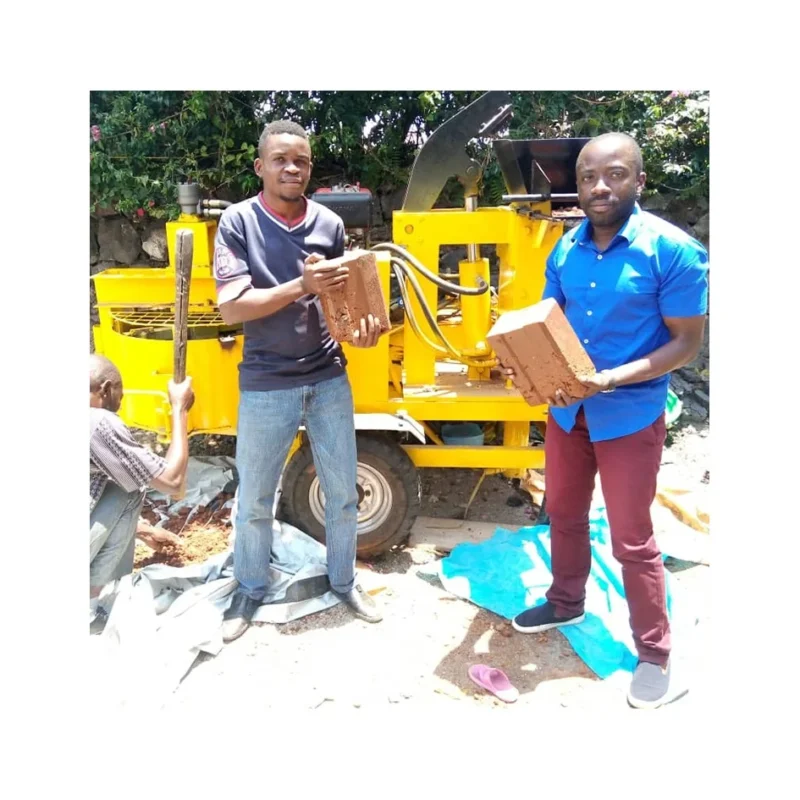
Matched System Output — The M7MI press, raw material mixer, pallet feeder and stacking stations are specified together so their cycle times align, preventing the press from idling or downstream bottlenecks from forming during an 8-hour shift.
Technical Specifications
| Parameter | Value |
|---|---|
| Model | M7MI |
| Product Type | Hydraulic Interlocking Clay Block Making Machine |
| Engine Type | Diesel Engine |
| Hydraulic Pressure | 16 MPa |
| Molding Cycle | 15–20 s (basis: 300×150×100 mm interlocking block, 1 pc/mould) |
| Output Capacity | 1,600 pcs/8hr (basis: 300×150×100 mm interlocking block, 1 pc/mould, 20 s cycle) |
| Qty per Mould | 1 pc (300×150×100 mm format) |
| Overall Dimensions (L×W×H) | 3,200 × 1,100 × 1,500 mm |
| Total Mass | 1,100 kg |
| Power Source | Diesel |
| Raw Material Compatibility | Clay, Soil, Mud, Concrete |
| Mould Change | Yes, supports multiple interlocking block formats |
| Block Locking System | Interlocking (mortise-and-tenon style) |
| Automation Level | Semi-automatic / manual pallet handling |
Application Suitability
| Application | Material or Output |
|---|---|
| On-site housing project production | Locally sourced clay or soil with interlocking block formats |
| Contractor-owned mobile setups | Mud and concrete mixes for development sites without grid power |
| Small-scale block plants adding formats | Concrete interlocking pavers and wall blocks for regional markets |
| Off-grid regional production | Diesel-powered operation in areas with unreliable electricity supply |
What "2,200 Pieces per Day" Leaves Out About Line Throughput
Real daily output depends on which block format you run and whether upstream mixing keeps pace with the press cycle.
Many quotations state a headline daily capacity without naming the block format, mould cavity count or cycle time behind that number. When the actual format differs from the unstated assumption, the press completes fewer cycles per shift than projected. A hydraulic interlocking clay block machine production line only delivers its quoted volume when the mixer batch size, pallet feed rate and stacking rhythm are all timed to the press cycle, not specified in isolation. [NEED_CITE: capacity calculation standards for block making equipment]
How Upstream Feeding and Mixing Must Match the 15–20 Second Press Cycle
The M7MI completes one moulding cycle every 15 to 20 seconds when running a 300×150×100 mm interlocking block. If the mixer discharges a batch that takes longer than this interval to prepare, the press sits idle between cycles and the hydraulic interlocking clay block machine production line loses throughput that no amount of press speed can recover. The raw material feeder, mixer drum capacity and discharge gate must therefore be sized so that a fresh batch arrives at the hopper before the previous one is exhausted, keeping the press continuously fed throughout an 8-hour shift.
Downstream Pallet Handling and Why It Governs Actual Shift Output
Once the press releases a formed block on its pallet, that pallet must move to the curing area before the next cycle begins. If pallet handling is manual and the operator cannot clear and replace the pallet within the cycle window, the press waits. On a complete hydraulic interlocking clay block machine production line, pallet feed speed, stacking method and curing rack distance are calculated against the 15–20 second cycle so that no station becomes a constraint. [NEED_CITE: material handling synchronisation in block production plants]
Reading the Specifications Against Your Local Material and Site Conditions
The 16 MPa hydraulic pressure is sufficient to compact clay, soil, mud and concrete mixes, but the achievable block density depends on how well the local aggregate gradation and moisture content suit the mould design. A clay with high plasticity may require a different moisture window than a sandy soil, and the mixer must deliver consistent moisture batch after batch. The diesel power source removes the dependency on grid electricity, making this configuration practical for project sites where power supply is unreliable or absent entirely.
What Happens When Line Stations Are Specified Separately
When a buyer sources the press from one supplier and the mixer, pallet feeder and stacking equipment from others, the cycle times rarely align without significant rework. The mixer may be oversized, wasting energy and floor space, or undersized, starving the press. Pallet dimensions chosen without reference to the curing racks already on site force the buyer into an unplanned rack replacement. These mismatches surface only after commissioning, when the line fails to reach the output the buyer budgeted for. [NEED_CITE: integration risks in multi-supplier block production lines]
Why the M7MI Is Specified as Part of a Coordinated Line
Block machinery is the single focus here, so the M7MI press, mould, pallet and handling equipment are configured as one matched system rather than assembled from separate catalogues. The line layout accounts for the buyer’s actual mix design and target block format from the start. Mould options cover the interlocking formats the buyer’s market demands, including custom drawings where standard formats do not apply. Automation level is selectable, so a buyer can begin with semi-automatic operation and add pallet feeding or stacking automation later as volume grows. Installation support includes operator training on the specific configuration delivered, and wear parts availability is confirmed before the first replacement falls due.
Documentation & Verification
- Line layout drawing with capacity calculation stated per block format and cycle time
- Machine specification sheet with hydraulic pressure and moulding cycle confirmed
- Mould drawing and format list showing every interlocking block type the line can produce
- Pallet specification matched to the curing area dimensions and handling method
- Hydraulic and electrical schematic for on-site maintenance reference
- Factory test record run on the buyer’s target block format before dispatch
Installation, Commissioning & Support
- Foundation plan sized to the 3,200 × 1,100 mm footprint and 1,100 kg mass with vibration isolation
- Diesel engine service schedule and fuel specification provided before first start-up
- Machine shipped in dismantled state with reassembly sequence documented for site crews
- Commissioning includes cycle time verification on the buyer’s chosen interlocking block format
- Operator training covers mould change procedure and hydraulic pressure adjustment for local material
- Wear parts list identifies mould liners and hydraulic seals with first replacement intervals
Before You Request a Quotation
Share the interlocking block format your market sells most, the daily volume you need to meet and the clay or soil type available at your project site. Confirm whether your curing area uses existing pallets or racks so the handling equipment can be matched accordingly. State whether diesel operation is a preference or a necessity given local power conditions.
Frequently Asked Questions
Q: How do I verify the real daily output for the block format I intend to produce?
A: Output depends on the mould cavity count, cycle time and shift length for your specific format. The 1,600-piece figure applies to a 300×150×100 mm interlocking block at one piece per mould over a 20-second cycle in an 8-hour shift. Request a capacity calculation that names your exact format, its cycle time and the resulting shift total so you can plan against a known number.
Q: How should the mixer and pallet feeder be timed to the M7MI press cycle?
A: The mixer must discharge a full batch before the press hopper runs empty, and the pallet feeder must present a fresh pallet within the 15–20 second moulding window. If either station lags, the press idles and shift output drops. Line configuration should specify each station’s cycle contribution so no single point constrains throughput.
Q: Does local clay type affect which mould and pressure setting I should choose?
A: Yes. Clay plasticity, sand content and moisture level all influence how the material compacts under 16 MPa hydraulic pressure. A highly plastic clay may need moisture adjustment or a different mould draft angle compared to a sandy soil. Providing a sample or lab analysis of your local material allows the mould and mix configuration to be matched before production begins.
Q: Can I switch from diesel to electric power if grid electricity becomes available later?
A: The diesel configuration is chosen for sites where grid power is absent or unreliable. Converting to electric drive involves replacing the engine with a motor and adding a control panel with the correct voltage and frequency for your site. This upgrade path can be planned during initial line configuration so that the mechanical layout accommodates a future changeover without major structural modification.
Q: When will I need to replace moulds or hydraulic wear parts for the first time?
A: Replacement timing depends on the abrasiveness of your raw material and daily production volume. Mould liners wearing against clay or concrete gradually lose dimensional accuracy, while hydraulic seals degrade with pressure cycles. A wear parts list with estimated first replacement intervals is supplied with the machine so you can order spares before production is interrupted.