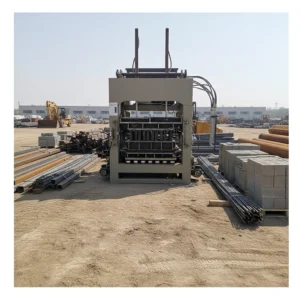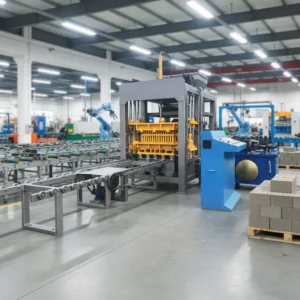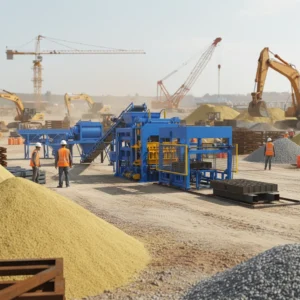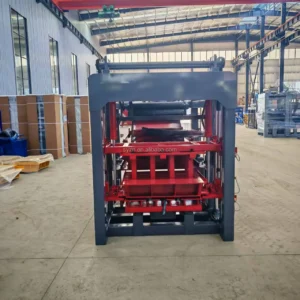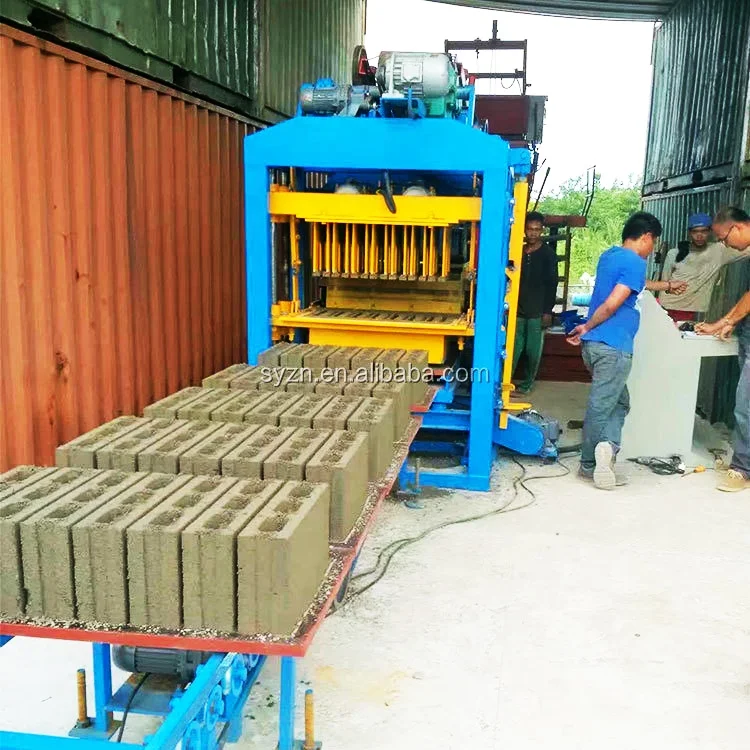
Integrated Line Flow — QTJ4-25 mixer, conveyor, and pallet loop are timed together so the press never sits idle waiting for the next station.
Technical Specifications
| Parameter | Value |
|---|---|
| Model | QTJ4-25 |
| Product Type | Semi-Automatic Concrete Block Making Machine |
| Overall Dimensions (L×W×H) | 6400×1500×2700 mm |
| Molding Cycle | 25 s |
| Vibration Frequency | 2800–5100 r/min |
| Exciting Power (Vibration Force) | 60 kN |
| Total Power | 17.9 kW |
| Mixer Model | JQ350 |
| Pallet Size | 850×550×20 mm |
| Total Weight | 2500 kg |
| Applied Products | Concrete hollow blocks (8 inch, 6 inch), solid bricks, pavers |
| Raw Materials | Crushed stones, sand, cement, dust, fly ash |
| Output Capacity (390×190×190 mm hollow block) | 4 pcs/mould, 480 pcs/h, 3800 pcs/8hr |
| Output Capacity (400×150×200 mm hollow block) | 5 pcs/mould, 600 pcs/h, 4800 pcs/8hr |
| Output Capacity (240×115×53 mm solid brick) | 18 pcs/mould, 2100 pcs/h, 17000 pcs/8hr |
| Hydraulic Station | Equipped (high pressure, stable operation) |
| Automation Level | Semi-automatic |
| Vibration Type | Bed mould vertical vibration + upper mould compression vibration |
| Stacking Method | Manual (placed on pallet, moved by trolley) |
| Control System | (basis not stated in source — confirm PLC or relay logic) |
| Voltage & Frequency | (basis not stated in source — confirm with buyer’s local grid) |
Application Suitability
| Application | Material or Output |
|---|---|
| Small to medium-scale block plant | Hollow blocks from crushed stone, sand, and cement |
| On-site production for contractors | Solid bricks using locally available aggregates and fly ash |
| First block plant for entrepreneurs | Pavers and interlocking formats with standard pallet rotation |
| Existing plant press replacement | Hollow and solid formats matched to upstream mixer and conveyor |
What "480 Pieces per Hour" Leaves Out About Your Block Production Line Equipment
A press cycle means nothing if the mixer batch is not ready and the pallets are not back in position.
Capacity sheets often quote the QTJ4-25 at 480 hollow blocks per hour based on a 390×190×190 mm format, but that number assumes every upstream and downstream station keeps pace. I once spent three days on a Middle East site where the buyer paired this press with a belt conveyor that ran a different rhythm — bricks piled on the floor because pallets never returned in time. The block production line equipment around the press must share the same 25-second heartbeat, or the headline capacity stays on paper [NEED_CITE: line synchronization principles for semi-automatic block plants].
Mixer-to-Press Timing That Actually Holds Up
The JQ350 mixer is specified alongside the QTJ4-25 because its batch volume and discharge time align with what the press consumes every two to three cycles. If the mixer dumps too slowly, the hopper starves and the press sits through an empty cycle. When planning block production line equipment, the conveyor angle and belt speed between mixer and press hopper must also be locked in before production starts, not adjusted on the first morning of commissioning.
Pallet Circulation and Why It Decides Real Output
With an 850×550×20 mm pallet, a continuous run needs enough boards to fill the curing racks while a fresh set returns to the press. Under-count pallets and the operator is hand-stacking blocks on the floor, which defeats the purpose of a mechanized line. I always ask buyers how many square metres of curing space they have and what forklift they already own, then size the pallet pool and material accordingly [NEED_CITE: pallet quantity calculation for semi-automatic block curing].
How Vibration and Hydraulic Pressure Shape Block Density
The QTJ4-25 combines bed mould vertical vibration at 2800–5100 r/min with upper mould compression vibration at 60 kN. This dual action compacts the mix from both directions, which matters when local aggregate is coarse or fly ash content is high. The hydraulic station maintains steady pressure through each 25-second cycle, reducing density variation between the first block of the shift and the last. Getting this balance wrong — too much vibration on a dry mix, or insufficient hydraulic hold on a wet one — produces blocks that chip at the edges before they reach the curing rack.
The Hidden Cost of Ignoring Supporting Equipment
Buyers who focus only on the press often discover that material feeding, pallet return, and stacking consume more labour than expected. A mismatched conveyor forces one worker to shovel mix by hand; missing pallets force two more to carry boards back from the curing area. These are not small inefficiencies — they reshape the entire crew size and shift cost. I have seen lines where the press itself ran fine but the supporting block making machine equipment turned a two-person operation into a five-person one [NEED_CITE: labour allocation in semi-automatic block production].
Why Source the Full Line from One Supplier
Shiyue configures the QTJ4-25, JQ350 mixer, conveyor, and pallet system as a single matched set rather than assembling from separate vendors. Line layout drawings show station spacing and material flow path before the order is placed. Capacity calculations state which block format each output figure assumes. Pallet specifications are checked against the buyer’s curing area and forklift capacity. Voltage, frequency, and control language are confirmed before production begins, so commissioning is not delayed by a wrong motor or an unreadable display. Factory test records cover the full line, not just the press running in isolation.
Documentation & Verification
- Line layout drawing showing QTJ4-25 station spacing and material flow path
- Capacity calculation sheet stating block format assumed for each output figure
- Pallet specification matched to buyer’s curing area dimensions and forklift rating
- Voltage and control language confirmation record signed before production
- Factory test record covering press, mixer, and conveyor running together
- Operation and maintenance manual covering all line stations
Installation, Commissioning & Support
- Foundation plan sized to the 6400×1500 mm machine footprint and 2500 kg weight
- Dedicated power circuit for the 17.9 kW total load with correct voltage and frequency
- On-site assembly of host press, JQ350 mixer, and conveyor with alignment checks
- First-run cycle tuning across all stations to verify 25-second press timing
- Operator training on mould change, pallet loading, and daily greasing points
- Wear parts list for vibration bed, hydraulic seals, and mould liners
What to Include in Your Inquiry
To build a line that runs without bottlenecks, share your target block format, daily output goal, local aggregate type, and curing area size. Confirm your site voltage, frequency, and preferred control display language. Let us know if you already have a forklift or trolley system so the pallet spec fits what you have on the ground.
Frequently Asked Questions
Q: How are the mixer and conveyor cycle times matched to the 25-second press cycle?
A: The JQ350 batch volume and the conveyor belt speed are calculated so the press hopper receives enough mix for at least two moulding cycles before the next batch discharges. This prevents the press from idling through an empty cycle and keeps the 25-second rhythm intact throughout the shift.
Q: How many pallets do I need for continuous operation with the QTJ4-25?
A: The number depends on your curing rack capacity and how fast boards return to the press. We calculate the pallet pool based on your 850×550 mm board size, the curing area square footage, and the forklift cycle time, so blocks are never waiting on the floor for a free board.
Q: How is daily output calculated per block format?
A: Each capacity figure states the block format used. For example, 3800 pieces per 8-hour shift assumes the 390×190×190 mm hollow block at 4 per mould. Switching to a different format changes both pieces per mould and cycle count, so the output sheet is recalculated for your actual product mix.
Q: Can the line be upgraded to automatic stacking later?
A: The semi-automatic layout leaves space and structural mounting points for a future stacker and cubing station. When you plan the initial line, we note the upgrade path so the conveyor height and pallet exit position remain compatible with the automation module you add later.