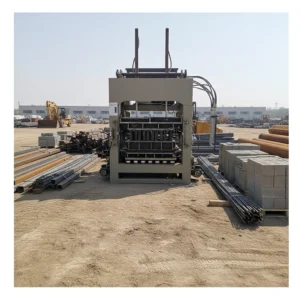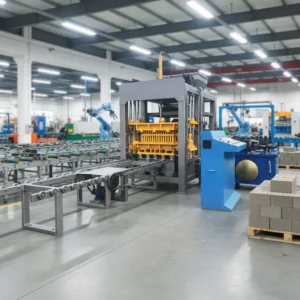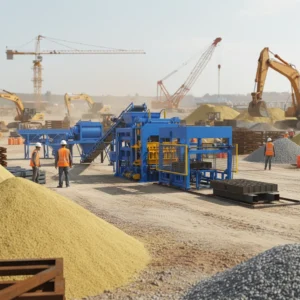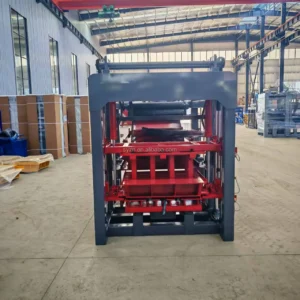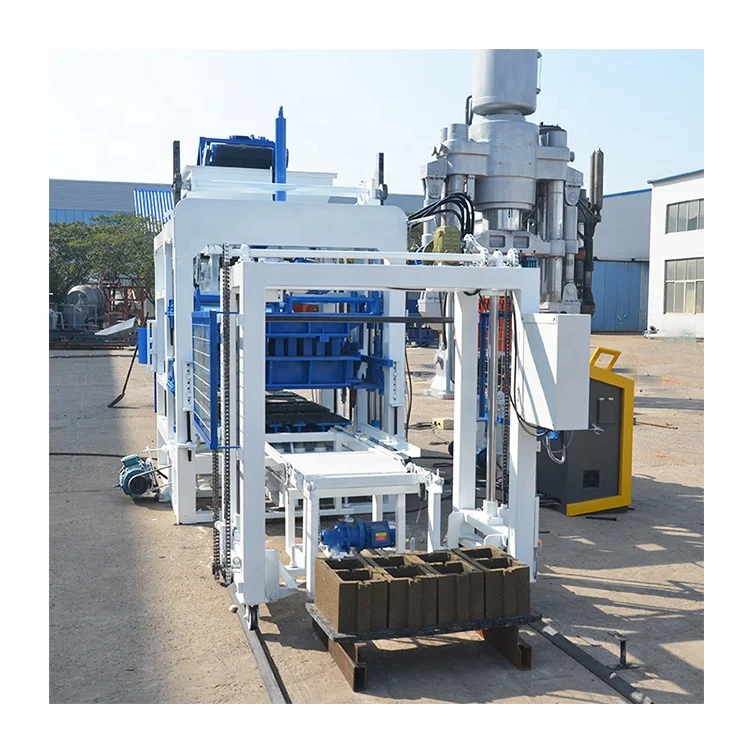
Matched Line Integration — The QT4-18 hydraulic block making machine is specified together with its JQ350 mixer, conveyor, pallets and automatic stacker so the press cycle is never starved by upstream or blocked downstream.
Technical Specifications
| Parameter | Value |
|---|---|
| Model | QT4-18 |
| Product Type | Hydraulic Block Making Machine |
| Overall Dimensions (L×W×H) | 3900×1600×2300 mm |
| Molding Cycle | 15–25 s (basis not stated in source — confirm block format / material / thickness) |
| Vibration Force | 40–50 kN |
| Rated Power | 24 kW |
| Mixer Model | JQ350 |
| Pallet Size | 850×550×25 mm |
| Net Weight | 3 T |
| Applied Products | Paver, solid block, hollow block, curbstone |
| Raw Materials | Crushed stone, sand, cement, dust, fly ash |
| Automation Level | Semi-automatic |
| Hydraulic System | Hydraulic station equipped (pressure rating not stated in source — confirm MPa) |
| Control System | To be confirmed (PLC / relay / manual) |
| Voltage & Frequency | To be confirmed based on target market supply |
| Stacking Method | Automatic stacker included |
| Output Capacity (400×200×200 mm hollow block, 4 pcs/mould) | 1200–1680 pcs/hr |
| Output Capacity (400×150×200 mm hollow block) | 1800–2400 pcs/hr |
| Output Capacity (240×115×53 mm solid brick) | 3240 pcs/hr |
Application Suitability
| Application | Material or Output |
|---|---|
| Hollow block production for masonry walls | Crushed stone, sand, cement, fly ash; 400×200×200 mm or 400×150×200 mm formats |
| Solid brick manufacturing | Sand, cement, stone dust; 240×115×53 mm format |
| Paver and curbstone production for site works | Aggregate and cement mixes; format-dependent cycle |
| On-site block production for housing projects | Locally sourced aggregate with semi-automatic line footprint |
What "1200 Blocks per Hour" Actually Assumes on the Line
A capacity figure only means something when the block format, mixer discharge rate, pallet return speed and stacker cycle are all stated alongside it.
I have stood on sites where the block making machine production line was quoted at an impressive hourly number, yet the mixer discharged a batch six seconds slower than the press needed it. The operator spent the entire shift waiting. In another case, the stacker could not clear pallets fast enough, so pressed blocks piled up on the conveyor and had to be moved by hand. These bottlenecks are invisible on a single-machine spec sheet [NEED_CITE: line balancing principles for concrete block plants]. The QT4-18 is therefore positioned as one station inside a block production line supporting equipment package — JQ350 mixer, belt conveyor, host press, and automatic stacker — each sized so the next station is ready when the press finishes its cycle.
How Each Station Feeds the Next
The JQ350 mixer must discharge a full batch within the press molding window so the hopper never runs dry mid-cycle. If the mixer is undersized, the press sits idle for seconds that compound across an eight-hour shift into thousands of lost blocks. The belt conveyor between mixer and press is matched to the batch volume so material arrives at the right moisture and consistency rather than segregating on a long, slow belt.
Pallet Circulation and Stacker Timing
The 850×550×25 mm pallet must travel from the press to the stacker, be offloaded, and return before the next cycle begins. When the curing yard is far from the press or the forklift cycle is slow, the pallet pool must be larger to keep the block making machine production line running without interruption. The automatic stacker is set to the press cycle so freshly formed blocks are lifted and grouped without operator handling [NEED_CITE: pallet return logistics in semi-automatic block plants].
Reading the Specs That Shape Daily Output
Vibration force of 40–50 kN works together with the hydraulic station to compact the mix into a dense block. If vibration is high but hydraulic pressure is low, the block surface may look closed while the core remains loose; if pressure is high but vibration is weak, the mix will not flow into the mould corners. The 15–25 second molding cycle covers different block formats and thicknesses — a thin paver will release faster than a 200 mm hollow block, so the daily block count changes with the product the buyer actually sells. The 24 kW rated power covers the press, vibration motors and hydraulic pump together, which matters when sizing the incoming supply and dedicated circuit breaker. Pallet size is fixed at 850×550×25 mm, meaning the curing racks and forklift tines on site must accept that dimension, not a size chosen from a different catalogue.
When Line Timing Goes Wrong
A mixer that discharges slower than the press cycle forces the operator to short-batch, which changes the water-to-cement ratio and weakens the block. A stacker that cycles slower than the press leaves hot blocks on the conveyor where they are bumped and chipped before the cement has set. Pallets specified in the wrong material warp under local sun and humidity, causing the block to crack during demoulding [NEED_CITE: effects of pallet material on green block handling]. None of these faults appear on a press-only quotation, yet they are the reason daily output falls short of the number the buyer was shown.
Why Specify the Whole Line Here
Block machinery is our single focus, so the QT4-18 is quoted with its mixer, conveyor, pallets and stacker as one matched system rather than assembled from separate suppliers. The line capacity is calculated per block format — 400×200×200 mm hollow, 400×150×200 mm hollow, or 240×115×53 mm solid brick — so the buyer sees the real daily number before placing the order. Pallet size and material are confirmed against the curing area layout and the forklift already on site. Voltage, frequency, and control language are locked down before production so the line can be commissioned on arrival without waiting for a transformer or a translated HMI. Moulds and hydraulic wear parts are listed at order stage so the first replacement is in stock before it is needed.
Documentation & Verification
- Line layout drawing showing QT4-18 press, JQ350 mixer, conveyor and stacker positions
- Capacity calculation sheet stating the block format assumed for each output figure
- Pallet specification including size, material and recommended quantity for curing cycle
- Hydraulic and electrical schematic with confirmed voltage and frequency
- Factory test record run on the buyer’s target block format before dispatch
- Operation and maintenance manual with mould change and wear part replacement procedures
Installation, Commissioning & Support
- Foundation pad sized for the 3900×1600 mm press footprint and 3 T operating weight
- Dedicated circuit rated for the 24 kW total draw with confirmed voltage and frequency
- Mixer, conveyor and stacker assembled on site and timed to the press cycle before full production
- Control language and PLC display set to operator preference before commissioning begins
- Operator training covering mould change, pallet return and mixer batch timing
- Wear parts list and first mould replacement schedule handed over at commissioning
What We Need to Quote the Line Accurately
To size the block production line supporting equipment around the QT4-18, please share the target block format, required daily output, and the raw materials available locally including aggregate grading. We also need the curing yard dimensions and the forklift specification already on site, plus the incoming voltage and frequency at the plant location.
Frequently Asked Questions
Q: How do I verify the daily output figure I am being quoted?
A: Ask which block format the capacity figure assumes — the QT4-18 produces 1200–1680 pieces per hour based on a 400×200×200 mm hollow block at four pieces per mould, but a different format changes that number. A line capacity sheet should state the assumed format, mixer batch time, and stacker cycle so you can calculate a realistic eight-hour total.
Q: Is the mixer capacity matched to the press cycle or sized independently?
A: The JQ350 mixer is selected so its discharge rate fits within the QT4-18 molding window. If the mixer were sized independently, it could discharge slower than the press needs material, forcing the operator to short-batch and changing the mix consistency across the shift.
Q: How many pallets do I need for continuous production?
A: The number depends on the curing time in your local climate and how quickly the forklift returns empty pallets. The 850×550×25 mm pallet size must match your curing racks, and the quotation should include enough pallets to keep the block making machine production line running through a full curing cycle without waiting.
Q: What happens to line timing when I switch from hollow block to paver?
A: Each format has a different molding cycle and mould weight. The stacker and conveyor speeds must be adjusted to the new cycle, and the mixer batch size may change. Mould change time and re-tuning should be included in the daily output calculation so format flexibility does not cost a full shift.
Q: Is the raw material feed configured for my local aggregate?
A: The mixer and feed system are set to the grading and moisture range of the aggregate you can actually source. A default configuration may require a material change or produce inconsistent block density, so the mix design and local aggregate test results should be reviewed before the line is finalized.