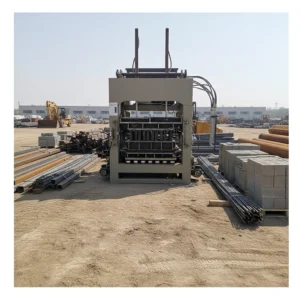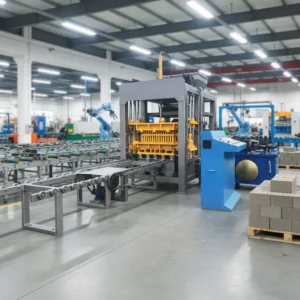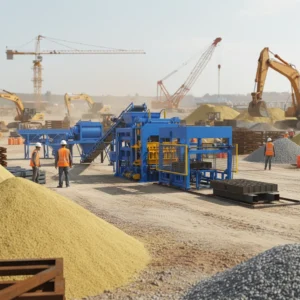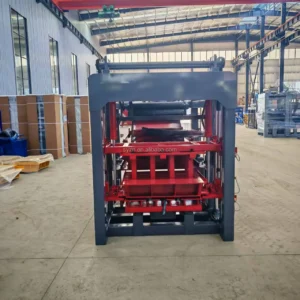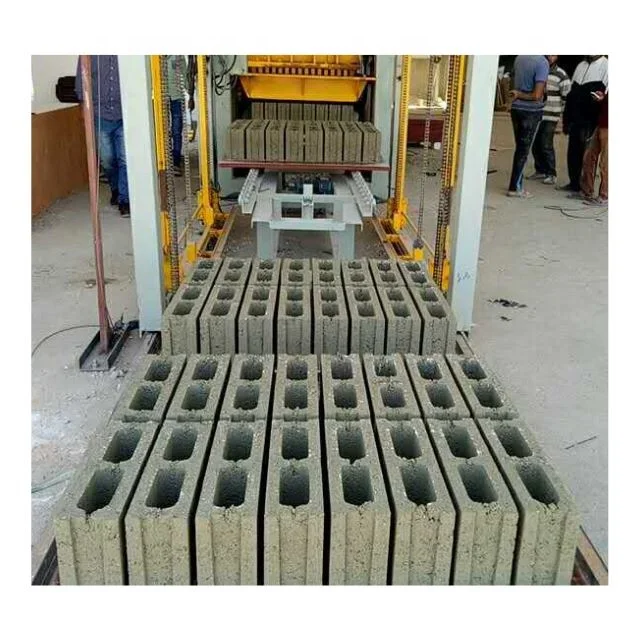
Matched Line Engineering — The QT5-15 block press is specified alongside material feeding, pallet circulation and stacking so every station holds the same cycle rhythm, preventing the press from idling while upstream or downstream equipment catches up.
Technical Specifications
| Parameter | Value |
|---|---|
| Product Type | Fully Automatic Concrete Block Making Machine |
| Overall Dimensions (L×W×H) | 7400×1950×2800 mm |
| Total Mass | 5000 kg |
| Overall Power | 32 kW |
| Vibration Form | Platform Vibration |
| Vibration Frequency | 0-60 Hz |
| Vibration Force | 80 kN |
| Moulding Mode | Automatic loading with vibration moulding |
| Demolding Method | Hydraulic |
| Hydraulic System | Independent integrated hydraulic station |
| Control System | PLC with touch screen interface |
| Pallet Size | 1100×550 mm |
| Molding Cycle | 15-20 s (basis not stated in source — confirm block format / material / thickness) |
| Output Capacity (Hollow block 400×200×200 mm) | 900-1200 pcs/h, 7200-9600 pcs/8hr |
| Output Capacity (Hollow block 400×150×200 mm) | 1080-1440 pcs/h, 8640-11520 pcs/8hr |
| Output Capacity (Solid brick 240×115×53 mm) | 5760-7680 pcs/h, 46080-61440 pcs/8hr |
| Output Capacity (Rectangular paver 200×100×60 mm) | 3600-4500 pcs/h, 28800-36000 pcs/8hr (cycle 20-25 s) |
| Output Capacity (Zigzag paver 225×112.5×60 mm) | 2304-2880 pcs/h, 18432-23040 pcs/8hr (cycle 20-25 s) |
| Block Compressive Strength | >15 MPa |
| Raw Material Compatibility | Fly ash (up to 70%), slag, gangue, sand, crushed stone, cement, water |
| Mould Change | Quick replacement for multi-format production |
| Automation Level | Fully automatic (pallet feeding, material feeding, vibrating, demoulding) |
| Electrical & Hydraulic Components | Imported or China famous brand |
| Factory Area Required | 1000 m² |
| Warranty | 1 year for whole machine (excluding spare parts) |
Application Suitability
| Application | Material or Output |
|---|---|
| Hollow block production for building walls | Crushed stone, sand, cement; fly ash blends up to 70% |
| Solid brick manufacturing for load-bearing structures | Sand, slag, gangue, cement mixes |
| Rectangular and zigzag paver production for roads and yards | Fine aggregate and cement at 20-25 s cycle |
| On-site block production for housing projects | Local aggregate with fly ash or slag substitution |
| Concrete product plants expanding format range | Multiple mould formats on a single automatic concrete block making machine production line |
Why Quoted Output Rarely Matches the First Month on Site
A capacity figure without a block format attached is not a capacity figure — it is a guess.
I have stood on job sites in West Africa and South Asia watching a QT5-15 host machine sit idle for four or five minutes between cycles, not because the press itself was slow, but because the mixer upstream could not deliver a fresh batch in time and the pallet return loop was still feeding boards from a curing rack that was too far away. The automatic concrete block making machine production line was rated for a certain hourly number on paper, yet the real daily count fell well short once the supporting equipment failed to hold pace [NEED_CITE: common causes of block line throughput loss in field conditions]. When you evaluate a line, the cycle time of every station must be checked against the press, not just the press alone.
How the Press Fits Inside the Full Line
The QT5-15 handles the forming stage — material feeding, vibration, hydraulic demoulding — inside a single PLC-controlled sequence. Before the press can start its next cycle, a fresh pallet must arrive from the return conveyor and a measured batch of mixed material must be waiting in the hopper. If either station is slower than the press cycle, the automatic concrete block making machine production line loses output every hour without any alarm ever sounding on the touch screen.
Where Cycle Time Mismatches Show Up First
The most common bottleneck I see is the pallet return path. Wet blocks travel on pallets to the curing area, and those pallets must come back clean and dry before the press can use them again. If the curing rack layout or the forklift schedule does not match the press output rate, pallets pile up at the far end and the press waits. Line planning must account for pallet travel distance, curing rack capacity, and the forklift cycle, not only the 15-20 second moulding window [NEED_CITE: pallet circulation planning for block production lines].
Reading the Numbers Behind the Output Table
The vibration force of 80 kN and the variable frequency range of 0-60 Hz work together to compact the mix inside the mould cavity. Higher frequency suits fine sand and fly ash blends, while coarser aggregate with crushed stone responds to lower frequency and longer vibration dwell. The PLC adjusts these parameters per mould, so switching from a 400×200×200 mm hollow block to a 200×100×60 mm rectangular paver changes both the vibration profile and the cycle length — from 15-20 seconds up to 20-25 seconds — which is why paver output figures carry a different hourly rate than hollow block figures.
The independent integrated hydraulic station sits apart from the main frame so that platform vibration and concrete dust do not reach the valve block and seals. This separation matters during long production runs where continuous vibration would otherwise accelerate wear on hydraulic fittings and cause pressure drift, leading to inconsistent demoulding force and cracked blocks leaving the press.
What Happens When Supporting Equipment Is an Afterthought
A quotation that covers only the press and leaves material feeding, mixing, pallet handling and stacking to be sourced separately creates hidden cost and hidden delay. The mixer may be too small to keep up, the pallet feeder may not match the 1100×550 mm pallet size, and the stacker may not handle the weight of a full curing rack load. Each mismatch shows up as lost output on the first week, and the buyer ends up spending more on-site fixing the gaps than the original equipment savings justified [NEED_CITE: hidden costs of unmatched block line equipment].
Why This Line Is Planned as One System
Block machinery is our single focus, so the press, mould, pallet and handling equipment are specified as one matched set rather than assembled from separate suppliers. Every configuration is checked against your actual mix design, local aggregate and target block format, not pulled from a catalogue default. Mould design covers the formats your market actually sells, with custom drawings available for special shapes. The automation level is selectable, so a buyer can begin with semi-automatic pallet handling and add automatic stacking later without replacing the press. Installation and commissioning support includes operator training on the PLC interface and hydraulic system so the crew can run the line independently from day one.
Documentation & Verification
- Line layout and capacity calculation stating the exact block format assumed for each output tier
- Machine specification sheet covering the QT5-15 press, hydraulic station and PLC parameters
- Mould drawing and format list matching your market’s hollow block, solid brick and paver dimensions
- Pallet specification matched to your curing area dimensions and existing forklift capacity
- Voltage, frequency and PLC display language confirmation signed before production begins
- Factory test record on your chosen block format before dispatch
Installation, Commissioning & Support
- Factory area of 1000 m² required with level concrete floor and drainage for wash-down
- 32 kW total power needs a dedicated circuit with voltage and frequency confirmed before wiring
- Machine ships dismantled to fit container loading; reassembly guided by the hydraulic and electrical schematic
- PLC touch screen configured to your operator language before the first production run
- Mould change training so your crew can switch formats within a single shift
- Wear parts and mould list supplied with the manual for first-year maintenance planning
What to Share Before Requesting a Quotation
To size the supporting equipment around the QT5-15, we need your target block formats and daily output, the raw materials available locally including aggregate type and any fly ash or slag substitution, and the dimensions of your site and curing area. Please also confirm the local voltage and frequency supply, the PLC language your operators require, and whether existing mixers, forklifts or pallet racks will be integrated into the line.
Frequently Asked Questions
Q: How is daily output calculated and which block format is assumed?
A: Every output figure in the specification table states the block format and dimensions it applies to. For example, the 900-1200 pieces per hour rate is based on a 400×200×200 mm hollow block. Daily figures assume an eight-hour production shift. Paver cycles run longer at 20-25 seconds, so paver hourly rates are lower. Always match the capacity line to the format you plan to produce most.
Q: Which supporting equipment stations are included in the line scope?
A: The full line covers raw material feeding, mixing, pallet feeding, the QT5-15 press, automatic stacking, curing rack handling and cubing. Each station’s cycle time is checked against the press so no single point slows the line. The quotation clearly lists which stations are included and which are buyer-supplied, leaving no gap to discover on arrival.
Q: How is pallet size selected to fit the curing area and forklift?
A: The standard pallet for the QT5-15 measures 1100×550 mm, but the selection must account for your curing rack spacing and the forklift tine width already on site. We confirm these dimensions during line layout so pallets move from press to curing rack and back without manual repositioning or fork damage.
Q: What electrical and control details are confirmed before shipment?
A: Voltage, frequency and PLC touch screen language are confirmed in writing before production starts. This prevents commissioning delays where the motor rotation is wrong or the operator cannot read the interface. The electrical schematic is supplied so your electrician can prepare the site panel before the container arrives.
Q: How does the line layout keep feeding and stacking in pace with the press?
A: The layout starts from the press cycle time and works outward. The mixer batch size and discharge rate are matched so a fresh mix arrives before the hopper empties. The pallet return conveyor length and curing rack distance are calculated so empty pallets reach the feeder within the molding cycle. Stacking speed is set to clear wet blocks before the next demoulding stroke.