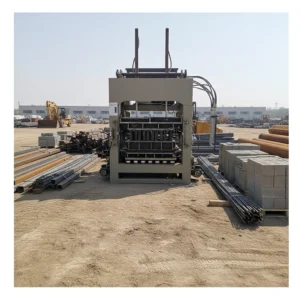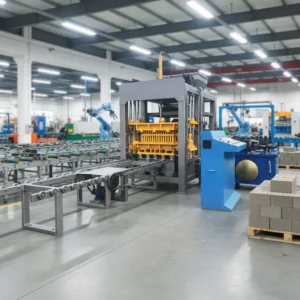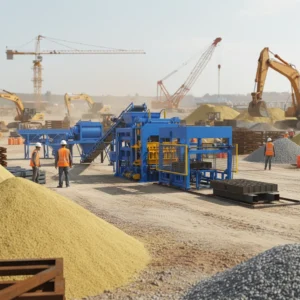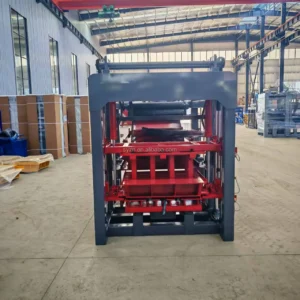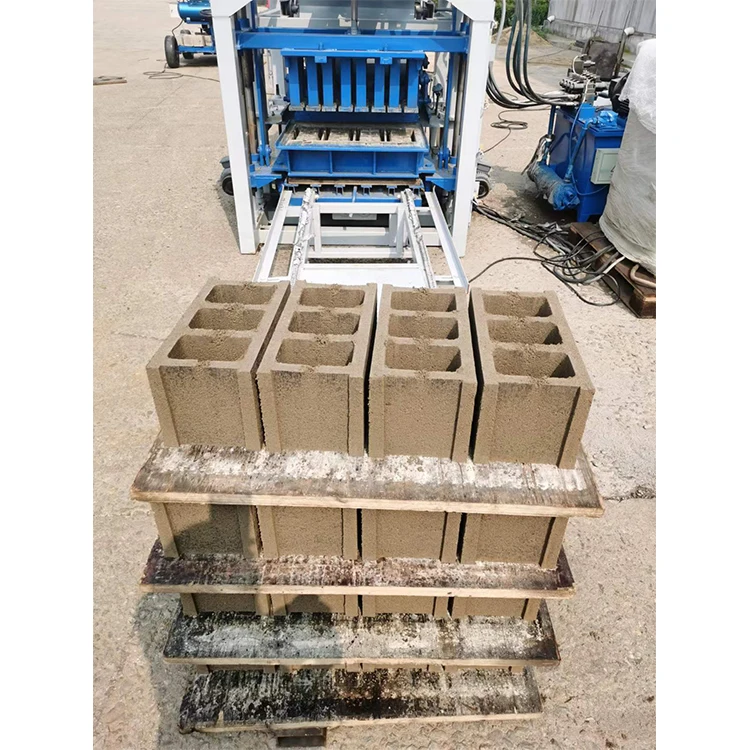
Line-Wide Coordination — the QT4-15A stations are timed against the press cycle so the host machine is never left idle waiting for upstream material or downstream pallet clearance.
Technical Specifications
| Parameter | Value |
|---|---|
| Model | QT4-15A |
| Product Type | Fully Automatic Concrete Block Production Line |
| Overall Dimensions | 7100 × 1600 × 2610 mm |
| Molding Cycle | 15–25 s |
| Vibration Frequency | 4600 r/min |
| Vibration Force | 40–50 kN |
| Total Power | 18.45 kW |
| Mixer Model | JQ350 |
| Pallet Size | 850 × 550 × 25 mm |
| Total Weight | 3 T |
| Hydraulic Station | High-pressure hydraulic system included |
| Control System | PLC control system |
| Output Capacity (Hollow Block 400×200×200 mm) | 408 pcs/h, 3264 pcs/8hr |
| Output Capacity (Hollow Block 400×150×200 mm) | 510 pcs/h, 4080 pcs/8hr |
| Output Capacity (Solid Brick 240×115×53 mm) | 2100 pcs/h, 17000 pcs/8hr |
| Included Equipment | Block making machine, hydraulic station, PLC control system, pallet feeder, brick conveyor, block sweeper |
| Free Accessories | Manual hydraulic trolley, spare parts and tools |
Application Suitability
| Application | Material or Output |
|---|---|
| Hollow block production for wall construction | Crushed stones, sand, cement, fly ash |
| Solid brick manufacturing for masonry | Sand, cement, dust, crushed aggregate |
| Paver production for walkways and yards | Crushed stones, cement, fine aggregate |
| Curbstone forming for road edging | Coarse aggregate, cement, sand |
What "Fully Automatic" Should Actually Cover on a Concrete Block Production Line Turnkey
A genuine line specification accounts for every station between raw material intake and finished block output, not just the press.
Many quotations describe the block machine in detail and then treat pallet feeding, block conveying, and surface sweeping as optional extras the buyer is expected to source locally. When the pallet feeder cycle does not align with the press molding time, the host machine sits idle for seconds per cycle — losses that compound across a full shift. The QT4-15A concrete block production line turnkey scope defines each station and its timing relationship to the press up front [NEED_CITE: line station synchronization in automated block plants].
Station Timing from Mixer Through Conveyor
Every concrete block production line turnkey setup lives or dies on whether the upstream mixer delivers material at the rate the press consumes it. The JQ350 mixer paired with the QT4-15A is sized to keep the host hopper replenished across the 15–25 second molding cycle range. If the mixer batch time exceeds the press consumption rate, the press waits and daily output drops regardless of the rated cycle speed.
Pallet Feeder and Conveyor Integration
The pallet feeder places production pallets into the press at a rate matched to the molding cycle, while the brick conveyor removes loaded pallets before the next cycle begins. The block sweeper cleans the pallet return path so residual concrete does not build up and interfere with seating accuracy. Together these stations form a closed loop around the press that maintains consistent pacing throughout a shift [NEED_CITE: pallet circulation requirements in automatic block lines].
Reading the Specification Sheet Against Actual Production
Vibration force of 40–50 kN at 4600 r/min provides the compaction energy needed to consolidate the mix within the mold cavity, while the high-pressure hydraulic system supplies the clamp and ejection force that shapes the block. The 850 × 550 × 25 mm pallet size determines how many blocks fit per cycle — the quoted output figures of 408 pcs/h for 400×200×200 mm hollow blocks and 2100 pcs/h for 240×115×53 mm solid bricks are both based on this pallet format. Total installed power of 18.45 kW across all stations must be confirmed against the site electrical supply, including voltage and frequency, before production begins.
When Stations Are Not Matched
A press rated at a fast cycle time produces nothing if the pallet feeder cannot keep up or the conveyor cannot clear loaded pallets in time. Mismatched station speeds lead to the press cycling at a fraction of its capability while the operator watches idle time accumulate. Inconsistent pallet seating also causes uneven block height across the mold, creating rejects that further reduce effective output [NEED_CITE: bottleneck effects in multi-station block production].
Why Line Configuration Matters at This Scale
Block machinery is our single focus, so the QT4-15A press, mixer, pallet feeder, conveyor, and sweeper are specified as one matched system rather than assembled from separate suppliers. Line layout drawings show each station position and material flow path before the order is confirmed. The PLC control system coordinates station sequencing, and voltage and display language are confirmed before production to avoid commissioning delays on arrival. Capacity calculations state output per block format — not a single headline number — so daily planning reflects the format your market actually buys. Installation support covers station alignment, PLC parameter setting, and operator training on the full line sequence.
Documentation & Verification
- Line layout drawing showing station positions and material flow for the QT4-15A configuration
- Capacity calculation sheet stating output per block format with pallet size assumptions
- PLC control language and voltage confirmation document signed before production
- Factory test record on the buyer’s target block format before dispatch
- Hydraulic and electrical schematic for the complete line including all stations
Installation, Commissioning & Support
- Foundation plan based on the 7100 × 1600 mm press footprint and 3 T total weight
- Electrical supply confirmation for 18.45 kW total line power at site voltage and frequency
- Station-by-station commissioning with PLC cycle timing verified on the buyer’s block format
- Operator training covering pallet feeder loading, mixer batching, and conveyor clearance routines
- Wear parts list with reorder intervals for hydraulic seals and mold contact surfaces
Before You Send the Inquiry
To configure the QT4-15A line correctly, share the block formats your market sells, the target daily output per format, and the raw materials available locally including aggregate grading. Confirm your site voltage, frequency, and preferred PLC display language. If you have existing curing racks or forklifts, provide the pallet dimensions they accept so the line pallet size can be verified against your handling equipment.
Frequently Asked Questions
Q: Which stations are included in the QT4-15A line scope, and how are cycle times coordinated?
A: The line includes the block making machine, JQ350 mixer, high-pressure hydraulic station, PLC control system, pallet feeder, brick conveyor, and block sweeper. Station cycle times are matched to the 15–25 second press molding range so no single station bottlenecks the line. A layout drawing confirms each station position before order confirmation.
Q: How is output capacity calculated for different block formats?
A: Output is stated per format based on the 850 × 550 mm pallet: 408 pcs/h for 400×200×200 mm hollow blocks, 510 pcs/h for 400×150×200 mm hollow blocks, and 2100 pcs/h for 240×115×53 mm solid bricks. Each figure assumes continuous operation with matched upstream and downstream station timing.
Q: What voltage and PLC language options are available for export markets?
A: Voltage and frequency must be confirmed before production to match the buyer’s site electrical supply. PLC display language is specified at order stage so operators can read the interface on arrival. Both parameters are documented in a signed confirmation sheet before manufacturing begins.
Q: Is stacking automatic or manual on this line configuration?
A: The QT4-15A includes a brick conveyor that transports loaded pallets from the press. Stacking method depends on the automation level selected — confirm whether manual pallet handling or automatic stacking is required when requesting the line quotation so the downstream configuration matches your labor plan.
Q: What does installation and commissioning cover for the full line?
A: Installation covers station positioning, mechanical alignment, electrical connection of the 18.45 kW total system, and PLC parameter setup. Commissioning includes test runs on the buyer’s target block format using local raw materials. Operator training covers daily startup, mold exchange procedures, and routine maintenance intervals for hydraulic and vibration components.