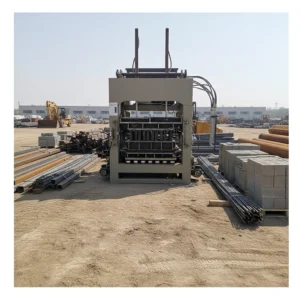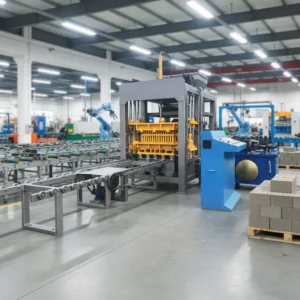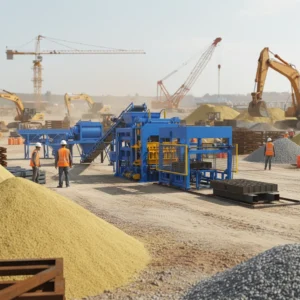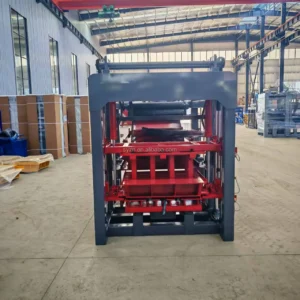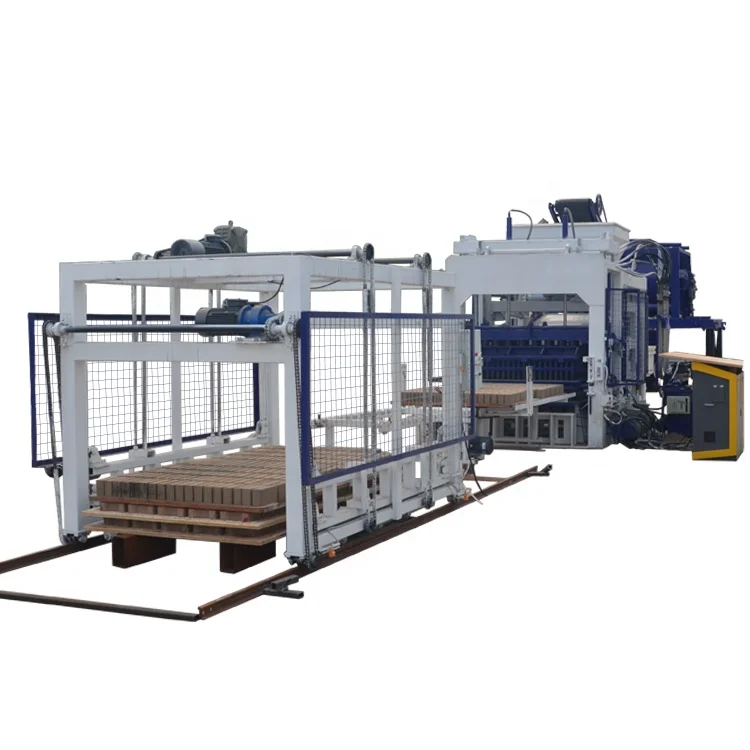
Matched System Sizing — every station from raw material feed to cubing is balanced against the 15–30 second press cycle so no upstream or downstream bottleneck starves the line.
Technical Specifications
| Parameter | Value |
|---|---|
| Model | QT12-15 |
| Product Type | Fully Automatic Concrete Block Making Machine |
| Total Power | 62 kW |
| Pallet Size | 1300×900 mm |
| Moulding Cycle | 15–30 seconds (basis not stated in source — confirm block format / material / thickness) |
| Vibration Type | Table vibration (dynamic and static table + frequency conversion technology) |
| Vibration Acceleration | 20g |
| Vibration Force | 120 KN |
| Voltage | Customized to local industrial supply |
| Control System | To be confirmed (PLC brand and display language) |
| Mould Configuration | Customized to buyer’s block format |
| Automation Level | Fully automatic |
| Applications | Hollow blocks, solid blocks, paving blocks, kerbstones, interlocking bricks, porous bricks, slope protection bricks, fly ash bricks |
| Standards | CE declaration available upon confirmation |
Application Suitability
| Application | Material or Output |
|---|---|
| High-capacity hollow block plants | Crushed stone, sand, cement, fly ash blends |
| Paving block and kerbstone production | Dense aggregate mixes with colour face layer |
| Interlocking and porous brick lines | Lightweight aggregate or fly ash–cement ratios |
| Fly ash brick manufacturing | Fly ash, lime, gypsum, sand composite mixes |
| Slope protection and retaining wall units | Coarse aggregate with high cement content |
Why the Supporting Equipment Determines Your Real Daily Output
A press rated in cycles per hour only delivers that rate when the entire block production line equipment around it is timed to match.
I have walked onto sites where a high-output press sat idle for minutes each cycle because the pallet return conveyor could not clear finished blocks fast enough, or the mixer could not deliver a fresh batch before the hopper ran dry. The crew stood around, the daily tally fell well short of the brochure figure, and the owner blamed the press. In most cases the press was fine — the block production line equipment feeding it and clearing its output was undersized or uncoordinated [NEED_CITE: common causes of block plant throughput loss]. When every station from raw material batching through stacking is specified as one system against the same cycle target, the press runs at the tempo it was designed for.
Raw Material Batching and Mixing Matched to Press Cadence
The QT12-15 completes a moulding cycle in 15–30 seconds depending on block format and mix density. The mixer upstream must deliver a homogenous batch within that same window, or the press hopper starves and the cycle stretches. We size the mixer drum volume, conveyor belt speed, and aggregate bin gates so that a full charge arrives before the press calls for it. Supporting equipment for block plant starts here — if the mix is late or inconsistent, every downstream station feels the delay and block quality varies from batch to batch.
Pallet Circulation, Stacking and Curing Rack Handling
A 1300×900 mm pallet leaving the press every 15–30 seconds means dozens of loaded pallets per hour need to move to the curing area without manual lifting. The pallet return conveyor must clear the press table before the next mould drops, and the automatic stacker must cube finished blocks at the same tempo. We configure pallet feeding, elevator conveyors, and curing rack spacing to the same pallet dimensions and cycle rhythm, so the supporting equipment for block plant never forces the press to wait [NEED_CITE: pallet handling bottleneck analysis in block plants].
Reading the Numbers That Actually Matter on Site
The 62 kW total power rating covers the press motors and should inform electrical load planning for the full line — mixer, conveyors, stacker, and hydraulic power unit all draw from the same supply. If the site transformer is sized for the press alone, the supporting motors will trip breakers under load. The table vibration system uses dynamic and static tables with frequency conversion, which means the vibration profile can be tuned to the mix arriving from the batching station; a fly ash mix needs a different frequency and amplitude than a dense crushed-stone paving mix. Vibration acceleration at 20g and vibration force at 120 KN set the compaction energy available, but block density and strength only hold consistent when the mix design and aggregate grading are locked in first. The moulding cycle window of 15–30 seconds must be confirmed against the specific block format and thickness you intend to run — quoting a single cycle figure without that context is the fastest way to overpromise on daily output.
When One Undersized Station Takes Down the Whole Line
A buyer who specs only the press and sources pallet conveyors, mixers, and stackers locally often discovers that the third-party equipment runs on different cycle timers, incompatible pallet dimensions, or mismatched voltage phases. The result is chronic micro-stoppages — a jammed pallet here, a dry hopper there — that shave hours off weekly throughput without triggering any single alarm. The supporting equipment for block plant is not a commodity add-on; it is the system that lets the press do what it was built to do [NEED_CITE: impact of line integration on block plant availability].
Why Sourcing the Full Line from One Supplier Changes the Outcome
Block machinery is our single focus, so the QT12-15 press, moulds, pallets, and handling equipment are specified as one matched system rather than assembled from separate vendors. Configuration is set against your actual mix design, local aggregate, and target block format — not a catalogue default. Mould design covers the formats your market sells, with custom drawings available when standard formats do not fit. Automation level is selectable, meaning a buyer can start with semi-automatic pallet handling and upgrade the stacking and cubing stations later without replacing the press. Installation and commissioning support covers the entire line from raw material infeed to cubed output, with operator training included.
Documentation & Verification
- Line layout drawing showing every station from feeding to cubing with capacity stated per block format
- Pallet specification sheet matched to your curing rack dimensions and forklift capacity
- Voltage, frequency, and PLC display language confirmation for every motor on the line
- Factory test record covering the complete line run, not the press in isolation
- Hydraulic and electrical schematics for press and all supporting stations
- Operation and maintenance manual with wear parts and mould cross-reference list
Installation, Commissioning & Support
- Foundation plan accounts for 62 kW total load distribution and vibration isolation across press and mixer stations
- Voltage and frequency confirmed for all line motors before shipment to avoid on-site rewiring delays
- Pallet conveyor sections shipped pre-assembled to reduce on-site welding around the 1300×900 mm pallet path
- Commissioning covers full line run from batch weigh hopper through stacker, not the press alone
- Operator training includes mould change procedure and PLC fault diagnosis across every station
- Wear parts list covers press and supporting equipment items with first-order quantities specified
What to Include in Your Inquiry
Share the block formats you sell today and plan to add, along with your target daily output per format. Tell us the local aggregate types and cement or fly ash sources available at your site, plus the curing area dimensions and forklift capacity you already operate. Confirm your site voltage and frequency, the PLC display language your operators need, and whether you want pallet handling and stacking included or will source those locally.
Frequently Asked Questions
Q: How is cycle time matched across the mixer, pallet feeder, press, and stacker so no station idles?
A: We calculate the press cycle for your specific block format, then size the mixer drum volume, conveyor belt speed, and pallet return path so each station completes its task within that same window. If the mixer delivers late or the stacker clears slowly, the press waits — so every motor and timer is set against one shared cycle target.
Q: What pallet size and material should I choose given my curing area and forklift?
A: The QT12-15 runs on 1300×900 mm pallets. We confirm whether your curing racks, fork pockets, and forklift tine spacing already match that size before the line ships. Pallet material — timber, steel, or composite — is then chosen based on your local climate and expected handling cycles.
Q: Which voltage and frequency apply to every motor on the line, not just the press?
A: The 62 kW total load covers the press, but the mixer, conveyors, stacker, and hydraulic unit each have their own motors. We confirm voltage and frequency for every station before production so that a single transformer mismatch does not hold up commissioning when the equipment arrives [NEED_CITE: industrial voltage and frequency standards by region].
Q: How do I verify daily output per block format rather than per abstract cycle count?
A: We provide a capacity calculation that states the moulding cycle for each specific block format and thickness you plan to run, then multiplies by available production hours minus mould change and maintenance time. That gives a realistic daily figure you can plan shifts and raw material orders around.
Q: What does the commissioning scope cover — press only or the full line from feeding to cubing?
A: Commissioning covers the complete line: raw material batching accuracy, mixer output consistency, pallet feed alignment, press cycle tuning, stacker timing, and curing rack loading. We run the entire sequence together and train operators on each station before sign-off.