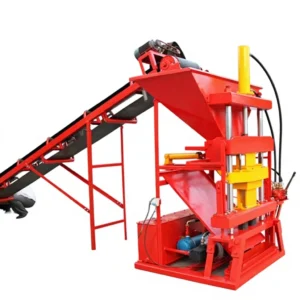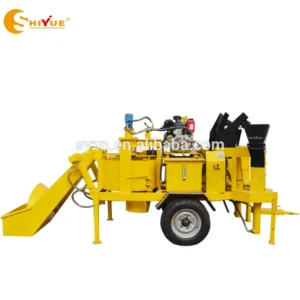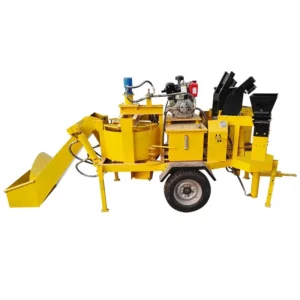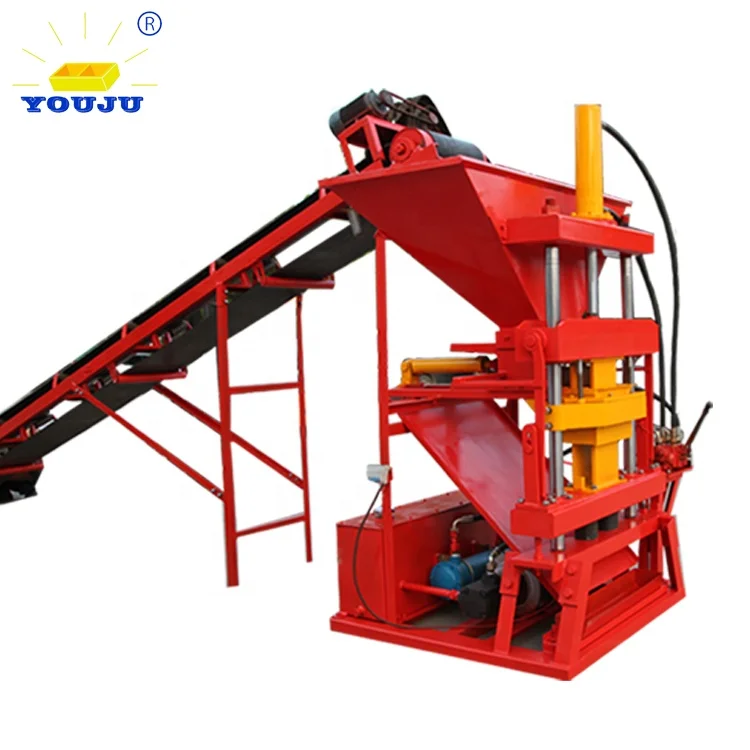
Balanced Line Integration — every upstream mixer, pallet feeder and curing rack is sized to the ECO 2700’s 10-second cycle so no station idles while the press waits.
Technical Specifications
| Parameter | Value |
|---|---|
| Model | ECO 2700 |
| Product Type | Hydraulic Clay Interlocking Brick Machine |
| Rated Power | 7.5 kW electric motor or 12 hp diesel engine |
| Hydraulic Pressure | 16 MPa |
| Molding Cycle | 10 s |
| Output Capacity | 2800 pcs / 8 h (basis not stated in source — confirm block format and material) |
| Raw Materials | Clay, soil, earth, mud, concrete, sand, cement, fly ash |
| Machine Weight | 900 kg |
| Overall Dimensions (L×W×H) | 1600 × 1300 × 2330 mm |
| Labor Requirement | 3–4 workers |
| Water Consumption | 4 t / day |
| Workshop Area | 150 m² |
| Automation Level | Automatic material feeding, mould pressing and mould lifting |
Application Suitability
| Application | Material or Output |
|---|---|
| On-site housing project brick production | Local clay and soil with cement stabilization |
| Small-plant interlocking brick manufacturing | Earth, mud and sand mixes with varying plasticity |
| Format diversification for existing concrete producers | Interchanging moulds for blocks, bricks and pavers on one press |
| Rural and remote infrastructure builds | Diesel-powered operation where grid supply is unreliable |
What a "2800 Bricks per Day" Claim Leaves Out of a Clay Interlocking Brick Line
Real daily throughput only holds when every station around the press is timed to the same cycle.
Capacity numbers quoted without naming the exact brick format, mould cavity count and mix design set buyers up for disappointment once the line is running. A hydraulic clay interlocking brick machine production line rated at a certain output on a 300×150×100 mm brick will produce far fewer pieces if the buyer switches to a larger format, yet the quotation rarely reflects that shift. I have watched lines sit half-idle because the mixer discharged batches too slowly for the press cycle, or pallets piled up at the curing end with nowhere to go [NEED_CITE: line balancing principles for block production].
Synchronizing the Mixer Discharge with the Press Cycle
The ECO 2700 completes a moulding cycle every 10 seconds, which means the upstream mixer must deliver a fresh batch of prepared clay or soil mix at intervals that match this rhythm. If the mixer batch size is too large, the material sits and begins to stiffen before the press is ready; if too small, the press waits between cycles and the hydraulic clay interlocking brick machine production line loses throughput. Proper line layout specifies the mixer drum volume and discharge gate timing against the press hopper capacity so material flows continuously without manual intervention.
Pallet Circulation and Curing Rack Alignment
Downstream of the press, each moulded brick sits on a pallet that must travel through the curing area and return to the feed station within the overall cycle window. The pallet size, circulation speed and curing rack capacity are all calculated from the 10-second press interval and the total number of pallets in the loop. When the curing area is undersized or the return conveyor runs slower than the press output, pallets back up and operators begin stacking wet bricks by hand — exactly the bottleneck a matched line is designed to prevent [NEED_CITE: pallet handling standards in block production].
Reading the Specifications That Matter on Site
Hydraulic pressure at 16 MPa is the force that compresses the clay or soil mix inside the mould cavity, and its effectiveness depends on how well it pairs with the vibration profile and the moisture content of the local material. A higher pressure does not automatically yield stronger bricks if the mix is too dry to consolidate; conversely, a wetter mix may require lower pressure to avoid extrusion flash. The 900 kg machine weight provides a stable base that resists the upward thrust during each pressing stroke, reducing the need for heavy foundation work in a compact 150 m² workshop. Power options — a 7.5 kW electric motor or a 12 hp diesel engine — let buyers match the drive to their site conditions, whether grid-connected or operating in areas with unreliable electricity. Automatic material feeding, mould pressing and mould lifting reduce manual handling steps, meaning the three to four workers on the line can focus on quality checks and pallet management rather than repetitive lever operation.
The Cost of Skipping Line Integration Checks
When a buyer purchases the press alone and sources the mixer, pallets and curing racks separately, mismatched cycle times surface only after installation. I have seen projects where the mixer output was rated for a different material density, causing the press hopper to overflow on one batch and starve on the next. Pallets ordered to a catalogue default size may not fit the forklift tines already in the buyer’s yard, forcing a costly replacement before the first production run [NEED_CITE: common commissioning delays in block plant projects]. Voltage and frequency assumptions left unconfirmed can stall the entire line at the control panel, leaving a brand-new press sitting idle while transformers or variable-frequency drives are sourced locally.
Why Sourcing the Full Line from One Supplier Matters Here
Block machinery is the single focus of this operation, which means the ECO 2700, its moulds, pallets and handling equipment are specified together rather than assembled from separate vendors. Configuration starts with the buyer’s actual clay sample and target brick format, not a catalogue default — I always ask clients to send local soil before finalizing hydraulic parameters, because red laterite behaves nothing like the standard sand-clay blend used in factory testing. Mould design covers the interlocking formats the buyer’s market actually demands, and custom drawings are available when standard profiles do not match. Automation level is selectable, so a buyer can begin with the automatic feeding and pressing functions included in the ECO 2700 and add upstream batching or downstream cubing as production volume grows. Installation support includes on-site commissioning with operator training, ensuring the line runs at its intended rhythm from the first shift.
Documentation & Verification
- Line layout showing capacity calculation tied to the specific interlocking brick format ordered
- Hydraulic and electrical schematics with confirmed voltage, frequency and control language
- Mould drawing and format list so first changeover is planned before the line ships
- Factory test record run on the buyer’s submitted soil sample at target moisture content
- Pallet specification sheet matched to curing area dimensions and existing forklift capacity
Installation, Commissioning & Support
- Workshop floor must accommodate the 1600 × 1300 mm machine footprint plus pallet circulation path within 150 m²
- Electrical supply verified for 7.5 kW motor draw or diesel engine mounting before commissioning day
- Hydraulic system filled and pressure set to 16 MPa against the buyer’s confirmed mix design
- Mould installed and test cycle run with local clay sample to validate brick density and dimensions
- Operator training covers automatic feeding, pressing and lifting sequences for the three to four person crew
- Wear parts list and mould maintenance schedule provided at handover for planned replacements
What to Include in Your Inquiry
Send your target interlocking brick dimensions, the daily volume you need to sustain, and a sample of the local clay or soil you plan to use. Include your workshop dimensions and ceiling height, along with the voltage and frequency available on site. If you already have pallets, forklifts or a curing yard in place, share those specifications so the line is configured around your existing assets rather than a generic layout.
Frequently Asked Questions
Q: How is the daily output of the ECO 2700 verified and which brick format is it based on?
A: The stated capacity of 2800 pieces per 8-hour shift is tied to a specific brick size and mould cavity count, which must be confirmed against your chosen interlocking format. We run a factory test using your submitted soil sample and document the actual cycle count, so the figure you receive reflects your product, not a generic catalogue number.
Q: How do upstream mixer batch size and downstream pallet feed speed stay matched to the 10-second press cycle?
A: The mixer drum volume and discharge timing are calculated so each batch arrives at the press hopper just as the previous cycle completes. Downstream, the number of pallets in circulation and the curing rack return speed are set to absorb the press output without backlog, keeping the hydraulic clay interlocking brick machine production line running at steady rhythm.
Q: Which voltage, frequency and control language are confirmed before the line ships?
A: Before production begins we confirm the buyer’s supply voltage and frequency, along with the preferred language for any control interface labels and documentation. This prevents commissioning delays caused by incompatible electrical components or unreadable panel markings once the equipment arrives on site.
Q: What curing area, pallet type and forklift spec does the line assume?
A: Pallet size and material are selected based on the buyer’s existing curing yard dimensions and forklift tine spacing, not a default catalogue size. The line layout specifies how many pallets are needed in the loop to sustain continuous production within the available 150 m² workshop and curing footprint.
Q: How are mould change time and format flexibility built into the line layout?
A: The interchangeable mould system is positioned so that changeover tools and lifting points are accessible without disrupting adjacent stations. The line layout accounts for the expected format change frequency, ensuring that switching between interlocking brick profiles does not cancel out the flexibility the buyer invested in.