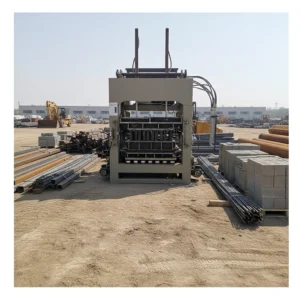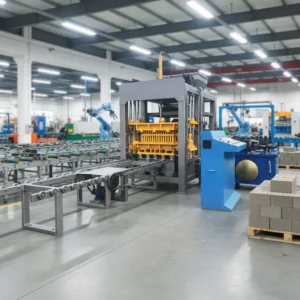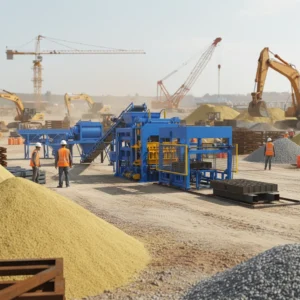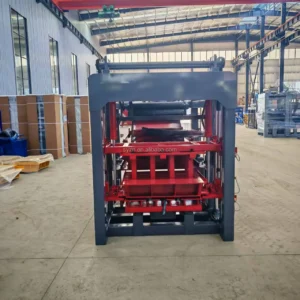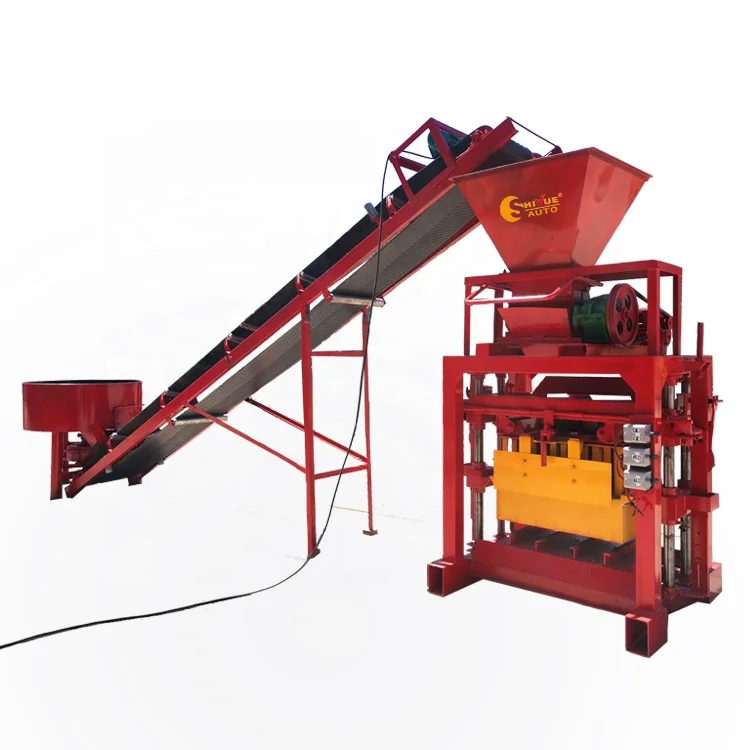
Specified as a matched line — the QTJ4-35 block machine, mixer, and pallets are configured together so cycle times align and the press is never left waiting for material or manual pallet handling.
Technical Specifications
| Parameter | Value |
|---|---|
| Model | QTJ4-35 |
| Product Type | Concrete Block Making Machine |
| Overall Dimensions (L×W×H) | 1350×1460×1800 mm |
| Molding Cycle | 35 s |
| Vibration Frequency | 2800 r/min |
| Vibration Force | 30 kN |
| Total Power | 11.15 kW |
| Mixer Model | JQ350 |
| Pallet Size | 850×450×20 mm |
| Net Weight | 1500 kg |
| Applied Products | Concrete hollow blocks (8 inch, 6 inch), solid bricks |
| Raw Materials | Crushed stone, sand, cement, dust, fly ash |
| Output Capacity | 408 pcs/h (based on 400×200×200 mm hollow block, 4 pcs/mould) |
| Output Capacity | 510 pcs/h (based on 400×150×200 mm hollow block, 5 pcs/mould) |
| Output Capacity | 2100 pcs/h (based on 240×115×53 mm solid brick, 18 pcs/mould) |
| Daily Output | 3264 pcs/8 hr (based on 400×200×200 mm hollow block) |
| Daily Output | 4080 pcs/8 hr (based on 400×150×200 mm hollow block) |
| Daily Output | 17000 pcs/8 hr (based on 240×115×53 mm solid brick) |
| Voltage & Frequency | Configurable to buyer market (basis to be confirmed) |
| Control System | Semi-automatic / manual pallet handling |
Application Suitability
| Application | Material or Output |
|---|---|
| Small-scale block plant startups | Fly ash, sand, and cement mixes for 8 inch and 6 inch hollow blocks |
| On-site housing project production | Crushed stone and cement for solid bricks and structural hollow blocks |
| Product range expansion for existing manufacturers | Solid bricks and interlocking formats using local aggregate blends |
| Limited-grid rural production sites | Low total power demand for basic hollow block and brick runs |
Why the Block Machine Supporting Equipment Often Gets Left Out of the Quote
A press without a specified mixer feed rate and pallet handling plan will spend half its shift idle or stacking output by hand.
Many buyers focus entirely on the press cycle time, only to discover that the quotation did not include the JQ350 mixer, pallets, or curing rack handling. The concrete block making machine production line then becomes a bottleneck rather than the solution. Pallet handling, stacking, and curing are frequently omitted, leaving workers to move heavy 850×450 mm pallets manually. This not only slows the line but introduces inconsistency in block density and curing quality. [NEED_CITE: typical block plant line integration requirements for semi-automatic setups]
Synchronizing the JQ350 Mixer with the 35-Second Press Cycle
The core of any reliable block machine supporting equipment setup is ensuring the mixer can discharge a fresh batch before the press completes its current mould. With a 35-second molding cycle, the JQ350 mixer must maintain a continuous feed of fly ash, sand, and cement to prevent the press from waiting. If the mixer throughput lags, the entire concrete block making machine production line stalls, dropping actual daily output well below the rated figures.
Pallet Size and the Reality of the Curing Area
The 850×450×20 mm pallet size dictates more than just the mould footprint; it determines the layout of the entire curing yard. Plant owners must ensure their existing forklifts and curing racks are compatible with these dimensions. If the block machine supporting equipment is specified without considering the buyer’s current site conditions, pallets may pile up on the floor, blocking access and creating safety hazards. [NEED_CITE: pallet handling logistics and curing yard layout planning]
Vibration Force and Mix Density Alignment
The 30 kN vibration force at 2800 r/min is specifically tuned for the fly ash and sand mixes common in small-scale plants. Vibration must be matched to the local aggregate and mix design; too little force and the hollow blocks lack structural integrity, too much and the mix segregates. This balance is critical for achieving consistent wall thickness in 8 inch and 6 inch blocks. The total power of 11.15 kW keeps utility demands manageable for sites with limited grid capacity, a common constraint in rural or developing market projects.
The Cost of Ignoring Line Integration
When the concrete block making machine production line is treated as a standalone press purchase, the hidden costs emerge quickly. Mould changeovers take longer without the correct tools, and manual pallet handling leads to higher breakage rates in green blocks. The lack of a coordinated block machine supporting equipment plan often means the buyer must source mixers, conveyors, and pallets separately, resulting in mismatched cycle times. [NEED_CITE: common causes of downtime in small-scale block production lines]
Configuration Based on Actual Site Conditions
We specify the QTJ4-35 not just as a press, but as a node within a larger material flow. The JQ350 mixer is paired to match the 35-second cycle, and pallet specifications are confirmed against the buyer’s curing area. Voltage and frequency are verified before production to ensure the 11.15 kW motor and control systems match the local grid. This prevents the common delay where a machine arrives on site but cannot be commissioned due to electrical mismatches.
Documentation & Verification
- Line layout and capacity calculation stating the block format assumed for each output figure.
- Pallet specification matched to the buyer’s existing curing area and forklift dimensions.
- Voltage, frequency, and control language confirmation sheet before production begins.
- Factory test record covering JQ350 mixer throughput and press cycle synchronization.
- Operation and maintenance manual detailing vibration spring and mould bolt inspection intervals.
- Wear parts and mould list including part numbers for rapid reorder.
Installation, Commissioning & Support
- Foundation plan accounting for the 1500 kg net weight and vibration isolation requirements.
- Electrical schematic for the 11.15 kW total power load and dedicated circuit breaker sizing.
- Assembly guidance for the 1350×1460×1800 mm overall dimensions in compact workshops.
- Initial parameter setting for the 2800 r/min vibration frequency based on your specific mix design.
- Operator training focused on manual pallet handling safety and mould change procedures.
- Spare parts kit including vibration springs and mould紧固 bolts to prevent early stoppages.
- Maintenance schedule for the JQ350 mixer gearbox and drive belt tension checks.
What We Need to Configure Your Line
To ensure the block machine supporting equipment matches your site, please provide the target block formats you intend to produce daily. We also require details on your local raw material availability, specifically the type of aggregate and fly ash, as well as the voltage and frequency standard in your region. Finally, a sketch of your available floor space and curing yard helps us finalize the pallet handling layout.
Frequently Asked Questions
Q: How is daily output calculated, and which block format does each figure assume?
A: Daily output figures are always tied to a specific block size and the number of cavities in the mould. For the QTJ4-35, the 3264 pieces per 8-hour shift assumes a 400×200×200 mm hollow block with 4 cavities, while the 17000 pieces per 8-hour shift assumes a 240×115×53 mm solid brick with 18 cavities. We provide a capacity calculation sheet that clearly states the format and cycle time used for every projection.
Q: Does the quotation include the mixer, pallets, and curing rack handling, or only the press?
A: Our proposals for the concrete block making machine production line include the JQ350 mixer and the initial set of 850×450×20 mm pallets. Curing rack handling and automatic stacking are optional configurations depending on your automation level preference. We always clarify which block machine supporting equipment is included so there are no surprises when the shipment arrives.
Q: How does the 850×450 mm pallet size affect my curing area and forklift requirements?
A: The pallet size dictates the racking system and the forklift tine spacing needed for efficient movement. If your existing curing racks are designed for different dimensions, you may need to modify the racking or source compatible pallets. We verify these dimensions during the proposal stage to ensure the block machine supporting equipment integrates with your current site infrastructure without requiring major civil work changes.
Q: Can the line be configured for the fly ash and aggregate available at my site?
A: Yes, the 30 kN vibration force and 2800 r/min frequency can be adjusted or matched to your specific raw material mix. Different aggregates require different vibration characteristics to achieve proper compaction. We ask for a sample or detailed description of your local materials to ensure the press produces consistent block density and strength.
Q: What is the electrical supply requirement, and can voltage and frequency be matched to my market?
A: The total power is 11.15 kW, but the voltage and frequency must be confirmed to match your local grid standard before production. We configure the motor and control panel to your specific requirements, whether that is 220V, 380V, or 440V at 50Hz or 60Hz. This verification step is mandatory to prevent commissioning delays once the machine reaches your facility.