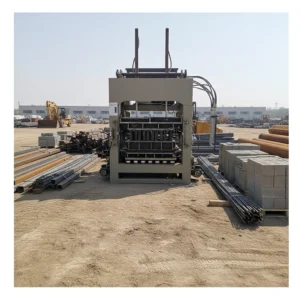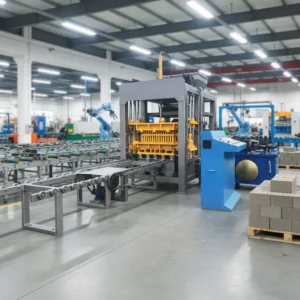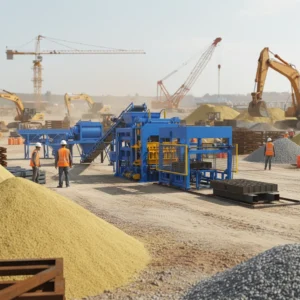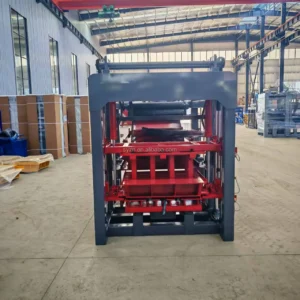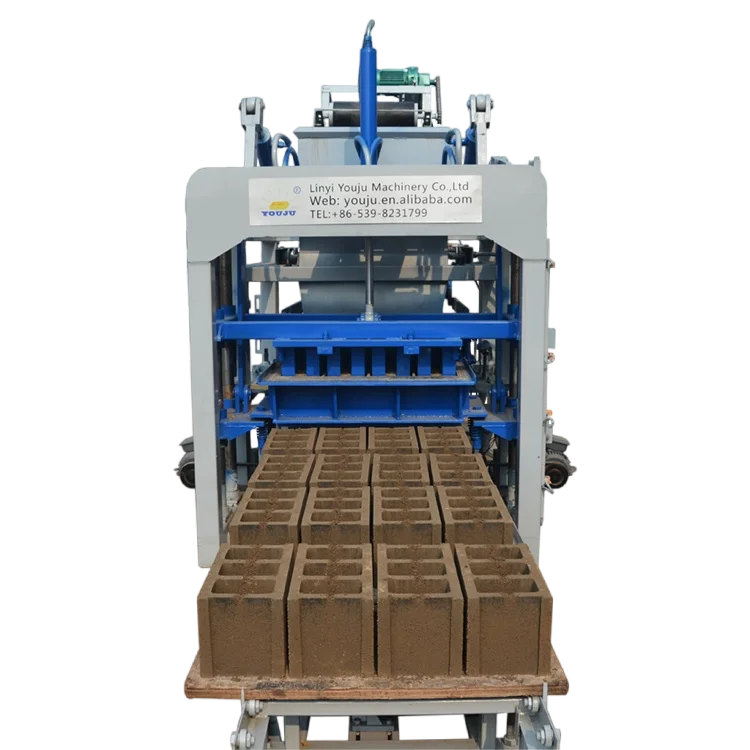
Single-Focus Line Engineering — the QT415 press is specified as part of a complete production system where every station from batching to stacking is matched so cycle times align and throughput holds steady.
Technical Specifications
| Parameter | Value |
|---|---|
| Model | QT415 |
| Product Type | Full Automatic Concrete Block Making Machine |
| Overall Dimensions (L×W×H) | 4100×1600×2600 mm |
| Rated Pressure | 16–21 MPa |
| Main Vibration Form | Platform Vibration |
| Vibration Frequency | 4200 r/min |
| Vibration Force | 55 kN |
| Pallet Size | 880×550 mm |
| Molding Cycle | 25–30 s (basis not stated in source — confirm block format / material / thickness) |
| Overall Power | 18.45 kW (verify against final line configuration) |
| Total Mass | 4 T |
| Demolding Method | Hydraulic |
| Factory Area Required | 300 m² |
| Control System | PLC (Full Automatic configuration) |
| Automation Level | Full Automatic |
| Applicable Raw Materials | Crushed stone, sand, cement, dust, fly ash, gravel, slag |
| Standards | CE (verify for specific configuration) |
| Warranty | 1 year |
Application Suitability
| Application | Material or Output |
|---|---|
| Hollow block production for building walls | Crushed stone, sand, cement, fly ash |
| Solid block manufacturing for load-bearing structures | Gravel, sand, cement blends |
| Paving block and colored paver runs | Fine aggregate with pigment additives |
| Interlocking brick for retaining walls | Cement-stabilized crushed stone |
| Kerbstone and curb units for road projects | Dense aggregate mix with high cement ratio |
| Porous brick for permeable surface applications | Open-graded aggregate with controlled binder content |
Why "Cycles per Hour" Misses the Real Output Picture
A press rated at a certain cycle speed only delivers if every upstream and downstream station keeps pace.
When I started in the assembly workshop here in Shandong, capacity was always quoted as cycles per hour on the press nameplate. Years later in technical sales, I watched a Tanzanian client run a QT415 line where the mixer discharged too slowly and the press sat idle for seconds every cycle — real daily output never reached what the spec sheet implied. The QT415 block machine production line must be evaluated as a chain of stations, not a single machine.
The vibration press completes its cycle in 25–30 seconds depending on the block format, but if the mixer takes longer to deliver a fresh batch, or the pallet return conveyor lags, the entire line stalls. Buyers who quote only the press end up with stacked-but-uncured product and frustrated crews [NEED_CITE: line synchronization principles in concrete block manufacturing].
Matching Upstream Feeding and Mixing to Press Rhythm
The QT415 block machine production line begins well before the press itself. Raw material batching and mixing must deliver a consistent volume of wet mix within the press’s molding window. If the mixer output does not align with the 25–30 second cycle rhythm, the platform vibration station waits — and waiting presses produce nothing.
Feeder selection, conveyor length, and mixer discharge gate sizing all affect whether the press receives material on time. A complete line specification accounts for these intervals station by station, so the overall throughput reflects the slowest link rather than the fastest one.
Pallet Circulation and Downstream Handling as Bottleneck Sources
Pallets are the silent bottleneck in many block plants. With an 880×550 mm pallet format, the QT415 line requires enough pallets in circulation to cover the press output, the curing rack travel time, and the return conveyor loop simultaneously. If pallet inventory falls short, the press halts regardless of how much mix is ready.
Downstream stacking and cubing must also absorb output at the rate the press delivers. A stacker that cannot keep pace forces operators to pull pallets manually — a scenario I have seen reduce a full automatic line to semi-manual operation within the first week [NEED_CITE: pallet circulation calculations in block production].
How Pressure and Vibration Interact to Set Block Density
The QT415 delivers 16–21 MPa of rated hydraulic pressure alongside 55 kN of platform vibration force at 4200 r/min. These two forces work together: vibration consolidates the mix into the mould cavity, while hydraulic pressure compresses it to final density. If either force is mismatched to the buyer’s aggregate gradation or cement content, blocks emerge with inconsistent strength.
The 880×550 mm pallet size determines how many blocks form per cycle, which in turn sets the demand on the mixer and curing area. A larger pallet does not automatically mean higher daily output if the curing rack dimensions or forklift capacity cannot accommodate it. Hydraulic demolding enables integration with automatic stacker stations, reducing the manual labour between press and curing zone.
The Hidden Cost of Ignoring Station Synchronization
When line stations are sourced separately and never timed against one another, the consequences surface on the first production day. Mixers that undershoot the press demand create stop-start operation that wears vibration motors prematurely. Pallets specified without checking curing rack spacing lead to jams on the return conveyor. Voltage and frequency mismatches delay commissioning by weeks while replacement electrical panels are shipped overseas [NEED_CITE: common commissioning delays in exported block machinery].
These problems are not press failures — they are line engineering failures. The cost shows up as lost production days, overtime labour, and buyer frustration that no amount of press horsepower can solve.
Why Sourcing the Full Line from One Supplier Matters
Block machinery is our single focus, which means the press, moulds, pallets, and handling equipment are specified as one matched system rather than assembled from unrelated vendors. Every QT415 line proposal includes a capacity calculation that states which block format the cycles-per-hour figure assumes — no ambiguity about real daily output.
Mould design covers the formats the buyer’s market actually sells, with custom drawings available when standard moulds do not fit. Automation level is selectable, so a plant can begin with semi-automatic pallet handling and add automatic stacking later as production volume grows. Installation and commissioning include operator training on the specific line configuration delivered, not a generic manual.
Documentation & Verification
- Line layout drawing showing station-by-station footprint and material flow direction
- Capacity calculation stating the block format assumed for each quoted output figure
- Pallet specification sheet confirming 880×550 mm size, material grade, and load rating
- Hydraulic and electrical schematic matching the as-built configuration
- Voltage, frequency, and PLC display language confirmation record before production
- Factory test record on the buyer’s selected block format before dispatch
Installation, Commissioning & Support
- Foundation plan sized to the 4100×1600 mm press footprint and dynamic vibration loads
- Dedicated electrical circuit matching confirmed voltage and the 18.45 kW total power draw
- Machine dismantled for container loading with reassembly supervision on site
- PLC parameter set to buyer’s block format and local language before first production run
- Operator training covering mould change procedure and hydraulic demolding sequence
- Wear parts and mould list supplied with recommended reorder intervals
What We Need to Size Your Line Correctly
Before quoting a QT415 block machine production line, we need to know which block formats you plan to produce and the target daily output for each. Share your local aggregate type and cement availability so the mix design can be factored into capacity calculations. Confirm your site’s voltage, frequency, and preferred PLC display language to avoid commissioning delays after arrival.
Frequently Asked Questions
Q: How is daily output calculated when the line includes mixer capacity, pallet circulation time, and stacking speed?
A: We calculate output by mapping every station’s cycle — mixer discharge interval, press molding time, pallet return speed, and stacker throughput — then identify the slowest link. The quoted daily figure states which block format it assumes, so buyers see realistic numbers rather than press-only cycles per hour.
Q: What supporting equipment is included versus quoted separately?
A: The line proposal itemizes each station: raw material feeder, mixer, pallet feeder, press, stacker, and curing rack handler. Every item is listed with its specification and cycle time. Buyers see exactly what is included and what requires separate procurement, eliminating surprises after the order is placed.
Q: How do we confirm the pallet size matches our existing curing area and forklift?
A: We request the curing rack dimensions, aisle widths, and forklift load rating before finalizing the 880×550 mm pallet specification. If the existing infrastructure requires a different pallet size, we adjust the line configuration accordingly so pallets move smoothly from press through curing to dispatch.
Q: What is the sequence from inquiry through commissioning?
A: The process runs from inquiry with target format and site conditions, through line layout and capacity proposal, pallet and automation confirmation, voltage and language sign-off, production and factory test, shipment, on-site reassembly, and operator training. Each stage has a defined deliverable the buyer reviews before the next stage begins.
Q: Can the automation level be upgraded later?
A: Yes. A buyer can start with semi-automatic pallet handling and manual stacking, then add automatic pallet feeding, stacking, and cubing stations later. The QT415 press and its PLC control system accommodate these upgrades without replacing the main machine, protecting the initial investment.