
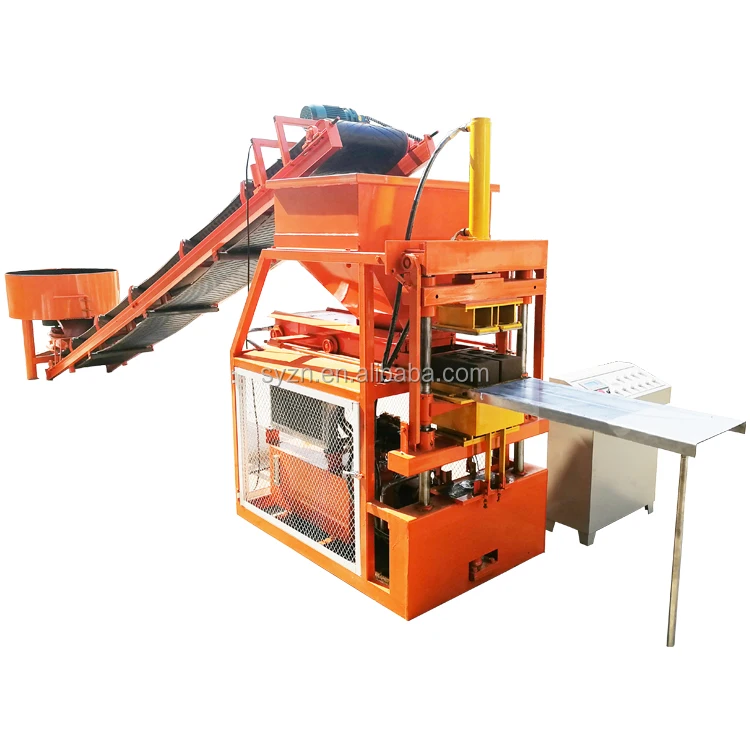
Integrated Line Pacing — the LY2-10 earth block press is specified alongside its feeder, mixer and pallet return so the 10-second moulding cycle is never starved or blocked by a slower station.
Technical Specifications
| Parameter | Value |
|---|---|
| Product Type | Compressed Earth Block Making Machine |
| Rated Power | 7.5 kW |
| Control System | Semi-automatic |
| Overall Dimensions (L×W×H) | 1300×1800×2400 mm |
| Cycle Time | 10 s |
| Mould Format Options | 300×150×100 mm / 250×125×75 mm / 230×220×115 mm interlocking earth block |
| Pcs per Mould | 1 |
| Throughput | 750 pcs/h (basis not stated in source — confirm block format, material and thickness before capacity planning) |
| Raw Material Compatibility | Clay, soil, earth, mud, concrete, cement, fly ash |
| Automation Level | Semi-automatic |
| Assembly State | Stationary |
Application Suitability
| Application | Material or Output |
|---|---|
| Rural housing and community building projects | Cement-stabilized soil or clay interlocking blocks produced on-site without a fixed batching plant |
| Small-scale block yard adding earth block formats | Local clay, earth or mud blended with cement or fly ash, pressed into interlocking profiles |
| Contractor producing for a single development | Site-sourced soil with stabilizer, output stacked and cured adjacent to the build area |
| Existing concrete product manufacturer diversifying range | Earth and clay mixes pressed on the same pallet circuit as conventional concrete pavers |
Why the Line Around the Press Decides Your Real Daily Output
A compressed earth block making machine production line only delivers its quoted cycle rate when every upstream and downstream station keeps the same rhythm.
I spent years flying across Latin America to fix lines that were theoretically fast but practically stalled. One plant in the Andes had a press that cycled perfectly, but the manual pallet return could not keep up, so the operator stood idle every third cycle. Another site mixed soil by hand in a trough, and the press waited for the next batch more often than it ran. The bottleneck is rarely the press itself — it is the station nobody thought to size correctly [NEED_CITE: common bottlenecks in semi-automatic block production lines]. When a buyer receives a quotation for the press alone, the real throughput depends entirely on how the feeding, mixing, pallet supply and stacking are resolved on the floor.
Matching Each Station to the 10-Second Moulding Cycle
The LY2-10 completes one interlocking earth block every 10 seconds, which sets a hard tempo for every other station. The soil feeder must deliver a measured charge into the hopper before the next cycle begins, and the mixer must have a batch ready well before the hopper runs empty. In a compressed earth block making machine production line, a half-second delay at any station compounds across hundreds of cycles and quietly erases the throughput the buyer expected.
Pallet Circuit and Curing Area Coordination
Interlocking earth blocks cure on pallets, and the pallet size must match both the mould footprint and the curing racks already on site. If the pallets are too large for the buyer’s existing forklift or curing shelves, blocks pile up on the floor and the line chokes. The semi-automatic configuration means an operator transfers pallets at defined points, so the layout must give that person a clear path without crossing the press zone [NEED_CITE: pallet handling standards for semi-automatic block plants]. Planning the pallet loop before the press ships prevents a costly rework of the curing area after arrival.
Reading the Specifications That Actually Shape the Line
The 7.5 kW rated power determines the electrical supply the buyer must prepare — not just for the press, but for the mixer, feeder and any conveyor motors sharing the same circuit. The three mould format options (300×150×100 mm, 250×125×75 mm, 230×220×115 mm) each demand a different pallet size and curing rack spacing, so the format choice made at inquiry stage cascades through the entire line layout. Semi-automatic control means the PLC governs press timing and vibration, while pallet feeding and stacking remain operator-driven — this split defines where labour is needed and where consistency is automated. The 1300×1800×2400 mm footprint is compact enough for a container-load installation, but the surrounding stations need their own clearances for maintenance access and material flow.
What Happens When Line Stations Are Specified in Isolation
When a buyer purchases the press from one supplier and the mixer from another, the two machines arrive with different cycle assumptions. The mixer may deliver a batch every three minutes, while the press exhausts that batch in ninety seconds, leaving the operator waiting. Pallets ordered separately may not fit the mould platen, forcing the buyer to source replacements locally at a premium. These mismatches do not show up in any single quotation — they only surface on the first production day, when the line is supposed to be earning revenue [NEED_CITE: equipment mismatch costs in block production startups]. The consequence is not a broken machine but a silent loss of output that the buyer attributes to the press.
Why Sourcing the Line as One Package Matters Here
Every station is configured against the same cycle target, so the feeder, mixer and pallet return are specified to match the press rather than sold as independent items. Mould design covers the interlocking formats the buyer’s market actually demands, including custom drawings when local building codes require a non-standard profile. The semi-automatic level is selectable, meaning a buyer can commission with manual pallet handling today and add automatic stacking later without replacing the press. Voltage, frequency and PLC language are confirmed against the buyer’s site before the line ships, eliminating the commissioning delays that arise when a 400 V machine arrives at a 380 V facility. Line layout drawings state the assumed block format alongside the capacity calculation, so the buyer can verify the throughput figure before production begins.
Documentation & Verification
- Line layout drawing with capacity calculation stated per chosen interlocking block format
- Machine specification sheet covering press, feeder, mixer and pallet system as one package
- Mould drawing and format list for all interlocking profiles included in the order
- Pallet specification matched to buyer’s curing rack dimensions and forklift capacity
- Hydraulic and electrical schematic with confirmed voltage, frequency and PLC language
- Factory test record run on the buyer’s specified soil or clay mix before dispatch
Installation, Commissioning & Support
- Foundation plan sized to the 1300×1800×2400 mm press footprint plus feeder and mixer clearances
- Dedicated circuit planned around the 7.5 kW press rating plus mixer and feeder motor loads
- Press shipped partially assembled with mould and pallet track bolted on-site to container dimensions
- First production run supervised to set vibration duration and feed timing for the local soil mix
- Operator training covers mould change procedure across all ordered interlocking formats
- Wear parts list identifies press liners, mould inserts and pallet scrapers by part number
What to Include With Your Inquiry
To size the line correctly, share the interlocking block format your market sells, the daily volume you need to sustain, and the soil or clay source you plan to use. Include your site voltage and frequency, the curing space available, and any forklift or pallet racking already in place. If you are adding earth blocks to an existing concrete product range, note the current pallet size and press cycle so the new line can be matched to it.
Frequently Asked Questions
Q: How is the 750 pieces per hour throughput calculated and which block format does it assume?
A: The figure is derived from one block per mould at a 10-second cycle, but the source does not state which of the three interlocking formats or which material mix was used. Before relying on this number for planning, request a capacity calculation that names your chosen block size, soil type and stabilizer ratio.
Q: Which upstream and downstream stations are included in the line quotation?
A: The quotation can cover the soil feeder, mixer, pallet supply track and stacking station alongside the LY2-10 press. Each station is optional, so confirm which ones are included and which you will source locally, then verify that the cycle times of any third-party equipment match the 10-second press rhythm.
Q: How do pallet size and material choices affect my existing curing setup?
A: Pallet dimensions must align with your curing rack spacing and the forklift tine width on site. A pallet too large for your racks forces floor curing, which slows output and risks block damage. Specify your current rack dimensions and handling equipment before the pallet order is finalized.
Q: Can the semi-automatic line be upgraded to full automatic stacking later?
A: Yes. The semi-automatic configuration leaves defined interface points for an automatic stacker and cubing system. When you are ready to add automation, the press PLC and pallet track can be extended without replacing the LY2-10 or changing the mould set.
Q: What voltage, frequency and PLC display language options are confirmed before shipping?
A: These are locked in during the order confirmation stage. Provide your site voltage, frequency and preferred operator language so the electrical cabinet and PLC screen are set correctly before the line leaves the factory, avoiding rewiring or reprogramming during commissioning.



