
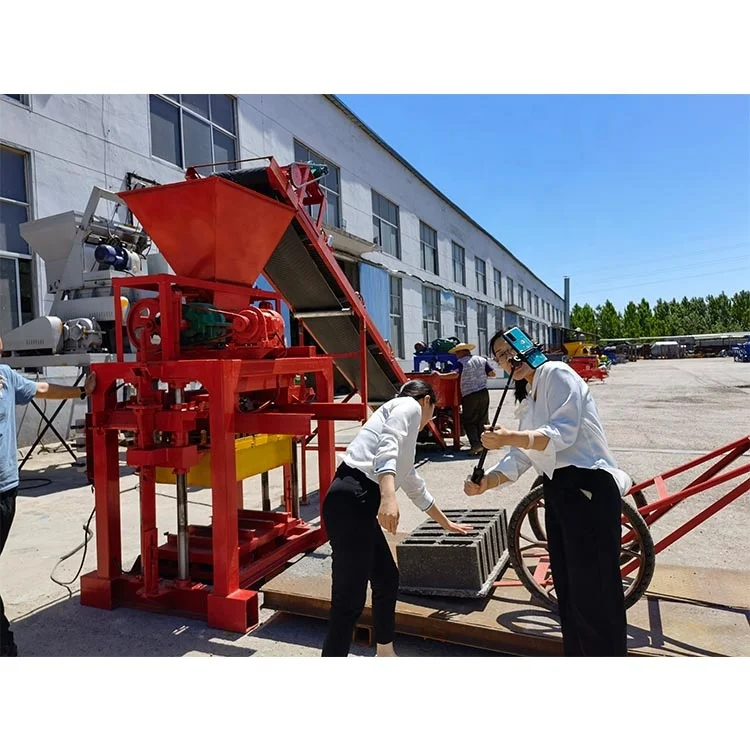
Matched System Design — Every station around the QTJ4-35 is sized against its 35-second molding cycle so the press never waits for material or pallets.
Technical Specifications
| Parameter | Value |
|---|---|
| Model | QTJ4-35 |
| Product Type | Stationary Concrete Block Making Machine |
| Overall Dimensions (L×W×H) | 2050 × 1660 × 1900 mm |
| Rated Vibration Force | 35 kN |
| Main Vibration Form | Platform Vibration |
| Vibration Frequency | 2800 r/min |
| Pallet Size | 850 × 450 mm |
| Molding Cycle | 35 s (basis not stated in source — confirm block format / material / thickness) |
| Overall Power | 9.7 kW |
| Total Mass | 1500 kg |
| Demolding Method | Vibration |
| Factory Area Requirement | 260 m² |
| Applied Products | Concrete blocks, hollow/solid blocks, pavers, interlocking blocks, curbstone |
| Raw Materials | Crushed stone, sand, cement, fly ash, gravel, slag |
| Control System | Manual / semi-automatic operation |
| Voltage & Frequency | Configurable to buyer’s site supply |
| Warranty | 1 year |
Application Suitability
| Application | Material or Output |
|---|---|
| Small-scale hollow block production | Crushed stone, sand, cement, fly ash blends |
| Solid block manufacturing for local masonry | Gravel, sand, cement mixes |
| Paver and interlocking brick runs | Fine aggregate with pigment additives |
| On-site block production for contractors | Locally sourced aggregate and cement |
| Supplementary line for existing plants | Compatible with existing pallet and curing stock |
Why a 35-Second Cycle Rarely Means What You Think
The molding cycle only holds if the mixer, pallet feeder, and curing layout keep pace with the press.
A Stationary Block Making Machine production line is often quoted on press speed alone. In practice, the mixer batches too slowly, the pallet return jams, or the curing yard has no room for wet output — and the press sits idle for half the shift. I have walked into plants in Southeast Asia where the operator spent more time clearing spilled mix from the feeder than actually running the QTJ4-35. The bottleneck is almost never the press itself [NEED_CITE: common causes of idle time in small block plants].
Upstream Feeding and Mixer Sizing
The QTJ4-35 completes one pallet every 35 seconds, which sets the tempo for everything upstream. The mixer must discharge a full batch within that window, and the raw material feeder must replenish the hopper before the next cycle begins. When mixer output falls behind, the press runs starved — producing underfilled pallets and inconsistent block density. A Stationary Block Making Machine production line only performs when every station before the press is timed to its cycle, not to catalogue defaults.
Downstream Pallet Handling and Curing Layout
Once the QTJ4-35 demolds by vibration, the wet pallet must move to the curing area without delay. If pallets pile up at the press exit, the operator is forced to stack manually, which damages fresh blocks and slows the next cycle. The 850 × 450 mm pallet size dictates the curing rack dimensions and the forklift capacity needed to move them. Planning the curing yard around this pallet footprint — rather than adapting later — prevents a Stationary Block Making Machine production line from choking on its own output [NEED_CITE: pallet handling bottlenecks in small block plants].
What the Specs Mean on the Shop Floor
The 35 kN vibration force at 2800 r/min works through the platform to compact the mix into the mould. This force level suits small-to-medium blocks in standard concrete mixes but requires the right aggregate grading to achieve consistent density. The 9.7 kW total power draw is modest, meaning most small workshops can run the line on a standard three-phase supply without a dedicated transformer. The 1500 kg mass keeps the machine stable under vibration but still allows repositioning within the 260 m² factory footprint if the layout needs adjustment. Platform vibration rather than mould vibration means the entire pallet receives uniform energy, which matters when running thinner products like pavers alongside standard hollow blocks.
The Cost of Ignoring Line Rhythm
When the pallet return is undersized or missing from the quotation, workers carry pallets back by hand. That slows the cycle from 35 seconds to over a minute, cutting output roughly in half and increasing breakage on freshly molded blocks. I have seen plants where the curing racks were built for a different pallet size, forcing the owner to either buy all-new racks or run a mismatched inventory that jams the return conveyor. These mismatches rarely appear in the initial quotation but show up as daily frustration and lost production [NEED_CITE: hidden costs of mismatched pallet systems].
Why This Line Approach Matters
Block machinery is our single focus, so the QTJ4-35 is never quoted as a standalone press. We specify the mixer batch size, pallet return speed, and curing rack layout as one matched system. Configuration is set against your actual mix design and local aggregate, not a generic catalogue mix. Mould options cover the hollow, solid, paver, and interlocking formats your market actually sells. The automation level is selectable — start with manual pallet handling and add a feeder or stacker later. Installation support includes operator training so the crew knows how each station connects before the first production run.
Documentation & Verification
- Line layout drawing with capacity calculation per block format
- Machine specification sheet with confirmed voltage and frequency
- Mould drawing and format list for your product range
- Pallet specification matched to your curing rack and forklift
- Factory test record on your mix before dispatch
- Operation and maintenance manual in your operator language
Installation, Commissioning & Support
- Foundation pad leveled within the 260 m² area, anchored to the 1500 kg frame
- Three-phase power supply wired for the confirmed 9.7 kW total load
- Pallet return conveyor aligned to the 850 × 450 mm pallet guide rails
- First production run supervised with cycle timing verified per block format
- Operator training covering mould change and daily vibration platform checks
- Wear parts list with reorder intervals for hydraulic and vibration components
What We Need to Size Your Line
Tell us the block formats you sell most — hollow, solid, paver — and the daily volume you need to hit. Share your local aggregate type and any existing mixer or curing racks so we can check compatibility with the QTJ4-35. Confirm your site voltage, frequency, and preferred control language so commissioning happens without delay.
Frequently Asked Questions
Q: What block format is assumed when quoting the 35-second molding cycle?
A: The 35-second figure is typically measured on a standard hollow block, but actual cycle time varies with block thickness, mix design, and mould complexity. Pavers and thinner products may cycle faster, while large solid blocks may take longer. We calculate real daily output per format before quoting so the figure matches your product.
Q: How should the upstream mixer be sized for this press?
A: The mixer must discharge a full batch within or slightly under the 35-second press cycle to avoid starving the hopper. Batch volume should match the pallet mould cavity volume plus a small surplus. We size the mixer and feeder as part of the line proposal so timing is confirmed before shipment.
Q: What pallet size and material work with the QTJ4-35?
A: The press uses 850 × 450 mm pallets. Material choice — bamboo, steel, or PVC — affects pallet weight, lifespan, and compatibility with your curing racks and forklift. We confirm pallet spec against your existing handling equipment so nothing needs to be replaced after arrival.
Q: What factory area is needed for the complete line?
A: Approximately 260 m² covers the press, mixer, raw material storage, pallet return, and a basic curing zone. The exact layout depends on your ceiling height, curing rack configuration, and whether stacking is manual or automatic. We provide a scaled line drawing with the proposal.
Q: Which supporting stations are included in the quotation?
A: The base quotation covers the press and its mould. Pallet feeder, mixer, raw material hopper, stacking unit, and curing rack handling are configured separately based on your automation level and budget. Each item is listed individually so you can start semi-automatic and expand later.


