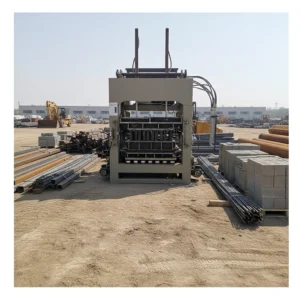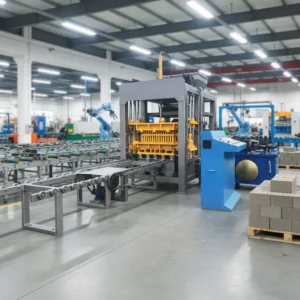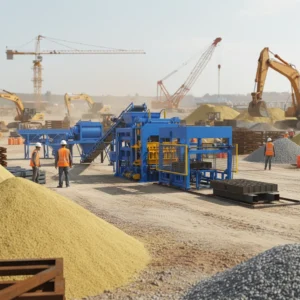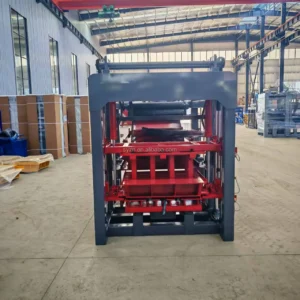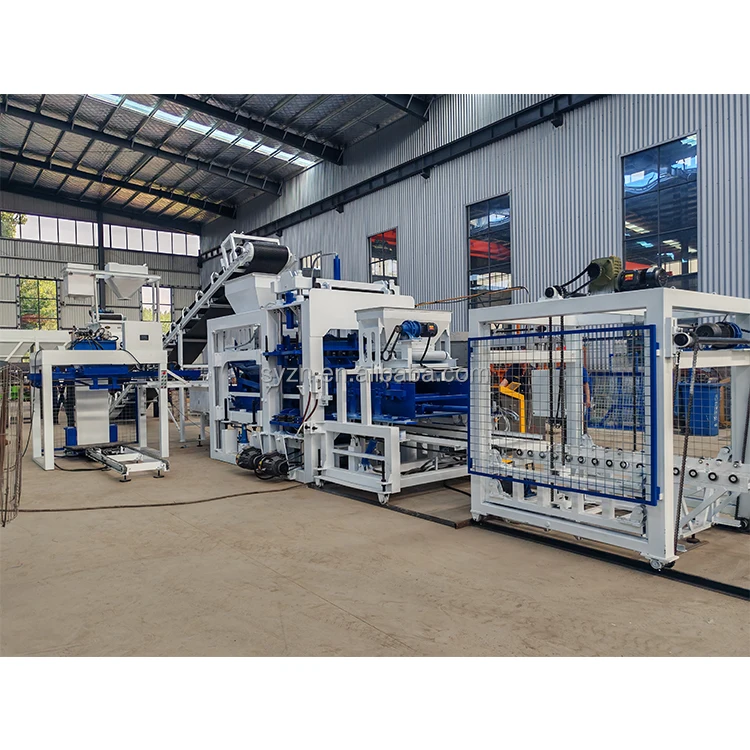
Synchronized Station Timing — Every pallet, mixer discharge, and stacker cycle is calculated against the QT8-15 molding rhythm so no station waits idle.
Technical Specifications
| Parameter | Value |
|---|---|
| Model | QT8-15 |
| Product Type | Hydraulic Block Making Machine |
| Overall Dimensions (L×W×H) | 8300×1860×3000 mm |
| Rated Pressure | 21 MPa |
| Main Vibration Form | Platform Vibration |
| Vibration Frequency | 2800–4500 r/min |
| Vibration Force | 45 kN |
| Pallet Size | 950×900 mm |
| Molding Cycle | 15–20 s (basis to be confirmed with specific block format and material) |
| Overall Power | 55.5 kW |
| Total Mass | 8 T |
| Demolding Method | Hydraulic |
| Recommended Factory Area | 300 m² |
| Applied Products | Concrete blocks, hollow/solid blocks, pavers, interlocking blocks, curbstone, colored pavers |
| Raw Material Compatibility | Crushed stone, sand, cement, dust, fly ash, gravel, slag |
Application Suitability
| Application | Material or Output |
|---|---|
| Hollow and solid block production plants | Crushed stone, sand, cement, fly ash blends |
| Paver and interlocking brick manufacturing | Fine aggregates with cement binder |
| On-site contractor production for housing projects | Locally sourced gravel, slag, and dust mixes |
| Curbstone and colored paver runs for municipal supply | Pigmented concrete with coarse aggregate |
Why Quoted Cycles Per Hour Rarely Match Real Daily Output
A press that cycles in 15 seconds means nothing if the pallet return loop takes 25.
I have watched buyers sign contracts based on a QT8-15 cycle figure, only to find on day one that the mixer could not discharge fast enough or the stacker jammed every fourth pallet. The press sat idle, operators stood around, and daily throughput fell to half the brochure number. That mismatch is not a machine fault — it is a line design fault [NEED_CITE: common causes of throughput shortfalls in block production lines]. When a block production line is quoted as a single matched system rather than a press plus disconnected accessories, those gaps disappear before the container ships.
Matching Mixer Discharge to the Press Rhythm
The QT8-15 completes a molding cycle in 15–20 seconds depending on block format and mix consistency. The upstream mixer must discharge a full batch within that same window, otherwise the press waits. In a properly balanced block production line, the mixer capacity, discharge gate speed, and conveyor transfer time are all calculated backward from the press cycle so material arrives exactly when the mold closes.
Pallet Return and Stacking Synchronization
After demolding, the loaded pallet travels to the stacking station. If the stacker lift cycle or the cubing sequence runs slower than the press output, pallets queue up on the return conveyor and eventually block the press exit. The 950×900 mm pallet dimension must align with curing rack spacing and forklift tine width already on site, or pallets pile up in the yard instead of moving to the curing area. Every station downstream of the press has to match or exceed its cycle rate [NEED_CITE: pallet handling synchronization standards in concrete product plants].
Reading the Specs That Actually Matter for Line Balance
The 21 MPa rated pressure and 45 kN vibration force together determine the density and compressive strength of the finished block. If vibration frequency sits at the lower end of the 2800–4500 r/min range, a drier mix may not compact fully, forcing longer cycle times. The 55.5 kW overall power draw dictates the electrical supply specification — undersized cabling or a shared circuit with the mixer causes voltage drops that trip the PLC mid-cycle. Platform vibration, rather than mold vibration, means the entire pallet receives uniform energy, which matters when producing thin pavers alongside taller hollow blocks on the same line. The 8 T total mass provides the dead weight needed to absorb vibration without transmitting it into the factory floor, reducing the need for a separate isolation foundation.
The Cost of Ignoring Downstream Equipment
I once visited a plant where the owner had purchased a high-output press but handled stacking manually. Two workers moved wet blocks off the line by hand while the press ran at reduced speed to avoid pallet pile-ups. Within months, worker fatigue led to cracked blocks and inconsistent curing rack loads. The owner then invested in a stacker that did not match the pallet size, adding a second bottleneck. Specifying the entire block production line as one system prevents these cascading mismatches and the expensive retrofit cycles they trigger [NEED_CITE: financial impact of mismatched line equipment in block plants].
Why Specifying the Whole Line Here Matters
Block machinery is our single focus, which means the QT8-15 press, its mold, pallet, and handling equipment are specified as one matched system rather than assembled from separate suppliers. Configuration is set against the buyer’s actual mix design, local aggregate, and target block format, not a catalogue default. Molds are designed for the formats the buyer’s market actually sells, including custom drawings when standard formats do not fit. Automation level is selectable, so a buyer can begin with semi-automatic pallet handling and upgrade the stacking station later without replacing the press. Installation and commissioning include operator training so the crew understands station timing from day one.
Documentation & Verification
- Line layout drawing showing station spacing and pallet flow path for the QT8-15
- Capacity calculation sheet stating the block format assumed for each station cycle
- Pallet specification matched to curing rack dimensions and forklift capacity
- Voltage, frequency, and PLC display language confirmation before production begins
- Factory test record documenting cycle time at mixer, press, and stacker stations
- Hydraulic and electrical schematic for the complete line configuration
Installation, Commissioning & Support
- Foundation plan sized for the 8300×1860 mm machine footprint and vibration isolation
- Electrical supply specification for the 55.5 kW total load with dedicated breaker circuit
- Machine shipped in dismantled modules for standard container loading and on-site reassembly
- Commissioning includes cycle timing verification at each station from mixer to stacker
- Operator training covers mold change procedure and pallet feed synchronization adjustment
- Wear parts list covering hydraulic seals and vibration components for first-year maintenance
- Recommended maintenance schedule based on platform vibration bearing and hydraulic system intervals
What We Need to Size Your Line Correctly
To build an accurate block production line proposal, share your target block formats with dimensions, the daily output you need per format, and the raw materials available locally with their gradation data. Tell us the curing area dimensions and the forklift model you already operate so pallet sizing aligns. Confirm your site voltage and frequency along with the preferred PLC display language so the control panel is correct before dispatch.
Frequently Asked Questions
Q: How are cycle times balanced across the mixer, press, and pallet return so no station waits?
A: We calculate each station’s cycle backward from the QT8-15 molding time of 15–20 seconds. Mixer batch size, discharge gate timing, pallet conveyor speed, and stacker lift duration are all set so material and pallets arrive at the press without queuing. The result is a line layout document that shows the timing chain for your specific block format.
Q: What pallet size and material does the line assume, and will it match my existing curing racks?
A: The standard pallet for this line is 950×900 mm, but the material — timber, bamboo, or composite — is chosen based on your curing method and local humidity. Before production, we confirm the pallet dimensions against your existing curing rack spacing and forklift tine width to avoid handling problems on site.
Q: Is automatic stacking and cubing included, or is output still handled manually after the press?
A: The stacking and cubing station is part of the line configuration and can be set to semi-automatic or fully automatic depending on your labor availability. The stacker cycle is timed to match press output so pallets do not accumulate. We specify this station together with the press rather than leaving it as an afterthought.
Q: How is the raw material feed configured for my local aggregate and mix design?
A: We review your local aggregate gradation, cement type, and any supplementary materials like fly ash or slag before finalizing the feeder and mixer setup. The goal is a mix that reaches the press at the right moisture and consistency for the 21 MPa pressure and platform vibration to produce blocks at target strength.
Q: What is the total factory footprint including material storage, curing area, and finished product yard?
A: The QT8-15 press area alone requires roughly 300 m², but the full line including raw material storage, mixing station, curing racks, and finished block yard typically needs a larger plot. We provide a complete line layout drawing that accounts for pallet circulation paths, forklift aisles, and curing time spacing based on your daily output target.