
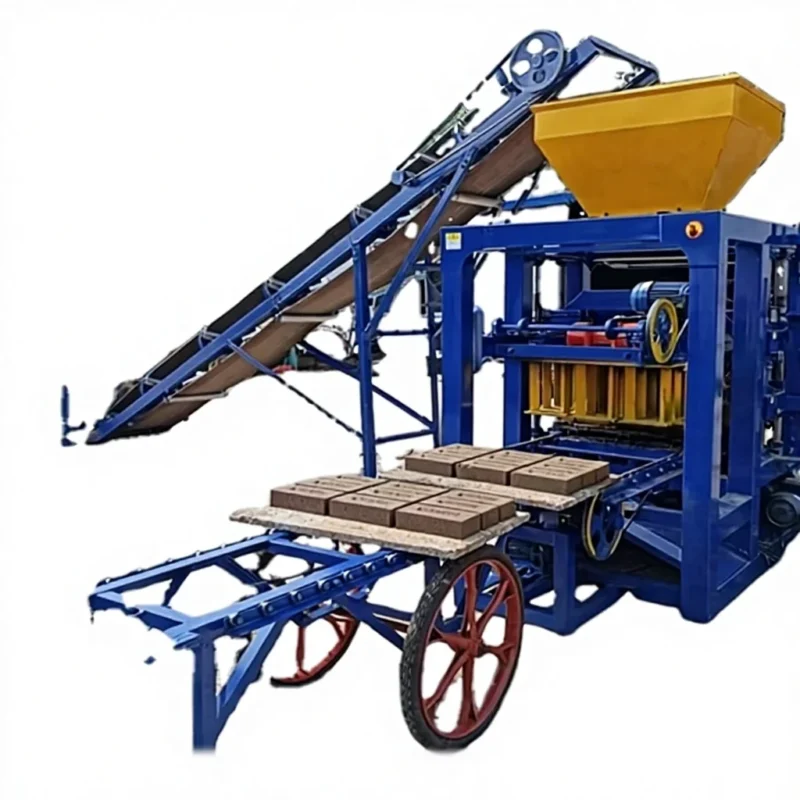
Line-matched rhythm — every station from the JQ350 mixer through the 6 m belt conveyor to the QTJ4-24 press and trolley is timed so the press never idles waiting for the next batch.
Technical Specifications
| Parameter | Value |
|---|---|
| Model | QTJ4-24 |
| Product Type | Semi-Automatic Concrete Block Making Machine |
| Molding Type | Platform Vibration |
| Pallet Size | 850 mm × 450 mm |
| Overall Power | 14.25 kW |
| Overall Dimension (working state) | 3600 mm × 1700 mm × 2560 mm |
| Total Mass | 1750 kg |
| Hollow Block Format | 390 mm × 190 mm × 190 mm, 4 pcs/mould |
| Solid Brick Format | 240 mm × 115 mm × 53 mm, 21 pcs/mould |
| Vibrating System | Lower platform 2 × 3 kW + upper 1.5 kW attached device |
| Elevating System | Cone-shape motor with JZQ250 speed reducer |
| Delivery Device | Cycloidal pin wheel reducer with chain and V-belt drive |
| Machine Frame | Dragon gate style, super steel, four vertical wear-resisting shafts |
| Control System | Electronic controlling part |
| Voltage & Frequency | Configurable to buyer’s site standard (basis to be confirmed) |
| Automation Level | Semi-automatic |
| Basic Supporting Equipment | JQ350 pan mixer, 6 m belt conveyor, trolley |
| Optional Supporting Equipment | Auto stacker (3–6 layers depending on block height) |
| Cycle Time | basis to be confirmed per block format and material |
| Output Capacity | basis to be confirmed per block format and material |
Application Suitability
| Application | Material or Output |
|---|---|
| Hollow concrete block production | Crushed stone, cement, sand aggregate; 390 × 190 × 190 mm format |
| Solid brick and paving brick | Local aggregate blended with cement; 240 × 115 × 53 mm format |
| Small-scale block plant setup | Matched line output for local market daily demand |
| On-site contractor production | Compact line footprint for project-based block forming |
| First-time block entrepreneur | Low-investment complete line from batching to trolley handling |
Why the Mixer-to-Press Rhythm Decides Your Real Output
A semi-automatic block making machine production line only performs as fast as its slowest station.
I once configured a semi-automatic block making machine production line where the press cycled through its mould before the pan mixer had finished discharging. The operator stood idle for seconds per cycle, and those gaps added up to thousands of missing blocks across a shift. The QTJ4-24 here is paired with the JQ350 pan mixer and a 6 m belt conveyor specifically to close that gap [NEED_CITE: typical batch-to-press timing mismatches in small block plants]. When the mixer discharge rate, conveyor travel time, and press cycle are calculated together, the host machine receives a steady material feed without waiting.
How the Stations Connect From Batching to Trolley
The JQ350 pan mixer sits at the start of this semi-automatic block making machine production line, blending cement and aggregate into a consistent mix. The 6 m belt conveyor carries that mix into the machine hopper at a rate matched to the press cycle. After compaction, fresh blocks on pallets move onto the included trolley for transport to the curing area. An optional auto stacker can replace manual pallet handling, stacking three to six layers depending on block height, so curing space is used vertically.
Where Cycle Time Gaps Hide in the Line
Every station has its own internal rhythm. The mixer runs on a batch timer, the conveyor moves at a fixed belt speed, and the QTJ4-24 completes its vibration and elevation sequence on its own cycle. If any one of those durations is longer than the next station expects, the press sits empty. We calculate each segment against the buyer’s chosen block format and mix design before the line ships [NEED_CITE: importance of station-to-station timing in block production]. That way the semi-automatic block making machine production line delivers its rated rhythm rather than losing cycles to upstream delays.
Reading the Vibration and Frame Specs for Real Compaction
The dual-vibration setup pairs two 3 kW lower platform motors with a 1.5 kW upper attached device. Lower platform vibration transmits force through the pallet into the mix, while the upper device consolidates the top surface — together they produce even density across the full 850 × 450 mm pallet area. The dragon gate frame with four vertical wear-resisting shafts keeps the mould aligned under that vibration, preventing uneven block heights that would cause rejection at the curing rack. The JZQ250 speed reducer on the elevating system controls the mould box lift speed, which affects how cleanly the block releases from the mould walls. A controlled lift matters especially for hollow block formats where thin shell walls can crack if the box rises too fast.
What Happens When Line Stations Are Sized Separately
Buyers who source a mixer, conveyor and press from separate suppliers often find the belt width too narrow for the mixer discharge volume, or the conveyor too short to reach the hopper at the correct angle. Material spills at transfer points, and operators spend time shovelling instead of managing pallets. Pallet handling left out of the quotation means fresh blocks are carried by hand to the curing area, slowing the entire line [NEED_CITE: hidden labour cost when stacking is excluded from block line quotations]. Even a well-tuned QTJ4-24 loses its cycle advantage when pallets pile up faster than workers can move them.
Why Sourcing the Full Line From One Supplier Matters Here
Block machinery is our single focus, so the QTJ4-24, JQ350 mixer, belt conveyor, pallet spec and trolley are specified as one matched system rather than assembled from separate sources. Configuration is set against the buyer’s actual mix design and local aggregate, not a catalogue default. Mould design covers the formats the buyer’s market sells, and custom drawings are available when a non-standard format is needed. The automation level is selectable — a buyer can start with the trolley and add the auto stacker later as volume grows. Installation support includes operator training so the crew understands how each station’s timing affects the next.
Documentation & Verification
- Line layout drawing with station-to-station timing for your block format
- Machine specification sheet covering QTJ4-24 power and vibration ratings
- Mould drawing and format list for hollow block and solid brick
- Pallet specification matched to your curing area and forklift
- Voltage and control language confirmation recorded before production
- Factory test record on your chosen block format before dispatch
Installation, Commissioning & Support
- Foundation pad sized to the 3600 × 1700 mm working footprint and 1750 kg mass
- Dedicated electrical circuit matching confirmed voltage and frequency for 14.25 kW total load
- Mixer, conveyor and press aligned on-site so belt discharge meets the hopper correctly
- First-run cycle timing verified against your mix design and block format
- Operator training covers mould change procedure on the four-shaft frame
- Wear parts and mould list supplied with reorder codes for the first replacement
What We Need to Size Your Line Accurately
To configure this semi-automatic block making machine production line for your project, share the block formats your market demands, the local aggregate you can source, and the daily output you need to meet. Tell us the voltage and frequency at your site, the language your operators read on a control display, and the curing area dimensions so we can match pallet material and size. If you already own a forklift or mixer, let us know so the line integrates with your existing equipment rather than duplicating it.
Frequently Asked Questions
Q: How is daily output calculated, and which block format is assumed?
A: Output figures depend entirely on the block format, mix design and cycle time. We calculate daily capacity based on the specific mould installed — for example, hollow blocks at 390 × 190 × 190 mm produce four pieces per cycle, while solid bricks at 240 × 115 × 53 mm produce twenty-one. Every capacity figure we quote names the format it assumes.
Q: What supporting equipment is included, and what is optional?
A: The standard line includes the JQ350 pan mixer, 6 m belt conveyor and a trolley for pallet transport to the curing area. The auto stacker is optional and stacks three to six layers depending on block height, reducing manual pallet handling when curing space is limited.
Q: How do the mixer, conveyor and press cycle times match?
A: We calculate the JQ350 batch time, belt conveyor travel duration and QTJ4-24 press cycle together so material arrives at the hopper before the press is ready for the next charge. This prevents idle time at the host machine caused by upstream delays.
Q: What voltage configurations are available, and is the control language configurable?
A: Voltage and frequency are set to match your site electrical standard, confirmed before production begins. The control display language is specified at the same stage so operators can read instructions in their working language on arrival.
Q: How does the optional auto stacker integrate with the line?
A: The auto stacker sits after the press, receiving loaded pallets and stacking them in three to six layers depending on the block height. This replaces manual pallet carrying and lets the curing area use vertical rack space instead of spreading across the floor.


