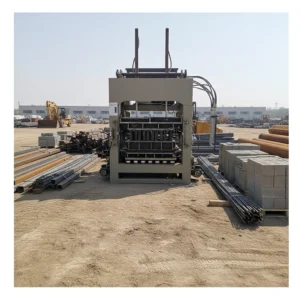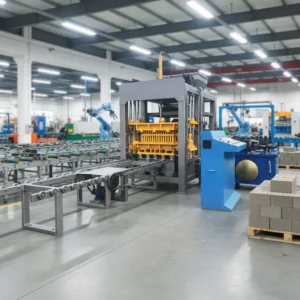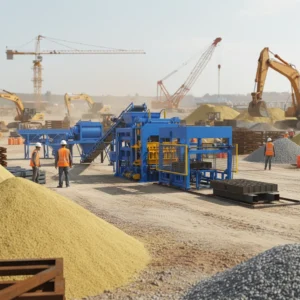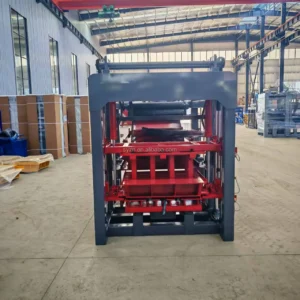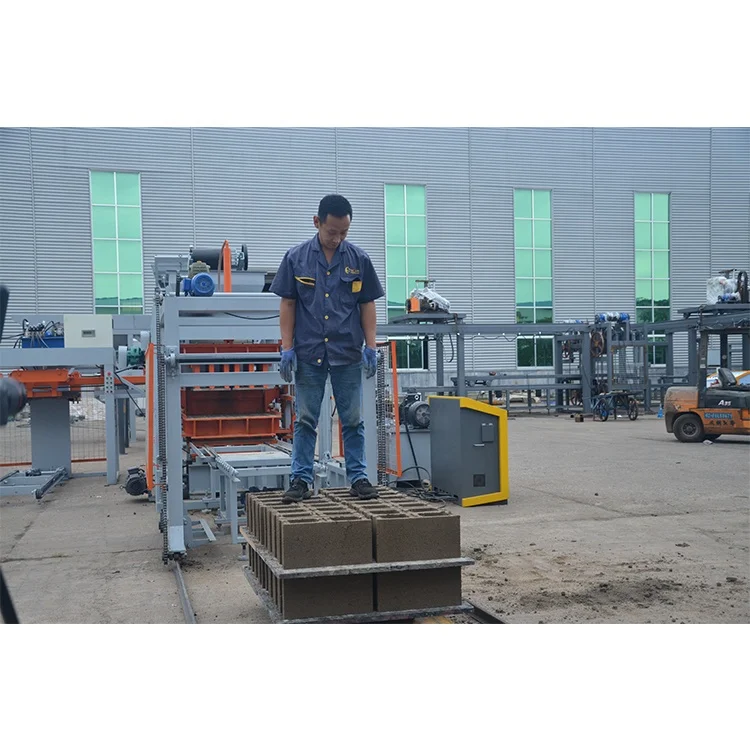
Matched line integration — The QT6-15 block making machine production line is specified as a coordinated system where feeding, mixing, pallet circulation, stacking, and curing stations are timed to the press cycle so no single point bottlenecks the entire plant output.
Technical Specifications
| Parameter | Value |
|---|---|
| Model | QT6-15 |
| Product Type | Hydraulic Block Making Machine |
| Overall Dimensions (L×W×H) | 8200×1700×2950 mm |
| Total Mass | 7 T |
| Vibration Form | Platform Vibration |
| Vibration Frequency | 0-60 Hz (adjustable) |
| Vibration Force | 45 kN |
| Moulding Mode | Automatic load, vibration moulding |
| Demolding Method | Hydraulic |
| Pallet Size | 880×850 mm |
| Molding Cycle | 15-20 s |
| Overall Power | 37 kW |
| Control System | PLC with touch screen and fault diagnosis |
| Hydraulic System | Independent integrated hydraulic station |
| Block Compressive Strength | More than 15 MPa |
| Output (Hollow 400×200×200 mm) | 1080-1440 pcs/hour (6 pcs/mould, 15-20s cycle) |
| Output (Hollow 400×150×200 mm) | 1440-1920 pcs/hour (8 pcs/mould, 15-20s cycle) |
| Output (Solid brick 240×115×53 mm) | 5760-7680 pcs/hour (32 pcs/mould, 15-20s cycle) |
| Output (Paving 200×100×60 mm) | 2160-2880 pcs/hour (21 pcs/mould, 20-25s cycle) |
| Factory Area Required | 1200 m² |
| Raw Material Adaptability | Waste ash, slag, various aggregates with reduced cement |
| Voltage & Frequency | Basis not stated in source — confirm with buyer’s local grid |
| PLC Language Options | Basis not stated in source — confirm before production |
| Standards | CE declaration where applicable |
Application Suitability
| Application | Material or Output |
|---|---|
| Hollow block production | Crushed stone, sand, cement, fly ash blends for 400×200×200 mm and 400×150×200 mm formats |
| Solid brick manufacturing | Dense aggregate and cement mixes for 240×115×53 mm standard bricks |
| Paving block production | High-strength mixes for 200×100×60 mm rectangular and 225×112.5×60 mm zigzag pavers |
| On-site contractor production | Local aggregate and waste ash blends adapted to project-specific block formats |
| Format expansion for existing plants | Additional mould configurations integrated with current pallet and curing systems |
Why "Cycles per Hour" Tells Only Part of the Story
Every capacity figure here is tied to a specific block format, mould cavity count, and verified cycle time.
Quoting a block making machine production line at a single cycles-per-hour number hides the fact that switching from a 400×200×200 mm hollow block to a 200×100×60 mm paving block changes both the mould cavity count and the cycle duration. I have watched plant owners in West Africa arrive at their facility expecting a daily throughput that simply was not achievable on the format they actually sold most [NEED_CITE: common mismatch between quoted capacity and real product mix in block plants]. The press itself may complete its cycle on schedule, but if the upstream mixer cannot deliver fresh material fast enough or the downstream stacker cannot clear pallets in time, the line stalls regardless of what the brochure promised.
How Upstream Feeding Sets the Real Pace
The QT6-15 completes a moulding cycle in 15-20 seconds for standard hollow and solid formats. That cycle time is achievable only when the raw material batching and mixing station delivers a consistent charge before each press closure. If the mixer capacity is undersized relative to the press demand, the QT6-15 sits idle for seconds between cycles, and those seconds accumulate into thousands of lost blocks over an eight-hour shift. Specifying the block making machine production line as a complete system means sizing the mixer output, conveyor speed, and feed hopper volume so that material arrives slightly ahead of the press demand, not behind it.
Why Pallet Circulation Dictates Daily Output
With a pallet size of 880×850 mm and a factory area requirement of 1200 m², the curing rack layout and pallet return path must be planned before the press is set in place [NEED_CITE: pallet circulation bottleneck case studies in block production]. Each pallet that leaves the press carrying a freshly formed block must travel to the curing area, be unloaded, and return to the pallet feeder before the next cycle can begin. If the return conveyor is too short or the curing racks are positioned beyond forklift reach, pallets accumulate on the floor and the press waits. The pallet specification is not an accessory choice — it is a line-wide timing constraint.
Reading the Specification Sheet Against Real Production
The independent integrated hydraulic station on the QT6-15 is mounted separately from the main frame, which isolates it from platform vibration and extends seal life under continuous operation. The adjustable vibration frequency from 0-60 Hz allows the operator to tune the energy input to the specific mix design — coarser aggregates generally require higher frequency and longer vibration to consolidate fully, while finer blends with fly ash or slag need lower settings to avoid segregation. The 45 kN vibration force combined with hydraulic demolding produces blocks exceeding 15 MPa compressive strength when the mix proportions are correct for the local aggregate. The PLC control system with touch screen and fault diagnosis reduces unplanned stops by surfacing sensor or valve faults before they escalate into full line shutdowns.
What Happens When Stations Are Specified in Isolation
I visited a plant in South Asia where the block press was rated correctly for its intended hollow block format, but the pallet feeder was a manually loaded rack designed for a smaller machine. Operators spent several minutes each cycle pulling pallets by hand, and the automatic stacking station downstream never received blocks fast enough to operate in its intended mode [NEED_CITE: manual pallet handling reducing effective line output]. The owner had paid for a fully automatic block making machine production line but was running a semi-manual process because the supporting stations had been quoted and purchased separately without anyone mapping the cycle time across every connection point.
Why Specifying the Line Together Matters
Shiyue configures the QT6-15 alongside its feeding, mixing, pallet handling, and stacking stations rather than treating the press as a standalone item. The pallet size of 880×850 mm is selected with the buyer’s existing curing rack dimensions and forklift capacity in mind, avoiding costly retrofits after arrival. Voltage and frequency are confirmed against the buyer’s local grid before production begins, and the PLC display language is set to match the operator team. The hydraulic and electrical schematics are provided so that upstream batching and downstream stacking equipment — whether supplied by us or sourced locally — can be wired and plumbed into a single coordinated sequence. Factory testing runs the press through its full cycle with the matched mould installed, and the test record is documented before dispatch.
Documentation & Verification
- Line layout drawing showing QT6-15 position relative to mixer, pallet feeder, and stacking stations
- Capacity calculation sheet stating output per block format with cycle time assumptions
- Pallet specification matched to buyer’s curing rack spacing and forklift load rating
- Hydraulic and electrical schematics for integration with upstream and downstream equipment
- Factory test record on buyer’s selected mould format before shipment
- Voltage, frequency, and PLC language confirmation document signed before production
Installation, Commissioning & Support
- Foundation plan based on 8200×1700 mm footprint and 7 T operating mass of the QT6-15
- Dedicated electrical circuit sized for 37 kW total power draw with confirmed voltage and frequency
- Main machine arrives fully assembled; independent hydraulic station connected on-site
- First-run commissioning with buyer’s local aggregate mix to verify 15 MPa block strength
- Operator training covering PLC touch screen navigation, fault diagnosis, and mould change procedure
- Wear parts list with mould-specific spares identified for first replacement cycle
What to Share Before Requesting a Quotation
To specify the QT6-15 block making machine production line accurately, share your target block formats with dimensions, required daily output per format, and the raw materials available locally including aggregate type and cement source. Confirm your site voltage, frequency, preferred PLC display language, and the curing area dimensions you have planned. If you already operate upstream batchers or downstream handling equipment, provide their cycle rates so we can verify synchronization across every station.
Frequently Asked Questions
Q: How is daily output calculated for the QT6-15 on different block formats?
A: Each output figure assumes a specific mould cavity count and cycle time. For example, 400×200×200 mm hollow blocks are produced at 1080-1440 pieces per hour based on 6 cavities per mould and a 15-20 second cycle. Switching to a paving format with 21 cavities and a 20-25 second cycle changes the hourly rate accordingly.
Q: How do I match upstream feeding speed with the QT6-15 press cycle?
A: The mixer and conveyor must deliver a full charge of raw material within the 15-20 second moulding window. We calculate the required mixer batch size and conveyor throughput against your selected block format and confirm that the feeding station can sustain continuous supply without the press waiting between cycles.
Q: What pallet size does the QT6-15 use and how does it affect my curing layout?
A: The QT6-15 uses 880×850 mm pallets. Your curing rack spacing, forklift fork width, and pallet return conveyor must all accommodate this dimension. We confirm your existing equipment compatibility or specify matching racks and handling gear as part of the line proposal.
Q: Which supporting stations are included versus optional in the quotation?
A: The quotation clearly separates the QT6-15 press, moulds, and pallets from optional stations such as the raw material mixer, automatic pallet feeder, stacking system, and cubing unit. Each optional station is priced and timed individually so you can integrate locally sourced equipment where preferred.