
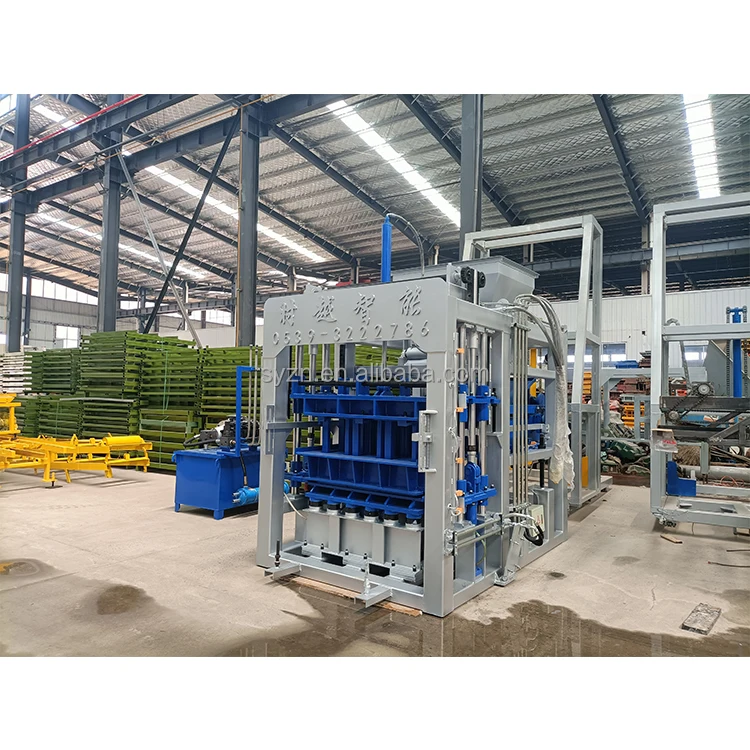
Complete line synchronization — every station from the raw material batcher to the cubing system is matched to the QT10-15 press cycle so the line runs at its rated rhythm without dead time.
Technical Specifications
| Parameter | Value |
|---|---|
| Product Type | Stationary block machine |
| Vibration Force | Up to 120 kN |
| Hydraulic Pressure | 31.5 MPa |
| Cycle Time | 20–25 seconds depending on block format |
| Pallet Size | 1100 × 850 mm |
| Mould Change System | Hydraulic clamp with guide rails |
| Control System | PLC with touchscreen HMI |
| Main Motor Power | 37 kW |
| Total Line Installed Power | Approximately 110 kW depending on configuration |
| Automation Level | Configurable from semi-automatic to fully automatic stacking and cubing |
| Voltage | Configurable to buyer’s site supply (basis to be confirmed) |
Application Suitability
| Application | Material or Output |
|---|---|
| Hollow block production | Crushed stone, cement, sand aggregate blends |
| Solid block production | Dense concrete mixes with local gravel |
| Paving block production | High-strength concrete with fine aggregate surface layer |
| Kerbstone and interlocking brick | Semi-dry concrete with pigment dosing |
| Porous permeable brick | Open-graded aggregate with controlled cement content |
What "Cycles per Hour" Leaves Out When Sizing a Block Machine QT10-15
A press rated at 20–25 seconds per cycle only delivers that pace when every upstream and downstream station keeps up.
I have stood on sites in West Africa where a QT10-15 sat idle for fifteen seconds every cycle because the mixer discharged a batch in forty seconds while the press needed fresh material in twenty-five. The daily output was roughly half of what the buyer expected from the brochure figure. The press itself was not at fault — the batching station and the pallet return conveyor were simply not timed to the same beat. [NEED_CITE: production line synchronization standards for concrete block plants]
Matching Every Station to the Press Rhythm
A Block Machine QT10-15 operates in a fixed sequence: mould fill, vibration and hydraulic compaction, demoulding, and pallet transfer. Each step has a defined duration. The raw material feeder must deliver a measured charge within the mould-fill window, the mixer must discharge a complete batch before the next fill begins, and the pallet feeder must place a clean pallet under the mould before the press head descends. If any one of these stations runs slow, the press waits and the cycle stretches.
Where Line Bottlenecks Actually Hide
The bottleneck is rarely the press itself. More often it is the pallet return loop — pallets travel from the press to the wet-side conveyor, through the curing rack system, and back to the feeder. If the curing rack handler moves slower than the press discharge rate, pallets queue up and the press pauses. On sites I have visited in South Asia, adding a second pallet transfer shuttle removed the queue and let the press run continuously through the shift. [NEED_CITE: curing rack throughput matching in stationary block plants]
Reading the Specs That Actually Matter
Vibration force and hydraulic pressure together determine the green strength of the block leaving the mould. The QT10-15 delivers up to 120 kN of vibration combined with 31.5 MPa hydraulic pressure — sufficient for dense hollow blocks and high-strength pavers. Pallet size at 1100 × 850 mm defines the mould footprint and therefore the number of cavities per cycle. The PLC touchscreen controls the entire sequence, but the operator must still confirm that the batching recipe matches the local aggregate grading and moisture content before the first production run.
The Cost of Skipping Line-Level Configuration
When a buyer orders the press alone and sources the mixer, pallet conveyor, and stacker from different suppliers, the interfaces become the problem. Signal protocols differ, pallet dimensions drift by a few millimetres, and the stacker grip does not align with the pallet slots. I have seen a line in East Africa where the buyer spent three weeks rewiring signal relays because the third-party stacker expected a dry-contact pulse that the press PLC was not configured to send. The delay cost more in lost production than the integrated stacker would have added to the original quotation. [NEED_CITE: interface compatibility risks in mixed-supplier block lines]
Why Sourcing the Full Line from One Supplier Changes the Outcome
Every station on a QT10-15 line is specified against the same cycle-time calculation, so the mixer discharge, pallet feed, and stacker pickup are all timed to the press rhythm before the equipment leaves the factory. The pallet size is chosen to match both the mould layout and the curing rack spacing the buyer already has on site. The PLC program covers the entire sequence from batching through cubing, eliminating signal-conversion relays between third-party controllers. Moulds are designed and built in-house to the buyer’s block format drawings, so cavity count and wall thickness match the local market requirement. Factory testing runs the complete line — not just the press — so cycle timing is verified before container loading. [NEED_CITE: factory acceptance testing for integrated block production lines]
Documentation & Verification
- Line layout drawing showing station spacing and pallet flow path for your QT10-15 configuration
- Capacity calculation sheet stating block format and cycle time assumption per product type
- Pallet specification matched to your curing rack dimensions and forklift tine width
- Hydraulic and electrical schematics with valve and sensor identification
- PLC program language and voltage confirmation signed off before production
- Factory test record running your chosen mould through a full production cycle
Installation, Commissioning & Support
- Foundation plan with load points and anchor bolt positions specific to the 37 kW press frame
- Dedicated power circuit sizing based on your confirmed voltage and the 110 kW total line draw
- Machine arrives in numbered sub-assemblies with lifting points marked for site crane handling
- Commissioning includes full-line cycle timing adjustment with your local aggregate and mix design
- Operator training covers PLC fault screens, mould change procedure, and daily greasing schedule
- Wear parts list with part numbers for hydraulic seals, vibration springs, and mould liners
Before You Request a Quotation
To size a QT10-15 line that actually runs at its rated pace, we need to know which block formats you plan to produce and the daily volume target for each. Tell us about your local aggregate source, available cement type, and the curing space you have on site. Confirm your site voltage, frequency, and preferred PLC display language so the control system arrives ready to run. If you already have pallets, forklifts, or a curing rack system, share the dimensions — the line will be configured to fit them.
Frequently Asked Questions
Q: Can I add automatic stacking and cubing to a semi-automatic QT10-15 later?
A: Yes. The PLC architecture supports a staged upgrade path. The semi-automatic configuration leaves reserved I/O channels and mechanical mounting points for an automatic stacker and cubing station. When you are ready to upgrade, the new modules plug into the existing control system without replacing the main PLC or rewiring the press. The upgrade is typically completed during a scheduled production shutdown.
Q: How do you confirm the line cycle time before shipment?
A: We run a factory acceptance test using your specified mould and a representative mix. Every station — batcher, mixer, pallet feeder, press, stacker — operates in sequence, and we record the actual cycle time for each format. The test report is shared with you before the equipment is dismantled for container loading, so you know the verified output before it leaves the factory.
Q: What happens if my local aggregate differs from the test mix?
A: The mix design is the first item we confirm during the inquiry stage. If your aggregate grading, particle shape, or moisture behavior differs from our test material, we adjust the vibration duration and hydraulic pressure profile in the PLC recipe. This adjustment is validated during on-site commissioning so that block strength meets your market standard with your actual raw materials.
Q: How long does a mould change take on the QT10-15?
A: The hydraulic clamp and guide rail system allows a trained operator to remove one mould and seat the next without disconnecting hydraulic lines. Typical changeover takes one shift segment when the operator is familiar with the procedure. We include a step-by-step mould change sequence in the operation manual and cover it during on-site training so your team can perform it independently.
Q: Do you supply spare pallets with the line?
A: Pallets are specified as part of the line package based on your curing rack capacity and daily production volume. We calculate the number of pallets needed to keep the press running continuously through your curing cycle duration. Replacement pallets can be ordered separately at any time, and the specification is documented so you can also source them locally if preferred.


