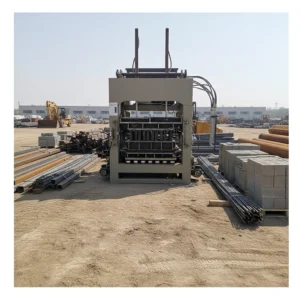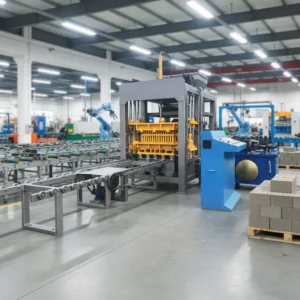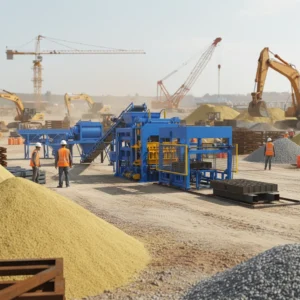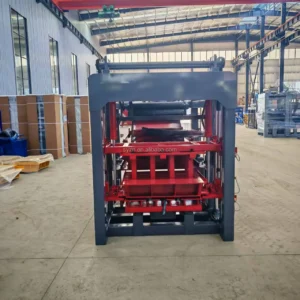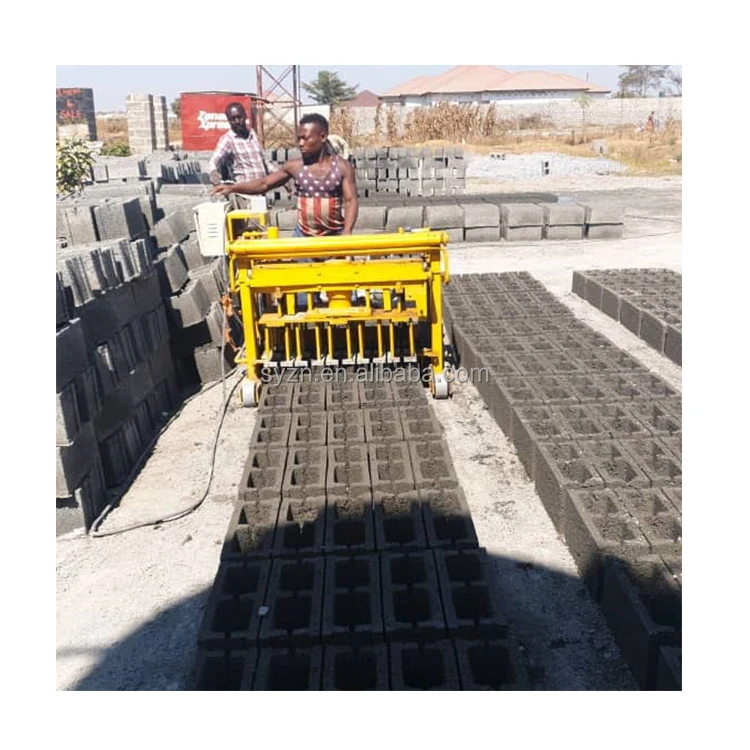
Line-Level Cycle Matching — the QMY4-30 mobile press is specified alongside its mixer, conveyor, and curing workflow so the 30-second molding cycle is never left waiting for upstream material.
Technical Specifications
| Parameter | Value |
|---|---|
| Model | QMY4-30 |
| Product Type | Mobile Egg-laying Block Making Machine |
| Overall Dimensions (L×W×H) | 1300 × 1500 × 1000 mm |
| Total Mass | 950 – 1000 kg |
| Vibration Method | Mold Vibration |
| Vibration Force | 28.6 kN |
| Excitation Frequency | 4500 r/min |
| Total Power | 5.95 kW |
| Molding Cycle | 30 s |
| Output Capacity | 3000 pcs/day (8 h) (basis not stated in source — confirm block format and mix) |
| Raw Materials | Concrete, sand, cement, fly ash, lime, slag, river sand, construction waste, stone dust, mine tailings, coal gangue |
| Control System | Manual handle operation |
| Mould Format | Customizable per buyer drawing |
| Automation Level | Manual |
| Pallet Requirement | None (egg-laying type) |
Application Suitability
| Application | Material or Output |
|---|---|
| On-site hollow block production for housing projects | Crushed stone, cement, sand |
| Remote or mountainous terrain block laying | Fly ash, river sand, lime blends |
| Small-scale paving and kerbstone runs | Stone dust, construction waste aggregate |
| First-time entrepreneur block plant | Slag, coal gangue, mine tailings |
| Coastal and desert construction camps | Local sand with cement binder |
Why Mixer Output Decides Your Real Block Count
A press that waits for concrete is a press that costs you money every idle minute.
I have watched QMY4-30 units sit silent on African job sites because the pan mixer could not discharge a fresh batch fast enough to feed the 30-second molding cycle. The press itself is capable, but when the block making machine production line is not planned as a continuous chain, the rated cycle time becomes irrelevant. Upstream batching, mixing duration, and material conveying must all be calculated backward from the press cadence so that each station hands off work exactly when the next station is ready [NEED_CITE: typical batch mixer discharge times for small-scale concrete operations].
Matching Every Station to the Press Cadence
The QMY4-30 completes a mold cycle every 30 seconds. That means the mixer must deliver a homogeneous batch at least every few cycles, and the raw material feeder must keep the mixer charged without pauses. When any upstream station falls behind, the block making machine production line stalls and daily output drops well below the calculated figure. We map each station’s throughput against the press demand before finalizing equipment selection.
Curing Logistics When There Are No Pallets
Egg-laying machines deposit blocks directly on the ground, which shifts the entire curing burden to floor space and protection methods. The curing area must be leveled, shaded, and large enough to hold multiple days of output before blocks can be moved. If the curing footprint is undersized, the operator runs out of production floor and the press stops early — a bottleneck that has nothing to do with the press itself [NEED_CITE: curing space requirements for ground-laid concrete blocks].
Vibration Force, Mix Design, and Block Density
The 28.6 kN mold vibration at 4500 r/min compacts concrete inside the mold cavity, but its effectiveness depends entirely on the mix design feeding it. A blend that is too dry will not consolidate fully, leaving weak corners; a blend that is too wet will slump after the mold lifts. The vibration parameters are fixed on this machine, so the mix must be adjusted to match — not the other way around. Local aggregate grading, cement ratio, and moisture content all shift the optimum, and trial batches are the only reliable way to lock in settings before full production begins.
The Cost of Skipping Line Integration
When a buyer treats the QMY4-30 as a standalone purchase and sources the mixer, conveyor, and curing racks separately, mismatched capacities are almost guaranteed. An undersized mixer starves the press. An unprepared curing area forces early shutdowns. Incorrect voltage or frequency on any single station delays the entire commissioning [NEED_CITE: common commissioning delays from voltage and frequency mismatches]. These are not equipment failures — they are planning gaps that surface only after the machines arrive on site.
Why Specify the Full Line Here
Block machinery is our single focus, so the QMY4-30 is never quoted in isolation. We configure the mixer batch size, material feeder rate, and curing rack count around the press cadence. Mould formats are designed against the buyer’s market demand, including custom drawings when standard shapes do not apply. Voltage, frequency, and control language are confirmed before production begins so that every electrical component matches the destination site. Factory testing runs the full sequence — feeding, mixing, molding, curing handling — not just the press alone, and the test record ships with the container.
Documentation & Verification
- Line layout drawing showing station spacing and material flow for the QMY4-30 setup
- Capacity calculation sheet stating the exact block format and mix assumed
- Hydraulic and electrical schematic with confirmed voltage and frequency
- Factory test record covering full cycle sequence before dispatch
- Mould drawing and format list matched to buyer’s product range
- Operation and maintenance manual in the confirmed control language
Installation, Commissioning & Support
- Ground leveling and curing area preparation guidance based on QMY4-30 egg-laying footprint
- Electrical circuit planning for 5.95 kW total press load plus mixer and feeder draw
- Machine assembly from shipping configuration with mold alignment verification
- First-run trial batching to match vibration force with local aggregate and cement ratio
- Operator training on manual handle cycle, mold change procedure, and daily lubrication points
- Wear parts list covering mold liners and vibration components with reorder intervals
Before You Request a Quote
To size a block making machine production line around the QMY4-30, we need your target block dimensions and daily volume, the local raw materials you plan to use, your available curing area dimensions, and the site voltage and frequency. Share any existing mixers or conveyors so we can assess whether they match the press cadence or need adjustment.
Frequently Asked Questions
Q: How is the 3000 pieces per day figure determined for this machine?
A: The daily figure is based on an eight-hour shift with a 30-second molding cycle, but the exact block format, wall thickness, and mix design are not stated in the source data. Real output depends on which block size you produce and whether upstream mixing keeps pace. We provide a format-specific capacity calculation with every line proposal.
Q: What mixing equipment do I need upstream of the QMY4-30?
A: The mixer must deliver a consistent batch often enough to prevent the press from idling between cycles. Batch volume, mixing time, and discharge speed all matter. We match the mixer model and conveyor rate to the 30-second press cadence during line planning so the block making machine production line runs without starvation.
Q: How should I plan the curing area for ground-laid blocks?
A: Since the egg-laying machine places blocks directly on the ground, you need a leveled, shaded surface large enough to hold several days of output. Blocks must remain undisturbed until they gain sufficient strength for handling. We include curing area sizing and protection recommendations in the line layout.
Q: What electrical details must I confirm before ordering?
A: Voltage, frequency, and plug type vary by country and must match every motor and control component on the line. The QMY4-30 draws 5.95 kW, but the full line including mixer and feeder requires additional capacity. We confirm all electrical specifications before production to avoid commissioning delays on arrival [NEED_CITE: voltage and frequency standards by export market].
Q: Can I expand from egg-laying to pallet-based production later?
A: The QMY4-30 is designed specifically as an egg-laying unit without pallets. If your production volume grows and you need automatic stacking or pallet-based curing, moving to a pallet-based press model is the typical path. We can discuss upgrade options and how your existing mixer and material prep stations may carry over to a larger line.