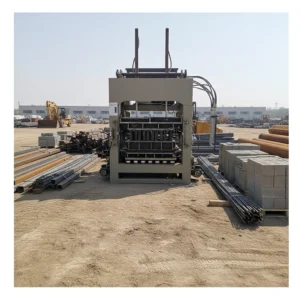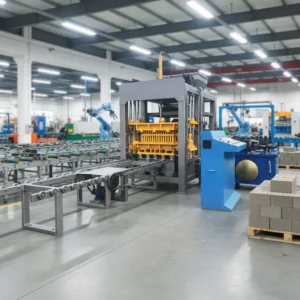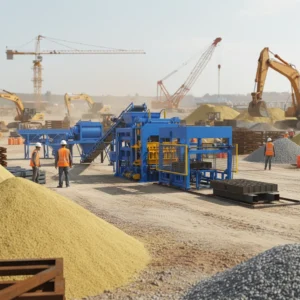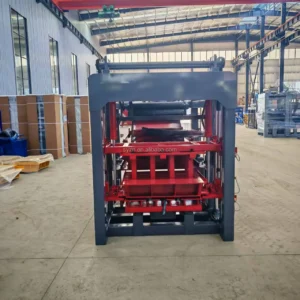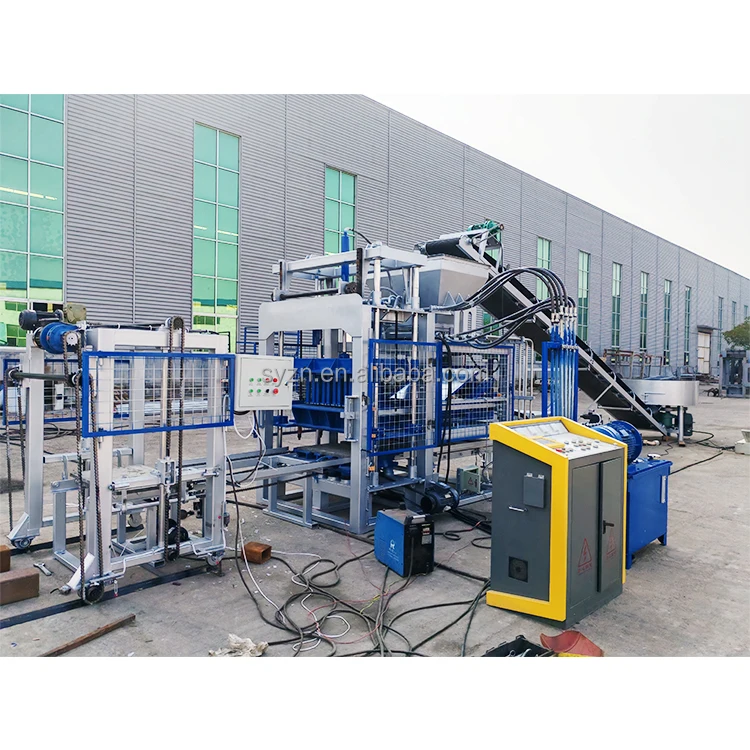
Line-Cadence Matching — every station from raw material intake to the curing rack is specified against the QT4-15 cycle so the press never waits for a pallet or mixer discharge.
Technical Specifications
| Parameter | Value |
|---|---|
| Model | QT4-15 |
| Product Type | Automatic Concrete Block Making Machine |
| Overall Dimensions (L×W×H) | 4100×1600×2600 mm |
| Total Mass | 4 T |
| Rated Pressure | 16–21 MPa |
| Main Vibration Form | Platform Vibration |
| Vibration Frequency | 4200 r/min |
| Vibration Force | 55 kN |
| Pallet Size | 880×550 mm |
| Molding Cycle | 25–30 s (basis not stated in source — confirm block format / material / thickness) |
| Overall Power | 18.45 kW |
| Demolding Method | Hydraulic |
| Factory Area Required | 300 m² |
| Automation Level | Fully automatic |
| Warranty | 1 year (excluding spare parts) |
Application Suitability
| Application | Material or Output |
|---|---|
| Hollow and solid block production for building walls | Crushed stone, sand, cement, fly ash, gravel, slag |
| Paving block manufacturing for municipal walkways and plazas | Colored aggregate blends and cement |
| Interlocking block production for retaining walls and landscaping | Sand, cement, dust, and fine gravel |
| Curbstone production for road and infrastructure projects | Coarse aggregate, sand, and cement |
| On-site block production for housing developments | Locally sourced crushed stone and cement |
What a Cycle Time Without a Block Format Actually Costs
A molding cycle is only a useful number once the block format, mix design, and pallet size are locked in.
I have watched contractors pull an automatic concrete block making machine production line onto a site and run the first shift, only to discover the daily tally falls well below the spreadsheet they used to justify the purchase. The cycle range on this press spans from a thin paver to a tall hollow block, and each format demands a different vibration dwell, hydraulic stroke, and feed depth. Until the buyer names the exact product the local market moves, the output figure remains a guess. [NEED_CITE: block format and mix design influence on cycle time]
How the Raw Material Station Sets the Press Rhythm
The QT4-15 completes a mold fill, press, and demold sequence within its stated cycle range, which means the mixer must discharge a fresh batch and the pallet feeder must present a clean board before the press finishes its current stroke. When the mixer is undersized or the belt conveyor runs too slowly, the press idles at the top of each cycle, and those empty seconds accumulate across a shift. We size the mixer drum, conveyor width, and hopper gate timing around the press cadence so the automatic concrete block making machine production line runs without micro-stops.
Where Pallet Handling Becomes the Real Bottleneck
A pallet size of 880×550 mm dictates the footprint of every curing rack, the turning radius of the forklift, and the stacking pattern in the yard. If the buyer already operates a curing area built for a different board dimension, the new pallets will not seat properly on existing racks, forcing a rebuild of the curing zone or a daily manual restacking routine. Confirming the pallet specification against the yard layout before the line ships prevents a bottleneck that no amount of press speed can fix. [NEED_CITE: pallet size coordination with curing rack systems]
Reading the Pressure and Vibration Numbers Together
The 16–21 MPa hydraulic pressure compresses the mix while the 55 kN vibration force at 4200 r/min settles fines into the voids between coarse aggregate. Neither figure works alone — high pressure without sufficient vibration leaves air pockets and weak corners, while heavy vibration without enough clamping force produces blocks that slump before demolding. The correct balance depends on the buyer’s local aggregate gradation and cement content, which is why mix design confirmation happens before the hydraulic relief valve is set on the factory floor.
The 880×550 mm pallet must be matched to a specific mold cavity layout, and each cavity count changes the tonnage per cycle. A mold that produces four hollow blocks per stroke places a different load on the platform than one producing twelve interlocking pavers, so the hydraulic circuit and vibration motor must be tuned to the heaviest format the buyer plans to run regularly.
The Price of Skipping the Line Audit
When the stacker, conveyor, and curing rack are sourced separately or left out of the initial order, the press outruns the rest of the yard within hours. Wet blocks pile up on the discharge side, handlers drop boards, and uncured products chip against each other, generating scrap that wipes out the margin the press was supposed to deliver. These losses show up as missing corners, uneven heights, and rejected pallets — problems that trace back to a line that was never balanced as a single system. [NEED_CITE: production line synchronization and block scrap rates]
Why Buyers Source the Complete Setup Here
Block machinery is our single focus, so the press, mold, pallet, and handling equipment are specified as one matched system rather than assembled from unrelated suppliers. Each configuration is set against the buyer’s actual mix design and local aggregate, not a catalog default, which means the hydraulic pressure and vibration force arrive calibrated for the materials the plant will actually use. Molds are designed for the formats the buyer’s market sells, including custom drawings when standard cavities do not match local demand. Automation levels remain selectable, allowing a buyer to start with semi-automatic pallet handling and add stacking and cubing later. Installation support includes on-site commissioning and operator training so the crew can run independent shifts from the first week.
Documentation & Verification
- Line layout and capacity calculation stating the block format assumed for each output figure
- Machine specification sheet with hydraulic and electrical schematics
- Mold drawing and format list covering every cavity option quoted
- Pallet specification matched to the buyer’s curing rack and forklift
- Voltage, frequency, and PLC display language confirmation before production
- Factory test record run on the buyer’s target block format before dispatch
Installation, Commissioning & Support
- Foundation pad sized to the 4100×1600 mm footprint with anchor bolt template provided
- Dedicated circuit rated for the 18.45 kW total load with voltage confirmed before shipment
- Machine arrives with hydraulic and electrical connections labeled for rapid field assembly
- First-run parameter tuning set to the buyer’s mix design and target block format
- Operator training covers mold change procedure, daily lubrication, and PLC navigation
- Wear parts and mold list supplied so first replacements are on hand when needed
Before You Send the Inquiry
Share the block formats your market moves most, the daily output you need per format, and the raw materials available at your site. Include your local voltage, frequency, and preferred PLC display language, along with the curing area dimensions and forklift capacity you already operate. If you have existing mixers, conveyors, or pallet systems you plan to retain, list their specifications so the new line can be matched to them.
Frequently Asked Questions
Q: How is daily output calculated for the QT4-15, and which block format does the cycle time assume?
A: The 25–30 second molding cycle is a range that shifts depending on block height, cavity count, and mix consistency. We calculate daily output by selecting the exact format the buyer plans to run, then multiplying the per-stroke cavity count by the achievable strokes per hour after accounting for pallet indexing and mold fill time. No single output figure applies across all formats.
Q: How do I match pallet size and material to my existing curing area and forklift?
A: The 880×550 mm pallet must seat on your current curing racks without overhang or gap, and your forklift must lift a full rack load within its rated capacity. We confirm rack spacing, forklift tine width, and maximum loaded weight before finalizing the pallet material — wood, bamboo, or composite — so the boards survive the curing cycle without warping.
Q: What supporting equipment is needed to prevent the press from waiting between cycles?
A: A mixer with discharge timing matched to the press cycle, a pallet feeder that indexes a clean board before each stroke, and a stacker or conveyor that clears finished pallets fast enough to keep the discharge side clear. Each station is sized so the QT4-15 never idles waiting for material or pallet space.
Q: How are voltage, frequency, and PLC control language confirmed before shipment?
A: We collect the buyer’s site voltage, phase, and frequency during the quotation stage, then confirm the PLC display language and electrical schematic before production starts. This prevents commissioning delays caused by mismatched motor windings or an interface the operators cannot read.
Q: What is included in the 1-year warranty, and are hydraulic wear parts and molds covered?
A: The warranty covers manufacturing defects in the press structure, hydraulic circuit, and electrical system for one year from commissioning. Consumable items such as mold liners, hydraulic seals, and vibration motor bearings are excluded but listed in the wear parts document so replacements can be ordered with the initial shipment.