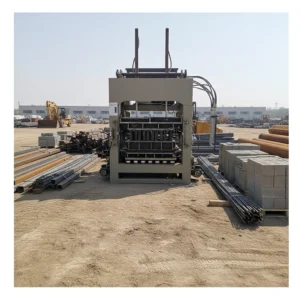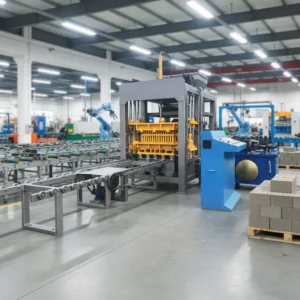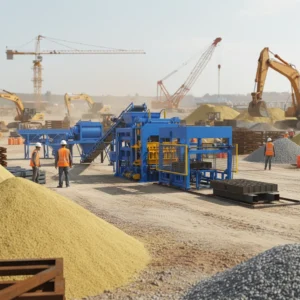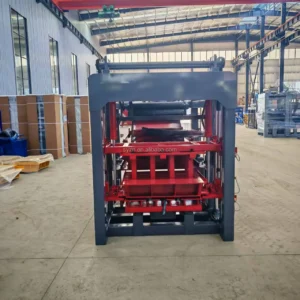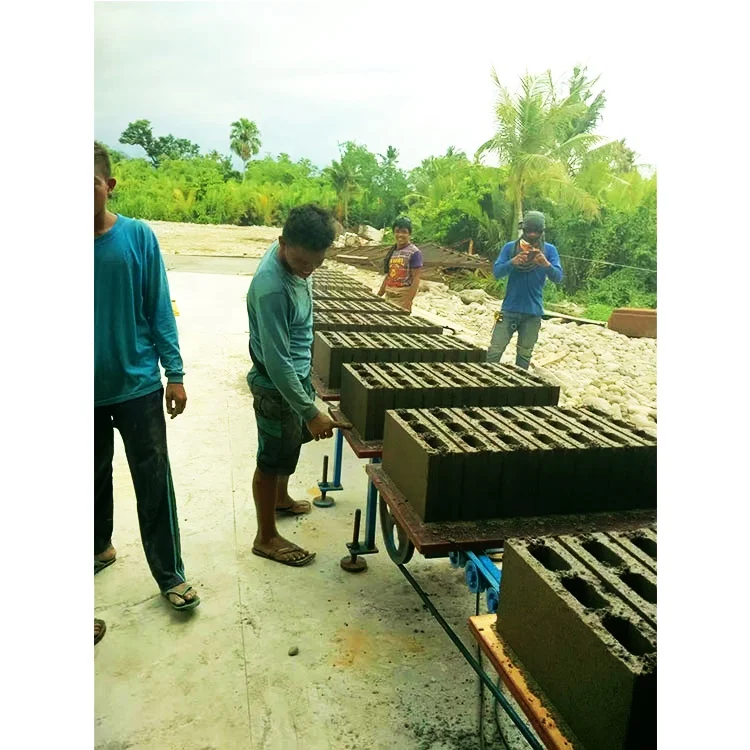
Matched System Supply — Every station around the Qt4-25a press, from raw material feed through to stacking and curing, is specified together so no single link in the line dictates your real daily output.
Technical Specifications
| Parameter | Value |
|---|---|
| Model | Qt4-25a |
| Product Type | Automatic Hydraulic Block Making Machine |
| Overall Dimensions (L×W×H) | 7100×1600×2610 mm |
| Net Weight | 5800 kg |
| Rated Power | 27.5 kW |
| Voltage & Frequency | 380V or customized (frequency confirmed before production) |
| Control System | PLC (brand and model to be confirmed) |
| Vibration Force | 60 kN |
| Pallet Size | 1020×850×40 mm |
| Mould Format Options | 400×200×200 mm hollow block (4 pcs/mould); 400×150×200 mm hollow block (6 pcs/mould); 225×112.5×53 mm solid brick (16 pcs/mould) |
| Output Capacity | 960 pcs/h based on 400×200×200 mm hollow block; 1440 pcs/h based on 400×150×200 mm hollow block; 3840 pcs/h based on 225×112.5×53 mm solid brick |
| Daily Output | 7680 pcs/day based on 400×200×200 mm hollow block; 11520 pcs/day based on 400×150×200 mm hollow block; 30720 pcs/day based on 225×112.5×53 mm solid brick (shift hours to be confirmed) |
| Automation Level | Automatic (pallet handling, stacking, and cubing scope to be confirmed) |
| Color Options | Customized to buyer request |
| Warranty | 1 year |
| Standards | ISO 9001:2008, CE |
Application Suitability
| Application | Material or Output |
|---|---|
| Block and paver production plant | Hollow blocks and solid bricks from crushed stone, sand, cement, and fly ash |
| Construction contractor producing on-site | Hollow blocks from locally available aggregate for project walling |
| Concrete product manufacturer adding formats | Solid bricks and hollow blocks alongside existing paver or kerbstone lines |
| Development and housing project contractor | Standard hollow blocks and bricks produced at the building site |
When the Rest of the Line Cannot Keep Up with Your Automatic Block Making Machine
A block press only runs as fast as the slowest station feeding it or clearing its output.
I once laid out an automatic block making machine production line where the press cycle was fast but the mixer discharge could not keep pace. The operator stood idle for seconds each cycle, waiting for the hopper to fill. Over a full shift, that gap cost roughly a third of the planned output. The press was never the problem; the batching and mixing stations were. This is the kind of mismatch that only becomes visible on site, when the line is running and the daily tally comes up short. A complete line plan must account for every station between the aggregate silo and the curing rack [NEED_CITE: material flow rate matching across block line stations].
How the Upstream Stations Must Match the Press Rhythm
The Qt4-25a completes a vibration and hydraulic pressing cycle within a fixed window. If the mixer has not delivered a fresh batch into the feed hopper before that cycle ends, the press pauses. For an automatic block making machine production line, the raw material batching system, the conveyor belt speed, and the mixer discharge timing are all calculated backward from the press cycle time. Each upstream station needs enough buffer capacity to absorb minor interruptions without starving the host.
What Happens Downstream When the Line Is Not Balanced
Wet blocks leaving the press ride on pallets that must be transferred, stacked, and moved to curing before the next pallet arrives. If the pallet return conveyor or the stacking station is undersized, pallets queue at the press exit and the machine stops. I have seen lines where the stacking was still done by hand, which capped output well below what the press was rated for. The automatic block making machine production line only delivers its stated capacity when the exit side is planned with the same precision as the press itself [NEED_CITE: block curing and pallet handling throughput requirements].
Reading the Specifications Against Real Production Conditions
The 60 kN vibration force works in tandem with hydraulic pressure to compact the mix into the mould cavity. The density and strength of the finished block depend on whether these two forces suit your specific aggregate gradation and cement content. A mix that is too dry will not consolidate fully under 60 kN; a mix that is too wet will slump after demoulding. The 1020×850×40 mm pallet size must match the curing rack spacing and the forklift tine width you already have on site, otherwise you face a costly equipment change before the first production run. Voltage and frequency are configurable — the 27.5 kW rated power is drawn across the press station, and the full line load will be higher once the mixer, conveyors, and pallet handling motors are added to the total connected load.
The Hidden Cost of a Quotation That Stops at the Press
When a quotation lists only the press, the buyer assumes responsibility for everything around it. Pallet handling, stacking, and curing rack transfer are left to manual labor or to equipment you source separately. Mismatches appear on the first production day: the mixer is too slow, the pallets are the wrong size for your racks, or the voltage at the panel does not match the motor nameplates. Each of these issues stops the line and burns through the schedule you promised your customer [NEED_CITE: common block line commissioning delays due to scope gaps].
Why the Whole Line Comes from One Source
Block machinery is our single focus, which means the Qt4-25a press, its moulds, pallets, and every handling station are specified as one matched set rather than assembled from separate suppliers. The line layout we provide states the block format assumed for each output figure, so there is no ambiguity about what 960 pieces per hour actually means. Configuration is set against your actual mix design and local aggregate, not a catalogue default. Pallet size and material are chosen to fit your curing area dimensions and existing forklift. Voltage, frequency, and PLC display language are confirmed before production begins, so commissioning is not delayed by electrical mismatches on arrival [NEED_CITE: block line documentation standards for export machinery].
Documentation & Verification
- Line layout drawing with capacity calculation stating the block format assumed per output tier
- Machine specification sheet covering all stations, not the press alone
- Mould drawing and format list showing cavity count per block size
- Hydraulic and electrical schematic for the full line circuit
- Factory test record run on your target block format before dispatch
- Voltage, frequency, and PLC language confirmation sheet signed before shipment
Installation, Commissioning & Support
- Foundation plan showing load points for the 5800 kg press and all supporting stations
- Electrical panel layout with dedicated circuit sizing for the 27.5 kW press load plus line motors
- Assembly sequence for the 7100×1600×2610 mm press and conveyor connections
- PLC parameter setting and mould change procedure on your block format
- Operator training covering daily start-up, pallet loading, and block quality checks
- Wear parts list and mould spare parts schedule for the first replacement interval
What We Need to Size Your Line
Send us your target block format and required daily output, the raw materials available locally with typical aggregate sizes, and your site dimensions including curing yard space. We also need your supply voltage, frequency, and preferred PLC display language so that the automatic block making machine production line we configure arrives ready to run. If you have existing conveyors, mixers, or forklifts that must integrate into the new layout, include those details so we can match the interfaces.
Frequently Asked Questions
Q: How are raw material feeding and mixing stations sized so the Qt4-25a press is not left waiting between cycles?
A: The mixer batch volume and discharge rate are calculated from the press cycle time and mould cavity count. The feed conveyor speed is then set so that a full batch reaches the hopper before the press completes its current cycle, keeping a continuous rhythm without material starvation or overflow.
Q: Is automatic stacking and cubing included in the line quotation, or must output be handled manually?
A: The stacking and cubing scope depends on the automation level selected. We confirm during the proposal stage whether pallet transfer, block stacking, and cubing are included in the quotation or left for manual handling, so there is no gap between the press exit and the curing rack.
Q: How is pallet size and material chosen to match the curing area and forklift already on site?
A: We take the dimensions of your existing curing racks and the tine width and load capacity of your forklift, then specify pallets that fit both. For the Qt4-25a, the standard pallet is 1020×850×40 mm, but material and thickness can be adjusted to suit your handling setup.
Q: What voltage, frequency, and PLC language are confirmed before the line ships?
A: Before production starts, we confirm your site supply voltage and frequency along with the preferred PLC display language. This avoids commissioning delays caused by motor or control mismatches when the automatic block making machine production line arrives at your facility.
Q: Can the line start semi-automatic and upgrade to full automatic stacking later?
A: Yes. The Qt4-25a can begin operation with manual pallet handling and be upgraded to automatic pallet feeding and stacking as production volume grows. The mechanical interfaces for the upgrade are planned into the initial line layout so that later additions connect without major modification.