
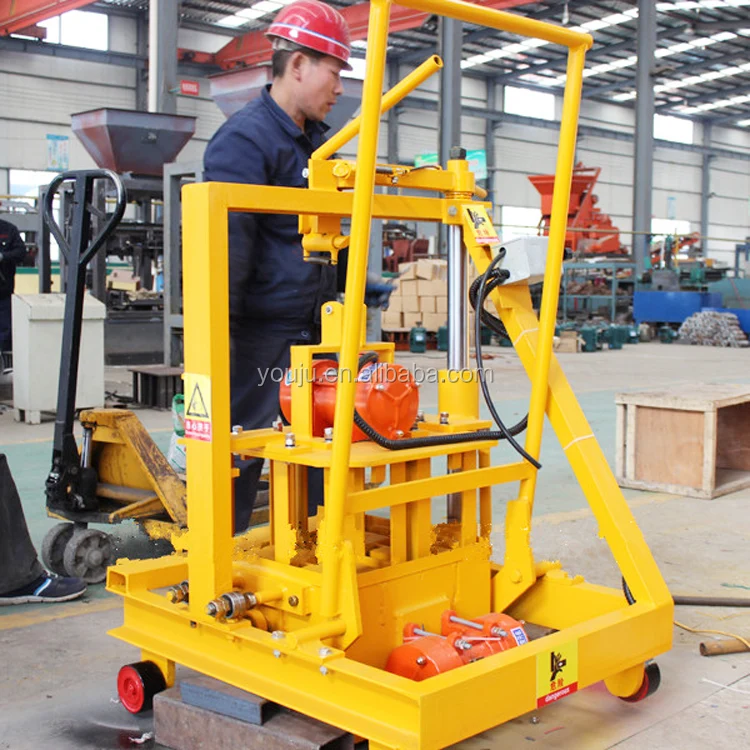
Line balance over press speed — the QMJ2-45 mobile block making machine is specified as the centerpiece of a coordinated on-site production cell, where mixer cycle time, material feed rate, and curing layout are sized around a 25–30 second moulding tempo so the press never waits between cycles.
Technical Specifications
| Parameter | Value |
|---|---|
| Model | QMJ2-45 |
| Product Type | Mobile Egg-laying Concrete Block Making Machine |
| Machine Type | Mobile / egg-laying (no pallets required) |
| Moulding Cycle | 25–30 s |
| Output — Hollow Brick 400×200×200 mm | 2 pcs/mould, 160 pcs/h, 1,280 pcs/8 hr |
| Output — Hollow Brick 400×150×200 mm | 3 pcs/mould, 240 pcs/h, 4,800 pcs/8 hr |
| Output — Hollow Brick 400×100×200 mm | 4 pcs/mould, 320 pcs/h, 2,560 pcs/8 hr |
| Mould Change | Manual, supports multiple hollow brick formats |
| Power Source | Electric motor (voltage & frequency to confirm before order) |
| Control System | Manual operation |
| Labor Requirement | 1–3 workers |
| Pallet Requirement | None (lays blocks directly on ground) |
| Mobility | Free-moving on site, no fixed foundation required |
| Mould Heat Treatment | Carburization technology |
| Certification | ISO 9001:2000 / CE |
Application Suitability
| Application | Material or Output |
|---|---|
| Temporary on-site housing projects | Hollow blocks from local river sand, crushed stone and cement |
| Remote construction sites without fixed plant | Masonry blocks laid directly on compacted ground |
| First-stage block production ventures | Low-volume hollow bricks with manual pallet-free workflow |
| Infrastructure masonry in space-constrained yards | Interlocking wall units from locally sourced aggregate |
What "Output per Hour" Means When the Mixer Cannot Keep Up
A mobile press that waits for the next batch of concrete is a line bottleneck, not a production asset.
I have watched small contractors in West Africa buy an egg-laying block machine based on the quoted hourly figure, then discover that a hand-fed drum mixer delivers fresh concrete every four minutes while the press cycles every half minute. The operator stands idle, the crew gets paid for a full shift, and the daily count lands well below the number on the invoice. When planning a mobile block making machine production line, the first question is always whether the mixing station can match the press tempo across an entire eight-hour day [NEED_CITE: on-site concrete batching cycle times for small block plants].
Mapping the Stations Around a Pallet-Free Press
An egg-laying machine removes the pallet return loop entirely, which simplifies the line but shifts planning effort to material flow. Aggregate and cement must reach the mixer at a rate that feeds the QMJ2-45 every 25–30 seconds, and the mixed concrete must travel from the mixer discharge to the press hopper without segregation. A mobile block making machine production line succeeds when each station — material storage, batching, mixing, and ground-level curing — is spaced so the machine operator walks the shortest practical distance between cycles.
Curing Layout as Part of the Production Cell
Because the QMJ2-45 lays blocks directly on the casting floor, the curing area is not a separate room but the ground the machine travels across. The floor must be level, compacted, and large enough to hold the full daily output before blocks are moved to final stacking. A shift producing hollow bricks at 400×150×200 mm leaves roughly 4,800 units on the ground, each requiring clearance for air circulation and forklift access once cured. Planning this area is as critical as sizing the mixer [NEED_CITE: ground curing area requirements per block format for egg-laying machines].
Reading the Numbers That Actually Matter
The moulding cycle of 25–30 seconds sets the rhythm, but real output depends on how fast a fresh mould of concrete arrives. The carburization-treated moulds hold their dimensional tolerance across abrasive local aggregates, reducing the frequency of block edge breakage during demoulding. Manual mould change across three standard hollow brick formats means one operator can switch production within a single shift, provided the next mould and the corresponding curing floor space are prepared in advance. The electric motor specification must match site voltage and frequency before dispatch, because a mismatched motor stalls the entire line on arrival and adds weeks of delay to commissioning.
The Cost of Skipping the Material Test
I once saw a crew in a laterite-rich region run a mobile press on unwashed clay-heavy sand. Blocks cracked during demoulding because the fine aggregate absorbed mixing water and weakened the green strength. The machine was not at fault — the mix design had never been adjusted for local material. Without a pre-production test on the exact aggregate the site will use, the quoted block strength becomes meaningless, and the curing floor fills with breakage instead of saleable product [NEED_CITE: effect of clay content in fine aggregate on hollow block compressive strength].
Why This Line Approach Reduces Idle Time
The QMJ2-45 is specified as part of a matched sequence rather than a standalone press. Line layout drawings show mixing station placement relative to the machine travel path, so concrete does not sit long enough to lose workability. Capacity calculations are stated per block format, meaning the curing area and material orders can be planned against a realistic number. Mould drawings confirm the exact hollow brick dimensions the buyer’s market requires, including custom formats to buyer specifications. Automation level is selectable — a buyer can start with manual pallet-free operation and add batching or stacking equipment later without replacing the press. Installation support includes operator training on mould change, daily greasing points, and the carburization-treated wear surfaces to inspect each week.
Documentation & Verification
- Line layout drawing showing QMJ2-45 travel path, mixer position, and curing area dimensions per block format
- Capacity calculation sheet stating the hollow brick size assumed for each output figure
- Mould drawing and format list confirming dimensions before production begins
- Voltage, frequency, and motor specification sheet confirmed against site power supply
- Factory test record on the buyer’s specified hollow brick format before dispatch
- Operation manual covering mould change procedure, daily maintenance points, and curing floor preparation
Installation, Commissioning & Support
- Level compacted ground required across the full casting and curing area before QMJ2-45 arrival
- Site power supply voltage and frequency confirmed so the electric motor is wired correctly on day one
- Machine delivered assembled with mould fitted; first run supervised to verify cycle tempo
- Mixer placement planned within one wheelbarrow distance of the press hopper to maintain the 25–30 second rhythm
- Operator training covers manual mould change across all three hollow brick formats and daily greasing schedule
- Carburization-treated mould wear surfaces inspected weekly; replacement mould lead time confirmed at order
Starting the Conversation
Before quoting a QMJ2-45 line, I ask for the target hollow brick format, the daily unit count the project requires, and a sample of the local aggregate. Site voltage and frequency determine the motor winding. If the casting floor area is known, I can confirm whether the curing layout supports the planned shift output or whether the mixer must be upsized to compress production into a smaller footprint.
Frequently Asked Questions
Q: How is daily output verified per block format, and what curing area does each format require?
A: Output figures for the QMJ2-45 are calculated at the 25–30 second cycle for each specific hollow brick size — 400×200×200, 400×150×200, or 400×100×200 mm. Curing area is then derived from the daily unit count and the ground clearance each block needs for air circulation. The line layout drawing includes this floor plan so the buyer can prepare the site before delivery.
Q: How should the mixing station be sized so the press is never waiting for material?
A: The mixer batch volume and cycle time must deliver fresh concrete to the QMJ2-45 hopper within the 25–30 second moulding window. An undersized mixer leaves the operator standing idle; an oversized one lets concrete stiffen before use. The line configuration specifies mixer capacity and placement distance based on the target block format and planned shift length.
Q: What ground preparation and curing layout is needed for an egg-laying machine on site?
A: The casting floor must be compacted, level, and large enough to hold the entire daily output of the QMJ2-45 before blocks are moved. For higher-output formats, this means several hundred square meters of cleared ground. The layout drawing marks machine travel lanes and block spacing so forklifts can access cured units without damaging fresh ones.
Q: How do voltage and frequency affect motor selection and line commissioning timing?
A: The QMJ2-45 electric motor is wound to match site voltage and frequency, which must be confirmed before production. A mismatch discovered on arrival halts commissioning until a replacement motor is sourced. The specification sheet locks in the electrical parameters so the machine runs on the first day of installation.
Q: Can the line be expanded later with batching or curing rack handling equipment?
A: Yes. The QMJ2-45 operates as a standalone mobile press initially, and the line can grow by adding an automated batching station, conveyor-fed mixer, or curing rack system as production volume increases. The manual mould change and egg-laying design remain compatible with upstream and downstream additions without replacing the press itself.


