
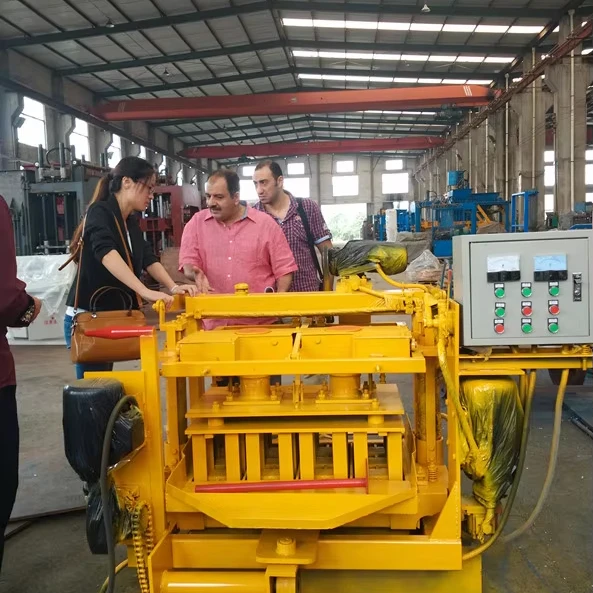
Matched System Design — the QMY4-30 mobile block machine is specified alongside its mixer, feeding station, and curing footprint so the press never waits between cycles.
Technical Specifications
| Parameter | Value |
|---|---|
| Model | QMY4-30 |
| Product Type | Mobile Concrete Block Making Machine |
| Rated Power | 5 kW |
| Control System | Manual operation (no PLC specified) |
| Overall Dimensions | 1200 × 1200 × 1100 mm |
| Net Weight | 950 kg |
| Mould Format | Changeable for hollow block and solid brick |
| Cycle Time | 30 seconds per mould (basis not stated in source — confirm block format and mix design) |
| Output Capacity (400×200×200 mm) | 4 pcs/mould, 480 pcs/h, 3840 pcs/8h (basis not stated in source) |
| Output Capacity (400×150×200 mm) | 5 pcs/mould, 600 pcs/h, 4800 pcs/8h (basis not stated in source) |
| Output Capacity (400×100×200 mm) | 7 pcs/mould, 840 pcs/h, 6720 pcs/8h (basis not stated in source) |
| Raw Materials | Cement, sand, crushed stones, slag |
| Automation Level | Manual / mobile egg-laying type |
| Pallet Size | Not required (mobile egg-laying operation on ground) |
| Assembly State | Single mobile unit |
| Voltage & Frequency | Configurable (confirm before shipment) |
Application Suitability
| Application | Material or Output |
|---|---|
| On-site hollow block production | Cement, sand, and crushed stone mix for 400×200×200 mm blocks |
| Solid brick manufacturing for housing projects | Cement and fine aggregate for 400×100×200 mm solid bricks |
| Small workshop block production | Local aggregate and slag blends for mixed hollow and solid formats |
| Contractor self-supply on remote job sites | Available raw materials with mobile egg-laying ground curing |
What "480 Pieces per Hour" Leaves Out About Mobile Block Machine Output
Cycle time only matters when you know which block format and mix design it assumes.
A Mobile Concrete Block Making Machine production line / turnkey is often quoted with a single output number, but that figure usually assumes the largest block format in the mould set. When a buyer switches to solid bricks, the per-mould piece count rises, but the cycle rhythm and curing logistics change completely. I have walked onto sites where the operator spent half the shift waiting for wet blocks to set enough to move, because the curing area was never sized against the actual daily volume [NEED_CITE: ground curing area requirements for egg-laying block machines]. The machine sat idle while the ground space caught up, and the real output fell far short of the catalogue claim. This page states capacity per format so planning starts with honest numbers.
The Press at the Center of a Compact Line
The QMY4-30 is a mobile egg-laying press that lays blocks directly onto the ground surface, eliminating the need for pallets and their associated handling systems. This means the supporting equipment around it must be configured differently from a stationary plant. The mixer must feed the machine’s hopper at a rate that matches the 30-second mould cycle, and the water supply must be consistent to avoid mix variation between batches. When the Mobile Concrete Block Making Machine production line / turnkey is set up correctly, the operator never waits for material or stops to clear a jam caused by an inconsistent feed.
How the Supporting Stations Must Match the Press Rhythm
In my years running equipment across project sites in Africa, the machines that performed worst were not the ones with mechanical faults — they were the ones where the mixer was too small, the feeding chute too narrow, or the curing ground too close to the machine path. A mobile egg-laying unit like the QMY4-30 moves forward after each cycle, so the travel path must be clear and the cured blocks from the previous day must already be removed. If the supporting stations are not matched to this rhythm, the press waits, and the daily output drops regardless of what the spec sheet says [NEED_CITE: production line synchronization for mobile block machines].
Why Power Rating and Machine Footprint Matter on Site
The 5 kW rated power drives both the vibration mechanism and the travel motor within a 1200 × 1200 × 1100 mm frame weighing 950 kg. This compact footprint allows the machine to operate in confined job sites where a stationary plant would require civil works and a dedicated building. However, the power draw must be matched to the site’s available supply, and the vibration force — which is not stated in the source data — must be confirmed against the buyer’s mix design. A mix with high clay content in the sand requires different vibration energy than clean crushed stone aggregate, and getting this wrong produces blocks that crumble before curing completes.
The Hidden Cost of Skipping the Line Layout Step
Buyers who order a mobile block machine without a line layout sketch often discover that their curing area is too small, their mixer is positioned too far from the feed point, or their forklift cannot navigate the machine’s travel path. The QMY4-30 produces blocks that must remain undisturbed on the ground for hours before they can be moved. If the site layout forces the machine to double back over fresh blocks, output drops and breakage rises [NEED_CITE: site layout impact on mobile block machine output]. These costs are invisible at the quotation stage but appear immediately during the first week of production.
Why Configuration Before Shipment Prevents On-Site Failure
The core reason to specify this machine as part of a complete line rather than a standalone press is that every parameter connects to the next. The mixer batch size must match what the hopper accepts per cycle. The water dosing must suit the local aggregate absorption rate. The curing ground must be level and large enough for the stated daily output. When these elements are confirmed before the machine leaves the factory, the operator starts producing usable blocks on day one rather than spending weeks adjusting ratios and rearranging the site. The Mobile Concrete Block Making Machine production line / turnkey approach means the buyer receives a system that works together, not a collection of parts that must be forced into alignment on site.
Documentation & Verification
- Line layout sketch showing mixer position, feed path, machine travel route, and required curing ground area
- Capacity calculation document stating block format, cycle time, and realistic 8-hour output per format
- Mould drawing and format list for each block size included in the shipment
- Voltage, frequency, and plug type confirmed in writing before production begins
- Factory test record on the buyer’s specified block format before dispatch
Installation, Commissioning & Support
- Ground must be level and compacted within the 1200 × 1200 mm machine footprint for stable egg-laying operation
- 5 kW power supply with dedicated circuit confirmed for site voltage and frequency before machine arrival
- Machine arrives as single mobile unit requiring no assembly beyond mould installation and hopper attachment
- First production run supervised to confirm cycle rhythm matches mixer output and curing area capacity
- Mould change procedure demonstrated on site for each block format included in the order
- Wear parts list supplied with recommended replacement intervals for vibration components and mould liners
What to Include in Your Inquiry
To configure the QMY4-30 as a working line rather than a standalone press, share your target block formats, daily output requirement, and the raw materials available locally including sand type and aggregate grading. Confirm your site voltage and frequency, the dimensions of your available curing ground, and whether you need the mixer and feeding equipment included in the scope. This information allows the line layout and capacity calculation to reflect your actual conditions rather than a catalogue default.
Frequently Asked Questions
Q: How is daily output calculated and what block format does the 30-second cycle assume?
A: The cycle time of 30 seconds per mould is stated without specifying which block format it assumes. For the 400×200×200 mm hollow block, the output is 4 pieces per mould yielding 3840 pieces per 8-hour shift. For the 400×100×200 mm solid brick, 7 pieces per mould yields 6720 pieces. These figures assume the mix design and aggregate support the stated cycle time, which must be confirmed against your local materials.
Q: What supporting equipment must the buyer prepare around the QMY4-30?
A: The machine operates as a mobile egg-laying unit, so pallets are not required. The buyer must provide a pan mixer sized to match the hopper feed rate, a consistent water supply, and a level ground curing area large enough for the daily output volume. The curing area must allow the machine to travel forward without crossing over blocks laid earlier the same day.
Q: Which block formats and moulds are included, and what is the mould change procedure?
A: The QMY4-30 accepts changeable moulds for hollow block and solid brick formats within one mobile unit. The mould change is a manual procedure performed on site. The exact formats included depend on the buyer’s order specification, and each mould is supplied with a drawing showing dimensions and block output per cycle.
Q: Is the machine configured for the buyer’s local aggregate and mix design?
A: The raw material range covers cement, sand, crushed stones, and slag, but the machine must be configured against the buyer’s specific aggregate grading and mix proportions. Without this information, the vibration energy and cycle time may not produce blocks that meet the required strength. Buyers should provide material samples or lab test data for configuration before shipment.


