
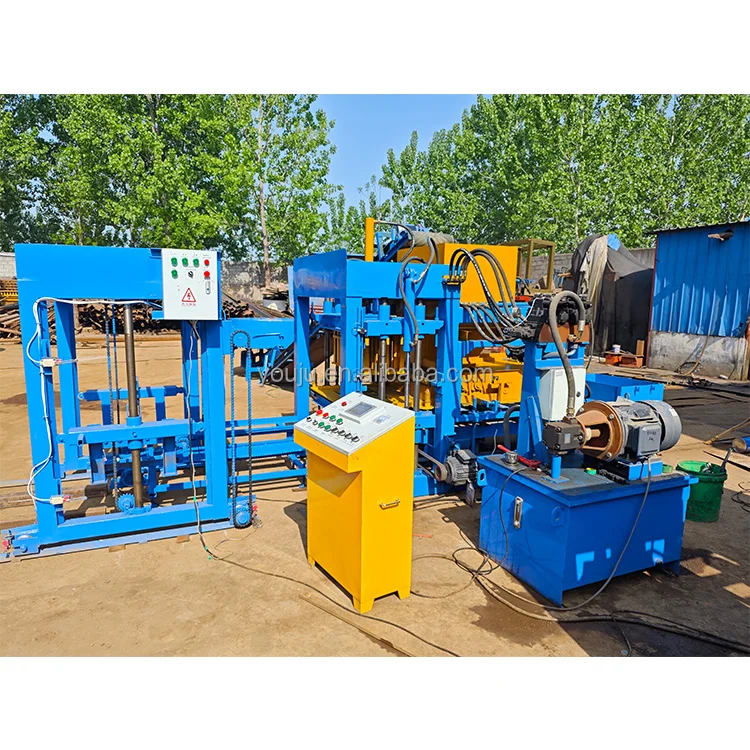
Line-matched stations — mixer output, conveyor feed, and press cycle are specified together so the press never starves for material.
Technical Specifications
| Parameter | Value |
|---|---|
| Model | QTJ4-25 |
| Product Type | Semi-Automatic Concrete Block Making Machine |
| Rated Power | 17.9 kW |
| Voltage & Frequency | Configurable to site requirement (basis to be confirmed) |
| Control System | Semi-automatic with hydraulic station |
| Overall Dimensions (L×W×H) | 6400 × 1500 × 2700 mm |
| Net Weight | 2500 kg |
| Output Capacity | 960 pcs/h / 7680 pcs/day (based on 400×200×200 mm hollow block, 4 pcs/mould) |
| Molding Cycle | 25 s |
| Pallet Size | 850 × 550 × 20 mm |
| Vibration Frequency | 2800 r/min |
| Exciting Force | 60 kN |
| Automation Level | Semi-automatic (manual pallet handling and stacking) |
| Included Configuration | Host machine 1 set, block mould 1 set, JQ350 mixer |
Application Suitability
| Application | Material or Output |
|---|---|
| Hollow block production for residential walls | Crushed stone, cement, sand, and fly ash mixes |
| Solid block production for load-bearing structures | Dense aggregate blends with standard cement ratios |
| Paving block manufacturing for walkways and yards | Fine aggregate and pigment mixes for surface finish |
| Curbstone production for road and driveway edges | Coarse aggregate with high cement content for impact resistance |
| On-site block production for housing projects | Locally sourced aggregate matched to available sand and gravel |
What "960 Pieces per Hour" Leaves Out When You Plan a Block Line
A press rate is only a line rate when every upstream and downstream station keeps pace.
I have watched contractors spend weeks selecting a block press on cycle time alone, only to find the mixer cannot batch fast enough to feed it. The press sits idle for seconds between cycles while the belt conveyor waits for the next batch, and the daily output drops well below the catalogue figure. A concrete block production line only reaches its rated throughput when the mixer batch size, conveyor feed rate, and pallet rotation are all matched to the 25-second moulding cycle of the press. Miss one station and the bottleneck shifts, but it never disappears. [NEED_CITE: line balancing principles in concrete product manufacturing]
How the Mixer and Conveyor Feed Rate Must Track the Press Cycle
The JQ350 mixer included with this line is sized so that one batch delivers enough material for a set number of moulding cycles before the next batch is ready. If the mixer were smaller, the QTJ4-25 would complete its cycle and wait. A larger mixer would hold material that begins to set before the press can use it. The belt conveyor between the mixer and the press hopper must move material at a rate that keeps the hopper level steady — too fast and material overflows, too slow and the press draws air into the mould. Every concrete block production line we configure starts with this feed-rate calculation, not with the press spec sheet.
Pallet Rotation and Why the Curing Area Dictates Line Speed
The 850 × 550 × 20 mm pallet size defines how many pallets fit on a standard curing rack, how many racks fit in the drying area, and whether the buyer’s existing forklift can handle the loaded rack. A semi-automatic line like this one relies on manual pallet handling, which means an operator pulls a finished pallet from the press, wheels it on a trolley to the curing area, and returns an empty pallet to the feed station. If the curing area is too small or too far from the press, pallet rotation slows and the press waits. We specify pallet quantity based on the buyer’s curing footprint and daily output target so the rotation never becomes the constraint. [NEED_CITE: pallet circulation requirements in semi-automatic block plants]
Reading the Specs That Actually Determine Block Density
The 60 kN exciting force and the hydraulic station work together during the 25-second moulding cycle. Vibration compacts the aggregate particles while hydraulic pressure holds the mould head down, and the combination determines the green density of the block before it leaves the press. A higher vibration frequency alone does not guarantee stronger blocks — if the hydraulic pressure is too low, the mould head lifts and the block surface cracks. The 2800 r/min vibration frequency is tuned for the typical aggregate gradation used in hollow and solid blocks, where particle sizes range from fine sand to 10 mm crushed stone. Local aggregate that runs coarser or finer may require vibration adjustment during commissioning.
The Hidden Cost of Treating the Press as a Standalone Purchase
When a buyer sources the mixer, conveyor, and pallet system from separate suppliers, each vendor quotes their own equipment in isolation. The mixer supplier guarantees batch output per hour without knowing the press cycle. The conveyor supplier sizes the belt width without knowing the hopper geometry. The pallet supplier ships a standard size that does not match the curing racks already on site. The result is a line where every station meets its own spec but the concrete block production line as a whole runs below capacity, and no single vendor accepts responsibility for the gap. [NEED_CITE: integration risks in multi-vendor block plant setups]
Why Sourcing the Line as One Package Changes the Outcome
Every station in this line — the JQ350 mixer, belt conveyor, QTJ4-25 press, and pallet trolley system — is specified against the same daily output target and the same block format. The mixer batch cycle is timed to the 25-second moulding cycle. The conveyor feed rate matches the hopper draw rate. The pallet dimensions match the curing rack spacing the buyer plans to build. Configuration is set against the buyer’s actual mix design and local aggregate, not a default catalogue recipe, so the vibration and pressure settings arrive close to the final working values. Mould design covers the formats the buyer’s market actually sells, with custom drawings available when standard formats do not fit the local demand. The semi-automatic configuration leaves room to add automatic pallet feeding or stacking later without replacing the press itself, which matters when a first plant grows into a second shift.
Documentation & Verification
- Line layout drawing showing mixer, conveyor, press, and pallet stations with cycle times per block format
- Machine specification sheet confirming rated power, vibration frequency, and pallet dimensions
- Mould drawing and format list for every block type included in the quotation
- Pallet specification sheet confirming size, material, and recommended quantity for the curing area
- Factory test record on the buyer’s target block format before dispatch
- Voltage and control language confirmation documented before production begins
Installation, Commissioning & Support
- Foundation plan based on the 6400 × 1500 mm footprint and 2500 kg operating weight
- Electrical supply requirement confirmed for the 17.9 kW total load and site voltage
- Machine arrives as a single host unit with mixer and conveyor shipped alongside for on-site assembly
- Commissioning includes vibration and hydraulic pressure tuning on the buyer’s actual aggregate mix
- Operator training covers mould change procedure, pallet rotation routine, and daily maintenance checks
- Wear parts list with first-replacement intervals for hydraulic seals and mould liners
What to Include in Your First Inquiry
To configure this concrete block production line around your actual conditions, we need the block formats your market sells, the daily output target stated per format, and the local aggregate available including sand type and maximum stone size. Share your site voltage and frequency, the curing area dimensions you can allocate, and whether you plan to use existing forklifts or pallet racks. If you are replacing a press in an operating plant, tell us the mixer and conveyor models already running so we can confirm feed-rate compatibility.
Frequently Asked Questions
Q: How is daily output calculated for the line, and which block format is it based on?
A: The 7680 pieces per day figure is based on 400×200×200 mm hollow blocks at 4 pieces per mould and a 25-second cycle, assuming continuous operation with matched mixer output and pallet rotation. Different block formats have different piece counts per mould and may require longer cycles, so the daily figure changes with each format. We provide a capacity table showing output per format, not a single headline number.
Q: How must the mixer batch size match the 25-second moulding cycle?
A: The JQ350 mixer included in this line is sized so one batch fills the press hopper for a calculated number of cycles before the next batch completes mixing. If the batch is too small, the hopper runs dry and the press idles. We confirm the batch-to-cycle ratio during line configuration so the concrete block production line runs without feed interruptions.
Q: What pallet material and quantity does the line need to avoid curing bottlenecks?
A: The 850 × 550 × 20 mm pallet size is fixed for this press, but the material — bamboo, PVC, or steel — depends on the buyer’s curing method and climate. Quantity must cover all pallets on the press, in transit, on curing racks, and returning, which typically means several hundred pallets for a full day’s production. We specify the count against the buyer’s curing rack layout.
Q: Which stations can be upgraded later without replacing the press?
A: The semi-automatic QTJ4-25 can later accept automatic pallet feeding and automatic stacking systems while the press, mixer, and conveyor remain in place. The hydraulic station and control cabinet are specified with upgrade headroom so adding automation does not require rewiring the entire line. This path lets a first plant start with manual handling and add automation as volume grows.
Q: What line-level documentation is supplied before and after shipment?
A: Before production, you receive a line layout drawing with station-by-station cycle times, voltage and control language confirmation, and mould drawings for every format ordered. After the factory test, we provide the test record on your target block format along with hydraulic and electrical schematics, a wear parts list, and customs documentation support for the complete shipment.


