
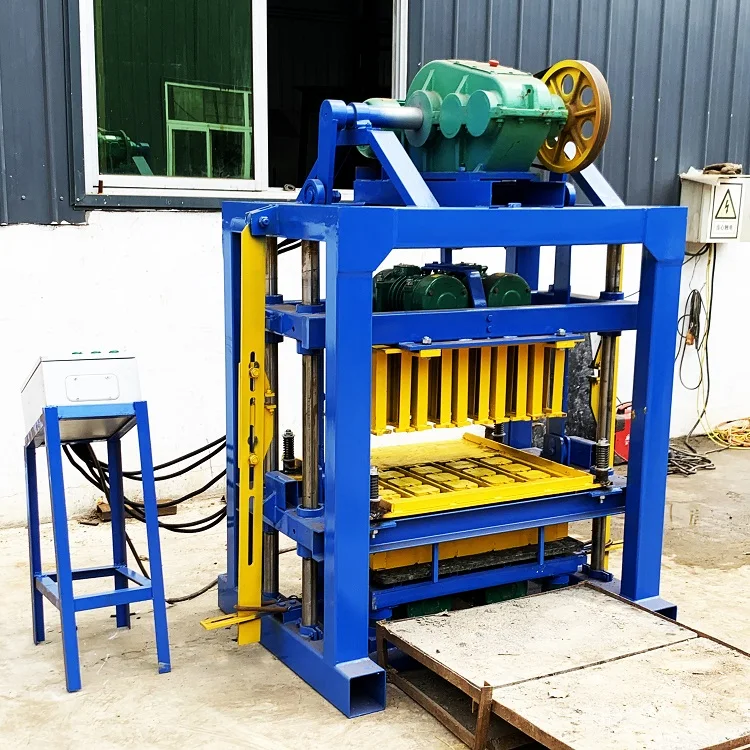
Single-focus block machinery supplier — the QTJ4-40 is positioned not as an isolated press but as one station within a coordinated small-scale line, with every upstream and downstream element checked for cycle-time alignment before dispatch.
Technical Specifications
| Parameter | Value |
|---|---|
| Model | QTJ4-40 |
| Product Type | Interlocking Brick Machine / Manual Block Making Machine |
| Overall Dimensions (L×W×H) | 1350×1460×1800 mm |
| Net Weight | 1 T |
| Rated Power | 9.5 kW |
| Voltage & Frequency | 380V or configurable to local supply (frequency to be confirmed) |
| Control System | Manual operation with vibration motor |
| Pallet Size | 850×450×40 mm |
| Mould Format | 400×200×200 mm (4 pcs/mould); 400×240×200 mm (3 pcs/mould) |
| Moulding Cycle | 40 s |
| Vibration Frequency | 2800 r/min |
| Motor | Siemens motor |
| Required Factory Area | 200 m² |
| Workers Required | 3–5 |
| Assembly State | Stationary |
| Warranty | 1 year |
| Output Capacity | 4 pcs per 40 s cycle based on 400×200×200 mm hollow block format; 3 pcs per 40 s cycle based on 400×240×200 mm format |
| Automation Level | Manual / semi-manual |
| Stacking Method | Manual pallet handling |
Application Suitability
| Application | Material or Output |
|---|---|
| Small-scale hollow block production | Crushed stone, sand, cement, and water mix |
| Interlocking brick manufacturing | Laterite soil or cement-stabilized aggregate |
| On-site block making for construction projects | Locally sourced concrete mix with standard aggregate |
| Startup block plant with limited investment | Cement and locally available sand or stone dust |
| Solid block production | Dense aggregate mix with cement binder |
What "4 Pieces Every 40 Seconds" Leaves Out About Your Line
A quoted cycle time only holds if every supporting station for block production line equipment delivers within that same window.
I have watched a QTJ4-40 Interlocking Brick Machine Manual Brick Maker sit idle for half a shift because the pan mixer upstream needed ninety seconds to discharge a batch the press could use in forty. The operator stood by the hopper, tapping the feed lever, while freshly pressed blocks cooled on the pallets behind him. The press was never the problem. The supporting equipment for block machine was. When buyers evaluate a stationary press, they almost always focus on vibration force and cycle time, but the actual daily output depends on whether raw material feeding, pallet circulation, and curing logistics keep pace. [NEED_CITE: typical causes of idle time in small-scale block production lines]
Raw Material Flow Must Match the 40-Second Rhythm
A small-scale block production line equipment setup around the QTJ4-40 starts at the raw material hopper. Aggregate and cement need to reach the mixer, blend thoroughly, and arrive at the press feed tray within each 40-second moulding cycle. If the mixer is undersized or the conveyor belt runs too slow, the press waits. I typically recommend matching mixer batch size to the mould volume so that one mix cycle fills one press cycle, leaving no gap. The supporting equipment for block machine configuration must account for this timing from day one.
Pallet Circulation and Curing Area Alignment
The 850×450×40 mm pallet is the physical link between the press station and the curing zone. Every pallet that leaves the press carrying wet blocks must travel to a rack, stay there for the curing period, and return clean and dry. If the curing rack spacing does not accept this pallet size, workers end up restacking blocks by hand — adding labour and breakage risk. The pallet material also matters: bamboo pallets absorb moisture and warp in humid climates, while steel pallets last longer but add weight that slows manual transfer. Planning the curing area layout around the actual pallet dimension prevents a bottleneck that no amount of press speed can overcome. [NEED_CITE: pallet material selection for manual block making operations]
Reading the Numbers That Matter on Site
The 9.5 kW rated power covers both the vibration motor and any auxiliary drives on the line. At 2800 r/min vibration frequency, the QTJ4-40 compacts concrete mixes without hydraulic pressure, which means block density depends heavily on mix consistency and aggregate grading rather than press force alone. The 200 m² factory area requirement must accommodate the press footprint of 1350×1460 mm, raw material staging, mixer placement, pallet return path, and curing rack rows — a tight but workable layout for a first-line investment. Workers numbering 3–5 cover feeding, pressing, pallet transfer, and stacking; reducing headcount below this range slows pallet return and starves the press. The voltage must be confirmed before production because a 380V motor rewound for a different frequency will run at the wrong speed, shifting the vibration frequency away from 2800 r/min and changing block compaction.
When Stations Are Ordered Separately, Timing Breaks
One buyer sourced the press from a machinery exporter and the mixer from a local fabricator. The mixer discharged at a rate designed for a larger plant, flooding the QTJ4-40 feed tray and causing spillage that hardened on the mould surfaces. Clean-up added twenty minutes per shift. Another buyer purchased pallets in bulk without checking the curing rack dimensions his forklift was built to handle; the pallets fit the press but jammed on the rack, forcing a complete rack rebuild. These are not press failures. They are supporting equipment for block machine mismatches that surface only after the line runs for a week. [NEED_CITE: common integration failures in manually operated block lines]
Why Buyers Plan the Whole Line Before Ordering the Press
Block machinery as a single focus means the QTJ4-40 arrives with its pallet specification, mould format list, and supporting station list already reconciled. The mixer batch size is sized to the mould volume, not pulled from a catalogue default. The pallet size is confirmed against the buyer’s existing curing rack and forklift before production begins. The line layout drawing shows every station from raw material hopper to curing rack with the block format assumed for capacity calculation clearly stated. Mould design covers the formats the buyer’s local market actually sells, including custom drawings when standard formats do not match. Voltage, frequency, and control language are confirmed in writing before the machine enters production, so commissioning starts the day the container opens rather than weeks later. [NEED_CITE: pre-shipment documentation standards for block machinery exports]
Documentation & Verification
- Line layout drawing with every station and the block format assumed for the capacity calculation
- Pallet specification sheet confirming 850×450×40 mm size, material, and load rating
- Voltage and frequency confirmation document signed before production begins
- Factory test record on the buyer’s specified mould format before dispatch
- Operation and maintenance manual with wear parts list and mould format list
Installation, Commissioning & Support
- Site preparation guide covering the 200 m² area with floor levelness tolerance for the 1350×1460 mm base
- Electrical wiring diagram for 9.5 kW load with dedicated circuit and correct phase rotation
- Pallet guide rail alignment checked on site to match 850×450 mm pallet travel path
- Vibration motor rotation verified at 2800 r/min before first production run
- Operator training on mould change procedure and daily wear part inspection
- Wear parts supply list with lead times for vibration motor, mould liners, and pallet guides
What to Send With Your Inquiry
Provide the block format your market sells, the daily output target, and the local aggregate type available at your site. Include your workshop dimensions and existing equipment — mixer, forklift, curing racks — so the supporting equipment for block machine configuration can be matched before quotation. State your local voltage and frequency so the motor and wiring are correct from the first day of operation.
Frequently Asked Questions
Q: How is the daily output of the QTJ4-40 calculated, and which block format is assumed?
A: The quoted output is 4 pieces per 40-second cycle based on the 400×200×200 mm hollow block format, or 3 pieces per cycle based on the 400×240×200 mm format. Daily output depends on actual operating hours, pallet return speed, and mixer delivery rate. A capacity calculation sheet stating the assumed block format is provided with every line layout proposal.
Q: How do the upstream mixer and pallet feeder need to be timed to match the 40-second press cycle?
A: The mixer must deliver one batch to the press feed tray within each 40-second window. If the mixer cycle is longer, the press idles. Batch size should equal one mould fill volume so the mixer and press run in a continuous loop without material waiting or overflowing.
Q: What pallet size and material work with this press, and how must the curing area be laid out?
A: The press uses 850×450×40 mm pallets. Curing rack spacing must accept this dimension, and the forklift or hand cart used for pallet transfer must handle the loaded weight. Material choice — bamboo, PVC, or steel — depends on local humidity and expected pallet lifespan.
Q: Which supporting stations are included in the line quotation, and which are buyer-supplied?
A: The quotation specifies which stations — mixer, conveyor, pallet feeder, curing racks — are included and which the buyer sources locally. Every station is listed on the line layout drawing so there are no gaps or duplications when equipment arrives on site.
Q: What voltage, frequency, and wiring preparation does the site need before arrival?
A: The motor is wound for the buyer’s confirmed voltage and frequency. A dedicated circuit rated for the 9.5 kW load with correct phase rotation must be ready before commissioning. Wiring preparation details are included in the electrical schematic provided before shipment.


