
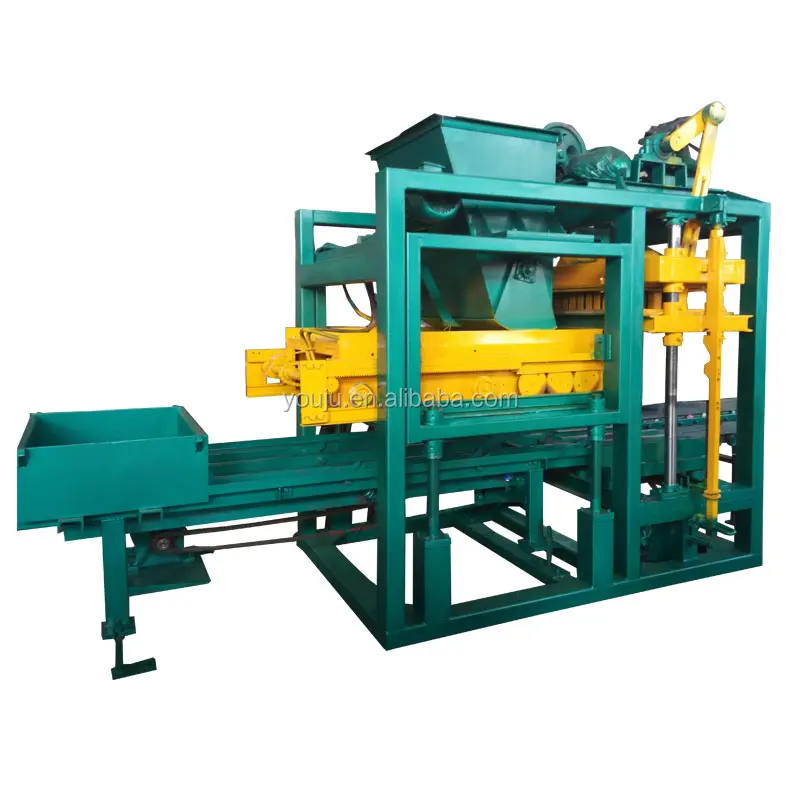
Single-Line Focus — The QTJ4-25 stationary block machine is specified as the press within a complete stationary block making machine production line, with mixer output, conveyor speed and pallet circulation calculated against the 25-second cycle so no station waits on another.
Technical Specifications
| Parameter | Value |
|---|---|
| Product Type | Stationary Block Making Machine |
| Model | QTJ4-25 |
| Rated Power | 17.9 kW |
| Control System | PLC Controlled |
| Overall Dimensions | 6400 × 1500 × 2700 mm |
| Net Weight | 2500 kg |
| Cycle Time | 25 s per pallet |
| Vibration Force | 60 kN |
| Vibration Frequency | 2800 r/min |
| Pallet Size | 850 × 550 × 20 mm |
| Output Capacity | 960 pcs/h, 7680 pcs/day (based on 400×200×200 mm hollow block, 4 pcs/mould) |
| Mould Format | Hollow, solid, paver, curbstone (multiple sizes: 8", 6", 5", 4") |
| Automation Level | Semi-automatic |
| Stacking Method | Manual stacking, move to dry place with trolley |
| Standard Configuration | Host machine 1 set, block mould 1 set, JQ350 mixer, belt conveyor |
Application Suitability
| Application | Material or Output |
|---|---|
| Hollow block production | Crushed stone, sand, cement, fly ash blends |
| Solid block production | Dense aggregate mixes for load-bearing walls |
| Paving block production | Fine-graded sand and cement for interlocking pavers |
| Curbstone production | Coarse aggregate with high cement content |
| Small to medium block plants | 400×200×200 mm hollow blocks at 960 pcs/h (based on 4 pcs/mould, 25 s cycle) |
| On-site contractor production | Daily output matched to local aggregate and curing space |
Why Quoted Capacity Rarely Matches What Leaves the Curing Yard
A stationary block making machine production line only delivers its rated output when every upstream and downstream station keeps pace with the press cycle.
I once stood on a site in Kenya where a semi-automatic press sat idle for half the day because the mixer could not feed fast enough. The press cycled at 25 seconds per pallet, but the JQ350-class mixer feeding it needed closer to 40 seconds per batch. Workers ended up hand-stacking blocks on the ground while pallets queued empty. The rated hourly capacity meant nothing because the bottleneck had simply moved one station upstream [NEED_CITE: line balancing principles for concrete block production].
Matching Mixer Throughput to the 25-Second Press Cycle
The QTJ4-25 stationary block making machine production line ships with a JQ350 mixer and belt conveyor as baseline configuration. The press demands a fresh batch every 25 seconds, which means the mixer must complete discharge, refill and mixing within that same window. When local aggregate is coarse or the mix is stiff, mixing time stretches — and the press starves. Specifying the mixer capacity against the actual mix design, not a catalogue default, is the single most important decision before the order is placed.
Pallet Circulation as the Hidden Bottleneck
With a pallet size of 850 × 550 × 20 mm and manual stacking, each pallet must be stripped, cleaned and returned to the feed station before the next cycle. If the curing area is too far from the press or the trolley fleet is too small, pallets pile up at the curing racks and the press waits. A typical plant running this configuration needs a pallet pool large enough to cover the entire curing cycle plus a buffer for return transit — usually several hundred pieces, depending on ambient cure time [NEED_CITE: pallet circulation ratios for semi-automatic block plants].
How Vibration and Pressure Translate to Block Density
The 60 kN vibration force at 2800 r/min works through bed mould vertical vibration combined with upper mould compression. This dual action consolidates the mix around the aggregate particles, driving out trapped air. The result is a denser, more uniform block — but only when the vibration force is matched to the buyer’s local aggregate gradation and cement ratio. A mix that is too wet will slump under vibration; a mix that is too dry will not consolidate fully. The semi-automatic PLC control allows the operator to adjust vibration duration per cycle, giving room to tune the setting once the local material behaviour is understood.
What Happens When Line Stations Are Mismatched
When the conveyor speed is slower than the press discharge rate, wet blocks sit on pallets longer than necessary, risking surface damage from vibration transfer through the belt frame. When pallet return is slower than the press cycle, the machine simply stops — and every minute of idle time compounds across an eight-hour shift. These mismatches are not visible in a catalogue quotation; they only appear once the line is running and the operator is watching the clock [NEED_CITE: production line synchronization in block manufacturing].
Why Specifying the Full Line Matters Here
Block machinery is our single focus, which means the QTJ4-25 press, its mould, the JQ350 mixer, the belt conveyor and the pallet pool are specified as one matched system rather than assembled from separate suppliers. Each configuration is set against the buyer’s actual mix design, local aggregate and target block format — not a catalogue default. Mould design covers the formats the buyer’s market actually sells, with custom drawings available when standard sizes do not fit. The automation level is selectable, so a buyer can start with manual pallet handling and add automatic stacking later without replacing the press.
Documentation & Verification
- Line layout drawing showing station-by-station connection and material flow for the QTJ4-25 configuration
- Capacity calculation stated per block format with mould cavity count and cycle time made explicit
- Pallet specification including material type and quantity recommendation verified against buyer’s curing rack system
- Voltage, frequency and PLC display language confirmed in writing before production begins
- Factory test record on buyer’s target block format before dispatch
- Operation and maintenance manual covering mixer, conveyor and press as one integrated line
Installation, Commissioning & Support
- Floor space allocation based on the 6400 × 1500 × 2700 mm overall dimensions plus conveyor run and curing area
- Electrical supply confirmed for 17.9 kW rated power with dedicated circuit and correct voltage before commissioning
- Mixer and belt conveyor aligned to the press feed height during on-site assembly
- Vibration duration and cycle timing tuned to local aggregate during first production run
- Operator training covering PLC interface, mould change procedure and daily maintenance schedule
- Wear parts and mould list supplied with recommended replacement intervals for the specific block formats in use
Before You Send an Inquiry
To size the QTJ4-25 stationary block making machine production line correctly, share your target block format, daily output requirement, local raw material source and curing area dimensions. Confirm your site voltage, frequency and preferred PLC display language. If you already have a mixer or pallet system in place, provide those specifications so the line can be balanced around existing equipment rather than replaced.
Frequently Asked Questions
Q: How do I verify the real daily output of the full line, not just the press cycle rate?
A: Request a capacity calculation that states the assumed block format, mould cavity count and cycle time. The quoted 960 pcs/h figure applies to 400×200×200 mm hollow blocks at 4 pcs/mould with a 25-second cycle. Real daily output also depends on mixer throughput, pallet return speed and curing area capacity — all of which must be included in the line calculation.
Q: Which supporting stations are included and which are optional?
A: The baseline QTJ4-25 configuration includes the host machine, one block mould set, a JQ350 mixer and a belt conveyor. Pallet supply, automatic stacking, curing rack handling and cubing are optional additions. Each station can be added or upgraded independently as production volume grows.
Q: How does pallet size selection affect my curing area layout?
A: The standard 850 × 550 × 20 mm pallet must fit your existing curing racks and be compatible with the trolley or forklift you plan to use. Choosing a pallet size without verifying rack dimensions leads to wasted floor space or additional rack purchases after the line arrives.
Q: Can I start with manual pallet handling and upgrade to automatic stacking later?
A: Yes. The QTJ4-25 is configured as semi-automatic with manual stacking as standard. Automatic pallet feeding, stacking and cubing stations can be added later without replacing the press, provided the floor layout reserves space for the upgrade path.
Q: What happens if the mixer output cannot match the 25-second press cycle?
A: The press will idle between cycles, and actual hourly output drops below the rated figure. This is why the JQ350 mixer is matched to the QTJ4-25 cycle time in the baseline configuration — and why the mixer specification must be rechecked if the buyer changes mix design or aggregate source after installation.


