
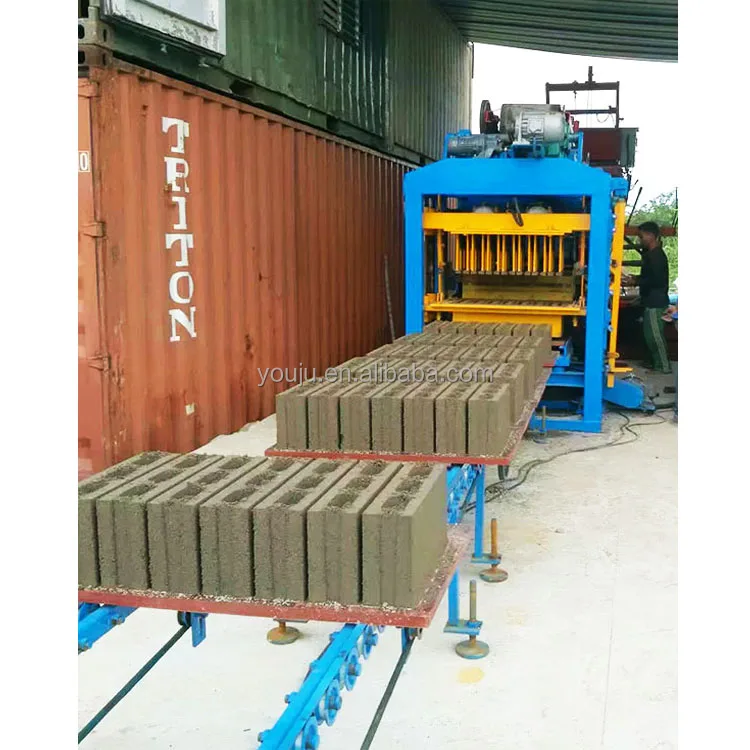
Matched Line Engineering — Every station from mixer to curing rack is sized against the QTJ4-25 press cycle so no equipment waits on the next.
Technical Specifications
| Parameter | Value |
|---|---|
| Model | QTJ4-25 |
| Product Type | Semi-Automatic Concrete Block Making Machine |
| Overall Dimensions (L×W×H) | 3000×1800×2680 mm |
| Total Mass | 3.5 T |
| Overall Power | 16.58 kW |
| Vibration Force | 60 kN |
| Vibration Frequency | 2800–4500 r/min |
| Main Vibration Form | Platform Vibration |
| Pallet Size | 850×480 mm |
| Molding Cycle | 25 s |
| Demolding Method | Mechanical |
| Frame Material | National standard manganese steel |
| Guide Column | Four-column, chrome-plated, overlong guide design |
| Control System | Semi-automatic (basis not stated in source) |
| Voltage & Frequency | Configurable (basis to be confirmed) |
| Output — 400×200×200 mm Hollow Block | 4 pcs/mould, 580 pcs/h, 4640 pcs/day (8 h) |
| Output — 240×115×90 mm Brick | 9 pcs/mould, 1400 pcs/h, 11200 pcs/day (8 h) |
| Output — 240×115×53 mm Brick | 21 pcs/mould, 3300 pcs/h, 26400 pcs/day (8 h) |
| Applied Raw Materials | Crushed stone, sand, cement, fly ash, gravel, slag, dust |
| Recommended Factory Area | 300 m² |
| Warranty | 1 year for whole machine (excluding spare parts) |
Application Suitability
| Application | Material or Output |
|---|---|
| Hollow block production for building walls | Crushed stone, sand, cement, fly ash blends |
| Solid brick manufacturing for load-bearing structures | Gravel, sand, cement with local aggregate |
| Paving and interlocking block for walkways | Fine aggregate, cement, pigment for colored pavers |
| On-site block production for housing projects | Site-sourced aggregate, sand, cement |
| Kerbstone and curb production for roadworks | Coarse aggregate, cement, high-density mix |
What "Cycles per Hour" Leaves Out About a Semi-Automatic Block Making Machine Production Line
A single cycle-time number tells you nothing about real daily output unless the supporting stations keep pace with the press.
I have walked into plants where the block press sat idle for fifteen minutes every hour because the mixer could not feed fast enough, or the pallet return conveyor jammed under wet concrete buildup. Buyers see 25-second molding cycles on paper and assume the line will sustain that tempo all shift. In reality, a Semi-Automatic Block Making Machine production line only reaches its rated capacity when material feeding, pallet circulation, stacking, and curing rack handling are each matched to the press rhythm [NEED_CITE:]. When one station falls behind, the entire line throttles down to the slowest link.
How Each Station Connects to the Press Cycle
The QTJ4-25 completes a molding cycle in 25 seconds, which means the mixer must deliver a fresh batch to the hopper within that same window. If the mixer takes 40 seconds per batch, the press waits. A Semi-Automatic Block Making Machine production line designed around this press must pair it with a mixer whose discharge rate matches the press consumption, not a mixer rated for a larger machine. The pallet feeder must also index a new pallet into position before the press completes its current cycle, otherwise the demolded block has nowhere to land.
Where Bottlenecks Typically Form Downstream
Once blocks leave the press, they ride on 850×480 mm pallets toward the curing area. If stacking is manual and workers cannot clear pallets fast enough, a queue forms and the press operator must hold the next cycle. In a Semi-Automatic Block Making Machine production line, the stacking station and curing rack system must absorb output at the same rate the press produces it [NEED_CITE:]. This is why the line quotation must include pallet quantity, stacking method, and curing rack capacity — not just the press itself.
Reading the Specifications Against Your Actual Block Format
The QTJ4-25 produces 4 pieces of 400×200×200 mm hollow block per mould, yielding 4640 pieces in an 8-hour shift. Switch to 240×115×53 mm solid brick and the same press delivers 21 pieces per mould, reaching 26400 pieces per day. These are fundamentally different production rates driven by block geometry, not machine speed. The vibration force of 60 kN at 2800–4500 r/min must be tuned to whichever format you run most often, because platform vibration behaves differently against a hollow block mould versus a dense solid brick mould. The four chrome-plated guide columns maintain demolding alignment across format changes, but the mould change itself adds downtime that must be factored into your shift plan.
The Cost of Undersizing the Supporting Equipment
When the pallet return system is left out of the quotation, workers carry empty pallets back to the feeder by hand. Freshly pressed blocks sit on the ground because there are not enough pallets in circulation. The curing area fills unevenly, and forklift traffic crosses the production path [NEED_CITE:]. These problems do not show up in the machine specification sheet. They appear on the factory floor during the first week of operation, and they trace back to a line that was quoted as a press rather than as a complete system.
Why Specifying the Full Line Here Matters
Every configuration starts with the buyer’s actual block format and local aggregate, not a catalogue default. The 850×480 mm pallet size is selected against your existing curing area dimensions and forklift capacity, so pallets fit the racks you already own. Pallet handling, stacking, and curing rack handling are included in the line layout from the start, not added as an afterthought. Voltage, frequency, and control language are confirmed before production begins, avoiding commissioning delays when the container arrives. Mould drawings and format lists are provided so you know exactly which block types the line covers and which require separate mould investment.
Documentation & Verification
- Line layout with capacity calculation per block format before order confirmation
- Pallet specification sheet covering size, material, and quantity in the quotation
- Voltage and control language confirmation document signed before production
- Mould drawing and format list for every block type the line will produce
- Factory test record on your target block format before dispatch
- Hydraulic and electrical schematic for on-site maintenance reference
Installation, Commissioning & Support
- Foundation must support 3.5 T total mass across the 3000×1800 mm press footprint
- Power supply must deliver 16.58 kW at confirmed voltage and frequency
- Mechanical demolding system calibrated on-site for each mould format installed
- Vibration frequency tuned between 2800–4500 r/min to match local aggregate density
- Operator training covers mould change procedure and pallet circulation workflow
- Wear parts list provided with recommended replacement intervals for guide columns and vibration components
What to Prepare Before Requesting a Quotation
Share the block formats your market sells, along with target daily output for each. Specify your local raw material source and aggregate type so the mix can be matched to the vibration settings. Confirm your site voltage, frequency, and preferred control display language. Provide the dimensions of your existing curing area and the forklift model you use, so pallet size and rack handling are specified to fit.
Frequently Asked Questions
Q: How is daily output verified per block format, and why does a single cycles-per-hour figure mislead?
A: The QTJ4-25 molding cycle is 25 seconds, but actual output depends on the block format in the mould. A 400×200×200 mm hollow block yields 4 pieces per cycle, while a 240×115×53 mm brick yields 21. Daily output is calculated per format across an 8-hour shift, not from a generic cycle rate that ignores geometry differences.
Q: Which supporting stations must match the QTJ4-25 cycle time to prevent the press from waiting?
A: The mixer must discharge a batch within 25 seconds, the pallet feeder must index a new pallet before demolding, and the stacking station must clear pressed blocks before the next cycle begins. Any station slower than the press becomes the line bottleneck.
Q: How is pallet size and material chosen to fit the buyer’s existing curing area and forklift?
A: The 850×480 mm pallet is evaluated against the buyer’s curing rack dimensions and forklift tine spacing. Material selection considers moisture exposure during curing and the weight load of wet concrete blocks, ensuring pallets survive daily handling without warping.
Q: Can the semi-automatic line be upgraded to automatic pallet feeding and stacking without replacing the press?
A: The QTJ4-25 frame and vibration system remain the same. Upgrading involves adding automatic pallet indexing and stacking equipment to the downstream stations, which requires confirming the existing line layout has space and the control system supports the additional I/O points.


