
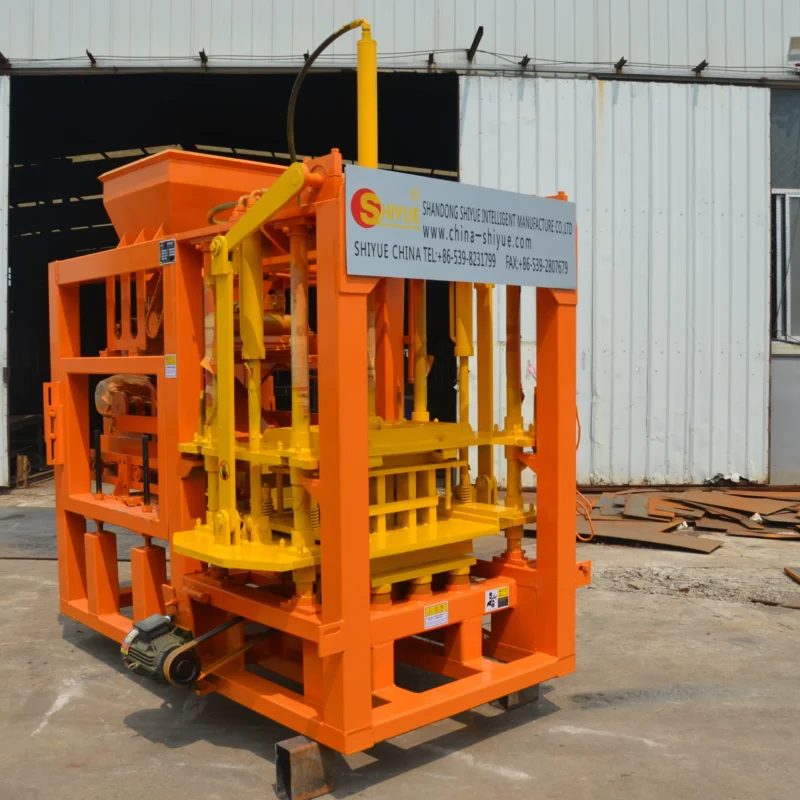
Line-matched cycle times — every station from the mixer discharge to the pallet return is sized against the QTF3-20 press rhythm, so no single machine sits idle while upstream or downstream bottlenecks accumulate.
Technical Specifications
| Parameter | Value |
|---|---|
| Model | QTF3-20 |
| Product Type | Semi-Automatic Concrete Paving Block Making Machine |
| Forming Method | Hydraulic press with vibration |
| Control System | Hydraulic system with vibration (semi-automatic) |
| Output Capacity (Paving Block) | 2,700 pcs/hour based on 200×100×60mm paving block, 15 pcs/mould |
| Output Capacity (Hollow Block) | 540 pcs/hour based on 400×200×200mm hollow block, 3 pcs/mould |
| Output Capacity (Interlocking Brick) | 1,440 pcs/hour based on 225×112.5×60mm interlocking brick, 8 pcs/mould |
| Daily Output (8h Shift) | 21,600 pcs (200×100×60mm paving block) |
| Daily Output (8h Shift) | 4,320 pcs (400×200×200mm hollow block) |
| Daily Output (8h Shift) | 11,520 pcs (225×112.5×60mm interlocking brick) |
| Mould Formats Supported | Paving block / hollow block / interlocking brick / curbstone |
| Automation Level | Semi-automatic |
| Voltage & Frequency | Customizable to buyer’s local standard |
| Warranty | 1 year (excluding wearing parts) |
| Pallet Size | (basis not stated in source — confirm dimension and material) |
| Mould Change Time | (basis not stated in source — confirm changeover duration) |
| Hydraulic Pressure | (basis not stated in source — confirm rating) |
| Vibration Force | (basis not stated in source — confirm kN) |
| Overall Dimensions | (basis not stated in source — confirm footprint) |
| Net Weight | (basis not stated in source — confirm weight) |
Application Suitability
| Application | Material or Output |
|---|---|
| Walkway and driveway paving | Concrete paving blocks, 200×100×60mm, from crushed stone, sand, and cement |
| Municipal road edging | Curbstone and kerbstone formats in high-density concrete mixes |
| Residential and commercial walling | 400×200×200mm hollow blocks from local aggregate and cement blends |
| Landscaping and permeable surfaces | 225×112.5×60mm interlocking bricks with permeable mix designs |
| Fixed yard for housing projects | Semi-automatic line producing multiple formats from one press station |
| On-site contractor production | Block supply for ongoing road or building projects at a fixed yard |
What "Pieces per Hour" Leaves Out About Line Output
A press rating means nothing when the mixer empties slower than the mould fills.
I learned this the hard way after configuring a semi-automatic block making machine production line for a project where the daily tally fell well below the headline figure. The press cycled fine on paper, but the front-end mixer discharged concrete slower than the hopper consumed it. Every third or fourth cycle, the operator stood waiting for the next batch. Multiply that idle gap across an eight-hour shift and the gap between quoted capacity and actual pallet count grows fast. [NEED_CITE: typical cycle-matching losses in block production lines] That is why the semi-automatic block making machine production line built around the QTF3-20 is specified station by station, not sold as a press with afterthoughts.
Matching Every Station to the Press Rhythm
The QTF3-20 operates as the centre of a connected sequence, not an island. Raw material feeding, mixing, pallet delivery, pressing, and wet-block handling each have their own cycle clock. When the mixer output does not arrive before the hopper runs dry, the press waits. When pallets are not staged and fed on time, the press idles again. This semi-automatic block making machine production line is planned so that each station finishes its task within the press cycle window, keeping the QTF3-20 running at its stated rhythm rather than drifting into gaps.
Where Semi-Automatic Meets Upgrade Paths
Starting with a semi-automatic configuration keeps initial capital lower and leaves room for later additions. The operator manually moves cured pallets and stacks blocks, but the line footprint already allocates space for a future automatic stacker or pallet return conveyor. This means a buyer can begin production, build market volume, and add handling stations without relocating the press or rewiring the entire semi-automatic block making machine production line. [NEED_CITE: modular expansion practices in concrete block plants]
Reading the Specs That Actually Matter
Hydraulic pressure and vibration force together determine block density. Higher pressure compacts the mix, while vibration settles fine aggregate into voids; without both acting in balance, paving blocks may pass visual inspection but crumble under load. Pallet size defines the mould footprint and must align with the curing rack dimensions and the forklift already on site, otherwise blocks stack unevenly or pallets jam on racks. Mould change time determines how practical it is to switch from hollow blocks to interlocking bricks within one shift, which affects whether a plant can serve multiple market segments from one QTF3-20. Voltage and frequency, confirmed before production, prevent the common delay of a machine arriving at a port with a motor or PLC display that does not match the local grid.
The Cost of Skipping Line-Wide Planning
When the quotation covers only the press, pallet handling and stacking fall to workers carrying wet blocks by hand. Output piles up unevenly, curing space is wasted, and cracked edges drive rejection rates higher than expected. A mixer sized too small for the hopper appetite creates micro-stoppages that add up across a shift. [NEED_CITE: common causes of output shortfall in small block plants] Buyers who skip confirming pallet material and curing rack compatibility discover, after arrival, that wooden pallets warp in local humidity or that steel pallets are too heavy for their existing forklift.
Why Source the Line From One Planning Point
The QTF3-20 is specified as part of a matched system rather than a standalone press, so machine, mould, pallet, and handling are planned together. Configuration is set against the buyer’s actual mix design, local aggregate, and target block format instead of a default catalogue entry. Mould design covers the formats the buyer’s market actually sells, including custom drawings when standard sizes do not fit. The automation level is selectable, allowing a start at semi-automatic with a clear upgrade path. Installation support includes operator training so the crew understands cycle timing and mould change procedure from the first production day.
Documentation & Verification
- Line layout drawing with each station and its cycle time marked
- Capacity calculation stating the block format assumed per output figure
- Mould drawing and format list for every block the buyer will produce
- Pallet specification matched to curing rack and forklift capacity
- Voltage, frequency, and control language confirmation before production
- Factory test record on the buyer’s target block format before dispatch
Installation, Commissioning & Support
- Foundation plan sized to QTF3-20 footprint and vibration load
- Dedicated circuit matching confirmed voltage and frequency before wiring
- Machine assembled on-site with press, hopper, and pallet feeder aligned
- First-run cycle timing adjusted to the buyer’s local mix and aggregate
- Operator training on mould change, vibration settings, and pallet handling
- Wear parts list covering hydraulic seals, vibration springs, and mould liners
- Maintenance schedule for hydraulic fluid checks and mould cleaning intervals
What to Include With Your Inquiry
Send the block formats you plan to produce, the target daily output per format, and the raw materials available locally including aggregate type and cement grade. Include your site voltage and frequency, the curing area dimensions, and the forklift capacity you already have. If you are replacing an existing press, note the current pallet size and the stations you want to keep. This information allows the QTF3-20 line to be configured around your actual conditions rather than generic defaults.
Frequently Asked Questions
Q: How do I verify the real daily output of this line for the block format I actually sell?
A: Request the capacity calculation document that states which block format each output figure assumes. For the QTF3-20, daily output varies significantly between 200×100×60mm paving blocks at 21,600 pieces and 400×200×200mm hollow blocks at 4,320 pieces per eight-hour shift. A single headline number without format context does not reflect what your plant will produce on a typical day.
Q: Which supporting stations are included in the quotation, and which are optional?
A: The semi-automatic line quotation covers raw material feeding, mixing, the QTF3-20 press, and pallet feeding as standard. Stacking, curing rack handling, and cubing can be added as optional stations. Each included station is cycle-matched to the press so the QTF3-20 does not idle between mould fills waiting on upstream or downstream equipment.
Q: How do I match the mixer output and pallet feed speed to the QTF3-20 press cycle time?
A: The line layout specifies mixer discharge rate and pallet feeder speed against the QTF3-20 cycle window. If the mixer empties slower than the hopper consumes, the press pauses each cycle. Confirming mixer capacity and pallet staging at the planning stage prevents micro-stoppages that accumulate across an eight-hour shift.
Q: What pallet size and material does this line require, and can it work with my existing curing racks?
A: Pallet dimension and material are confirmed during line planning to match both the QTF3-20 mould footprint and your existing curing rack spacing and forklift capacity. Wooden, bamboo, and steel pallets each behave differently under local humidity and curing conditions, so the choice affects block quality and handling labour from the first production day.
Q: Can I start semi-automatic and add automatic stacking later?
A: Yes. The semi-automatic block making machine production line around the QTF3-20 is planned with space reserved for a future stacker, pallet return conveyor, or cubing station. When production volume justifies the addition, the new station slots into the existing layout without relocating the press or rewiring the control system.


