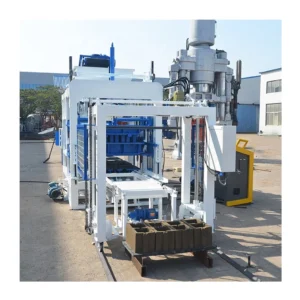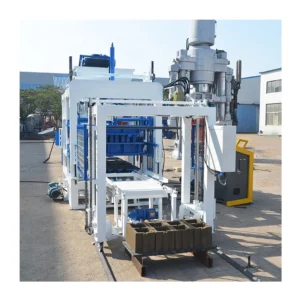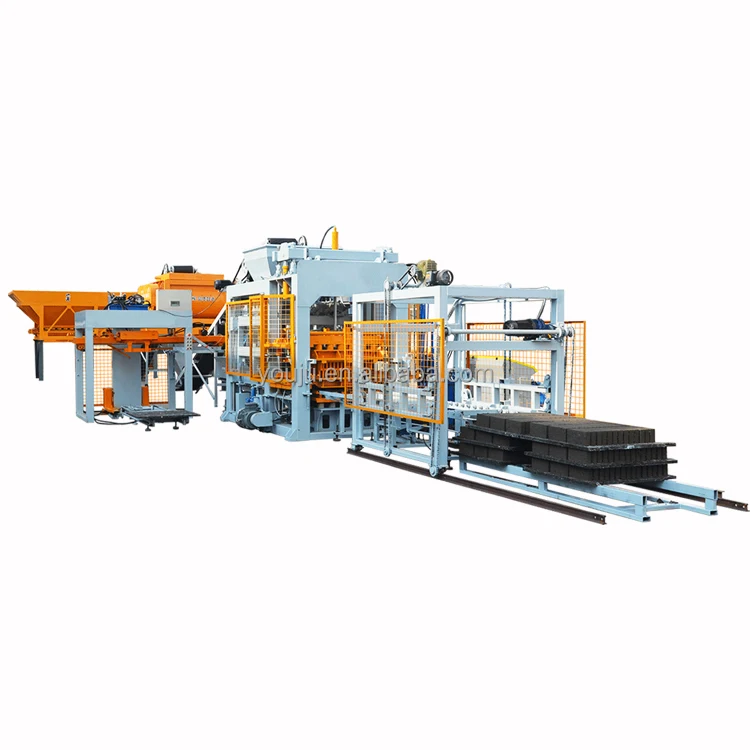
Integrated Line Synchronization — Every station from cement silo to stacker is specified against the QT8-15 cycle time, so the press never waits on upstream feeding or downstream pallet handling.
Technical Specifications
| Parameter | Value |
|---|---|
| Model | QT8-15 |
| Product Type | Fully Automatic Concrete Block Making Machine |
| Overall Dimensions (L×W×H) | 8300 x 1860 x 3000 mm |
| Rated Power | 37 kW |
| Control System | PLC with touch screen and Human Conversation Interface |
| Vibration Form | Platform Vibration |
| Vibration Frequency | 2800 – 4500 RPM |
| Pallet Size | 950 x 900 mm |
| Molding Cycle | 15 – 25 s (20 – 25 s with color feeding) |
| Brick Height Range | 50 – 200 mm |
| Block Comprehensive Strength | 15 MPa |
| Hydraulic System | Independent integrated hydraulic station |
| Assembly State | Stationary equipment |
| Raw Materials | Fly ash, slag, gangue, river sand, gravel, cement |
| Output Capacity (Hollow Block) | 1912 pcs/h based on 400 x 200 x 200 mm, 8 pcs/mold |
| Output Capacity (Solid Brick) | 9360 pcs/h based on 240 x 115 x 53 mm, 39 pcs/mold |
| Output Capacity (Paving Block) | 3000 pcs/h based on 225 x 112.5 x 60 mm, 18 pcs/mold |
| Daily Output (Hollow Block, 8 h) | 15300 pcs/day based on 400 x 200 x 200 mm |
| Daily Output (Solid Brick, 8 h) | 74880 pcs/day based on 240 x 115 x 53 mm |
| Production Line Equipment | Cement silo, host block machine, mixer, batching machine, stacker, forklift |
| Block Machine Components | Pallet feed machine, block molding machine, storage hopper, conveyor, hydraulic unit, PLC control cabinet |
| Voltage & Frequency | Basis not stated in source — confirm before production |
| Net Weight | Basis not stated in source — confirm before shipment |
| Hydraulic Pressure | Basis not stated in source — confirm rating |
| Vibration Force | Basis not stated in source — confirm rating |
Application Suitability
| Application | Material or Output |
|---|---|
| Hollow block production for load-bearing walls | Crushed stone, river sand, cement with fly ash or slag binder |
| Solid brick manufacturing for partition and infill | Gravel, cement, industrial waste including gangue |
| Paving block and kerbstone for municipal and landscape | Sand, gravel, cement with optional color feed layer |
| Porous block for thermal insulation fills | Lightweight aggregate, fly ash, cement |
| Slope-protecting and grass block for embankment | Coarse aggregate, cement, limited fine sand |
| Colored paving block with surface layer | Standard base mix plus pigment dosed through color feeding machine |
Why the Quotation Should List Every Station Before the Press Price
A block press only reaches rated cycle time when every upstream and downstream station matches that pace.
I have walked into plants where the QT8-15 block making machine production line was idling for seconds each cycle because the pallet feeder could not keep up, or the mixer was batched for a smaller machine entirely. The press was fine. The gap was in the stations nobody scoped. When a quotation covers the host press alone, the buyer fills in the blanks with mismatched equipment and the whole line runs below its design rhythm [NEED_CITE: typical block line bottleneck patterns in stationary plant installations]. Output ends up stacked by hand because pallet handling, stacking and curing were simply absent from the original scope.
Line Cycle Matching Across Raw Material Feeding and Press Discharge
The QT8-15 block making machine production line cycles between 15 and 25 seconds depending on block format and whether a color feed layer is engaged. Every station — cement silo discharge, batching accuracy, mixer batch size, conveyor belt speed, pallet feed timing — must deliver within that window. If the mixer discharges a batch that takes longer than the press hopper can accept, the press sits idle. Line layout drawings should show each station’s contribution to the overall cycle, not just the press in isolation.
Pallet Handling, Stacking and Curing as Part of the Line Scope
The 950 x 900 mm pallet size dictates the curing yard layout, the forklift tine spacing, and the rack dimensions the buyer must prepare before the machine arrives. When the stacker and pallet return conveyor are included in the scope, wet blocks move from press to curing rack without manual lifting. Leaving these stations out means the buyer hires extra labour to close a gap that should have been engineered out at the quotation stage [NEED_CITE: manual pallet handling injury rates in block plants].
Specification Breakdown for Line Planners
The 37 kW rated power covers the host press; the full line draw will be higher once the mixer, batching machine, conveyor motors and stacker are connected, so the buyer must size the incoming supply and dedicated circuit accordingly. Platform vibration running at 2800 to 4500 RPM, combined with the independent integrated hydraulic station, delivers consistent compaction across formats — but only when the hydraulic pressure and vibration force are matched to the buyer’s specific mix design and local aggregate. The PLC touch screen coordinates press timing with pallet feed and block discharge, and the display language should be confirmed before the cabinet leaves the factory. Molding cycle extends to 20-25 seconds when the color feeding machine is engaged for surface-layer paving blocks, which affects the daily output calculation the buyer uses for project planning.
The Cost of Underspecifying the Stations Around the Press
When pallet size is chosen without checking the curing area and forklift the buyer already has, pallets pile up at the press discharge and operators start pulling them by hand. When voltage and frequency are not locked in before production, the PLC cabinet arrives with the wrong contactor ratings and commissioning stalls while replacement parts ship across borders. These are not machine failures — they are specification gaps that surface weeks after arrival, and every day of downtime carries a cost the original quotation never mentioned [NEED_CITE: industrial equipment commissioning delays from voltage mismatch].
Why This Line Configuration Holds Together
Block machinery as a single focus means the QT8-15 press, moulds, pallets and handling equipment are specified as one matched system rather than assembled from separate suppliers who do not talk to each other. Configuration is set against the buyer’s actual mix design and target block format, not pulled from a catalogue default. Mould design covers the formats the buyer’s market actually sells, including custom drawings when standard formats do not fit. Automation level is selectable — a buyer can start with semi-automatic pallet handling and move to full automatic stacking later without replacing the press. Installation support includes operator training so the line runs at design rhythm from the first shift.
Documentation & Verification
- Line layout drawing with each station and capacity calculation stated per block format
- Machine specification sheet matching the dispatched configuration exactly
- Pallet specification confirming size, material and load rating against curing yard plan
- Hydraulic and electrical schematic with confirmed voltage, frequency and control language
- Factory test record showing full-line cycle synchronization, not the press alone
- Wear parts and mould list with part numbers for the first replacement order
Installation, Commissioning & Support
- Foundation plan sized to the 8300 x 1860 mm footprint with anchor bolt positions marked
- Dedicated power circuit rated above 37 kW to cover the full line including mixer and stacker
- Machine arrives as stationary equipment; on-site assembly includes conveyor alignment and pallet track leveling
- First-run parameter setting matched to the buyer’s local aggregate and mix design
- Operator training covers PLC touch screen navigation, mould change procedure and daily maintenance checkpoints
- Wear parts list supplied at delivery so the first replacement order can be placed before stock runs out
What to Share When Requesting a Line Quotation
Provide the target block formats and the daily output you need for each, along with the raw materials available locally — especially the aggregate grading and any industrial waste like fly ash or slag you plan to use. Share your site voltage and frequency, the PLC display language your operators need, and the curing yard area and forklift model you already have so the pallet specification can be matched before production starts.
Frequently Asked Questions
Q: How is the cycle time of each station matched so the press is never left waiting?
A: Each station — batching, mixing, conveyor, pallet feed and stacker — is timed against the QT8-15 molding cycle of 15 to 25 seconds. The line layout drawing shows the discharge and feed rate of every station so no single point bottlenecks the press. Any mismatch is corrected at the proposal stage, not after arrival.
Q: Which stations are included in the quotation and where does the line scope end?
A: The quotation covers cement silo, batching machine, mixer, conveyor, host press, pallet feed machine, stacker and forklift handling. The scope starts at raw material storage and ends at stacked blocks on the curing rack. Anything outside that range is identified in the proposal so there are no hidden gaps.
Q: What pallet size and material are specified for this line?
A: Pallets are 950 x 900 mm, sized to match the QT8-15 mold area. Material and load rating are confirmed against the buyer’s curing yard surface and existing forklift tine dimensions. A mismatch here blocks the discharge end of the line, so confirmation happens before production begins.
Q: How is raw material feeding and batching accuracy controlled across the line?
A: The batching machine doses each material by weight according to the mix design set in the PLC. Fly ash, slag, sand, gravel and cement are fed into the mixer in controlled proportions, and the batch size is matched to the press hopper capacity so the mixer discharges within the press cycle window.
Q: Can the automation level be set semi-automatic now and upgraded later?
A: Yes. The line can start with manual pallet handling and semi-automatic stacking while the press itself runs under full PLC control. When the buyer is ready, the stacker and cubing stations can be added or upgraded without replacing the host machine or the PLC cabinet.