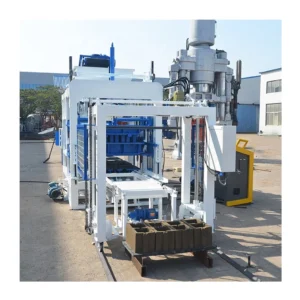
Matched Line Engineering — every station from mixer to stacker timed to the QT6-15 press cycle so upstream and downstream never leave the machine waiting.
Technical Specifications
| Parameter | Value |
|---|---|
| Model | QT6-15 |
| Product Type | Automatic Concrete Block Making Machine Line |
| Molding Way | Vibration and hydraulic pressing |
| Rated Pressure | 21 MPa |
| Molding Cycle | 15s–20s |
| Pallet Size | 900 × 700 mm |
| Main Machine Weight | 6000 KGS |
| Output — Hollow Block 400×200×200 mm | 1440 pcs/h, 11520 pcs/8h (basis stated per format) |
| Output — Paving Brick 200×100×60 mm | 5040 pcs/h, 40320 pcs/8h (basis stated per format) |
| Output — Solid Brick 240×115×53 mm | 7680 pcs/h, 61440 pcs/8h (basis stated per format) |
| Automation Level | Semi-automatic line (simple line with mixer, conveyor belt, stacker); optional full line with cement silo, screw conveyor, cement scale, batching machine, pallet loader, block and pallet separator |
| Mould Format | Hollow block, paving brick, solid brick; mould change supported |
| Stacking Method | Automatic stacker included in simple line |
| Supporting Equipment | JS500 mixer, 8M conveyor belt, automatic stacker (simple line); cement silo, screw conveyor, cement scale, batching machine, pallet loader, block and pallet separator (full line) |
| Raw Materials | Cement, sand, fly ash, stone powder, slag |
| Assembly State | Dismantled for container shipping (top cylinder removed for height) |
| Voltage & Frequency | Customizable to local voltage (basis not stated in source — confirm voltage and frequency) |
| Warranty | 1 year (excluding wearing parts) |
Application Suitability
| Application | Material or Output |
|---|---|
| Hollow block production for building walls | Cement, sand, fly ash, stone powder with 400×200×200 mm hollow format |
| Paving brick manufacturing for walkways and yards | Crushed stone and cement mix in 200×100×60 mm interlocking or rectangular format |
| Solid brick production for load-bearing masonry | Dense aggregate and cement in 240×115×53 mm solid format |
| On-site block production for housing projects | Local sand, slag, and cement adapted to available aggregate |
| Curbstone and color pavement brick runs | Pigmented cement mix with dedicated mould |
What the Quotation Leaves Out When the Line Stops at the Press
A press without matched upstream and downstream stations is only as fast as its slowest manual step.
I have watched plant owners invest in a capable QT6-15 block making machine production line, then discover after commissioning that hand-feeding pallets and stacking output manually consumed most of the shift. The press idled between cycles, not because it could not run, but because the operator was still moving wet blocks off the table. [NEED_CITE: common causes of block machine downtime in semi-automatic plants] When a line is quoted as a press alone, the buyer inherits the gap between the machine’s rated cycle and the real throughput of the surrounding workflow.
How Each Station Connects to the Press Cycle
The QT6-15 block making machine production line is built around one principle: every station before and after the press must deliver within the 15–20 second molding window. The JS500 mixer feeds the 8-meter conveyor belt at a rate that keeps the hopper charged without overflow. When the simple line configuration is chosen, the automatic stacker collects finished blocks off the pallets so the operator does not have to pull wet units by hand. Each connection point — mixer discharge height, conveyor speed, stacker pickup timing — is set against the press cycle, not left to field adjustment.
From Simple Semi-Automatic to Fully Equipped Line
Buyers who need higher daily consistency can extend the line beyond the base configuration. The full setup adds a cement silo with screw conveyor, a cement scale, and a batching machine that weighs each ingredient before it enters the mixer. A pallet loader feeds empty pallets automatically, and a block-and-pallet separator returns spent pallets to the loop. This matters because the QT6-15 press can complete hundreds of cycles per shift, and each one requires a clean pallet in place and a fresh batch ready in the hopper. [NEED_CITE: batch-to-batch consistency in cement block production] The automation level is selectable at order stage, so a plant can start with the simple line and add stations later.
Reading the Pressure, Pallet, and Capacity Figures Together
The 21 MPa rated pressure works together with the vibration system to compact the concrete mix inside the mould. Higher pressure alone does not guarantee block strength — the local aggregate gradation and cement ratio determine how much force the mix actually needs. The 900 × 700 mm pallet size must match the curing rack spacing and the forklift tine width already on site; a mismatch here forces the buyer to replace handling equipment before the first block ships. Capacity figures are stated per block format: hollow blocks at 400×200×200 mm yield 1440 pieces per hour, while paving bricks at 200×100×60 mm reach 5040 pieces per hour, because smaller formats fill more units per pallet. Always confirm which format the output figure assumes before comparing lines.
When the Mixer Becomes the Bottleneck
Skipping the pallet feeder or undersizing the mixer creates a mismatch the press cannot overcome on its own. I once saw a buyer pair a press of this class with a smaller drum mixer to cut initial spend. The mixer could not deliver a full batch within the press cycle, so every third cycle the press sat idle waiting for material. The output loss was not visible in the quotation — it only appeared on the first full production day. [NEED_CITE: effects of upstream equipment mismatch on block press utilization] The same risk applies to pallet handling: if pallets are returned manually and the curing area is far from the press, the operator cannot keep pace.
Why This Line Is Quoted as a System
The QT6-15 press, mould, pallet, and handling equipment are specified as one matched set rather than sourced from separate suppliers. Configuration is adjusted to the buyer’s actual mix design, local aggregate availability, and target block format — not pulled from a catalogue default. Mould design covers the formats the buyer’s market actually sells, including custom drawings when standard sizes do not fit. Automation is selectable, allowing a buyer to start semi-automatic and add stations as volume grows. Installation support includes operator training so the team understands not just the press, but the entire line sequence from batching to stacking.
Documentation & Verification
- Line layout drawing with capacity calculation per block format stated
- Machine specification sheet with pallet size and hydraulic pressure confirmed
- Mould drawing and format list matching buyer’s target product range
- Hydraulic and electrical schematic showing station-to-press connections
- Voltage and control language confirmation recorded before production
- Factory test record with output run on buyer’s specified block format
Installation, Commissioning & Support
- Main machine weight of 6000 KGS requires a leveled concrete foundation rated for vibration loads
- Voltage and frequency confirmed to local grid before electrical cabinet wiring begins
- Machine dismantled for container shipping with top cylinder removed to meet height limits
- Commissioning includes cycle timing adjustment between mixer, conveyor, and press
- Operator training covers mould change procedure and pallet loop sequence
- Wear parts list and mould maintenance schedule provided at handover
Before You Request a Quote
Share your target block format, required daily output, and the raw materials available locally so the line can be configured around what you can actually source. Confirm your existing voltage and frequency, pallet handling equipment, and curing area dimensions — these determine pallet size and automation level. If you already operate a mixer or batching station, note its capacity so the new line can be timed to match.
Frequently Asked Questions
Q: How is line capacity verified for the QT6-15?
A: Capacity is calculated per block format, not as a single headline number. The quotation states the assumed format — for example, 1440 hollow blocks per hour based on the 400×200×200 mm size. Line layout and cycle timing are then verified against that specific format during the factory test before dispatch.
Q: What supporting equipment comes with the simple line?
A: The simple line includes a JS500 mixer, an 8-meter conveyor belt, and an automatic stacker. The buyer supplies pallets, curing space, and forklift handling. A full line option adds cement silo, batching machine, pallet loader, and block-and-pallet separator for higher automation.
Q: How do upstream stations avoid becoming bottlenecks?
A: The mixer discharge rate and conveyor speed are set so a full batch reaches the press hopper within the 15–20 second molding cycle. If the mixer is undersized, the press idles every few cycles, reducing real daily output below the rated figure.
Q: What voltage and frequency options are available?
A: The control cabinet is wired to match the buyer’s local grid. Voltage and frequency must be confirmed at order stage because they affect motor selection, PLC configuration, and the display language on the control panel.
Q: What foundation does the complete line require?
A: The 6000 KGS main machine needs a reinforced concrete slab designed for dynamic vibration loads. The curing area and pallet return path must be planned alongside the press footprint so the full line fits within the available workshop length.