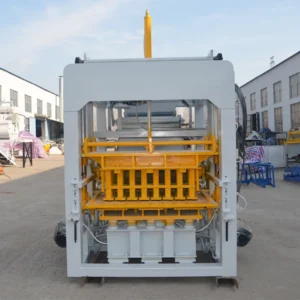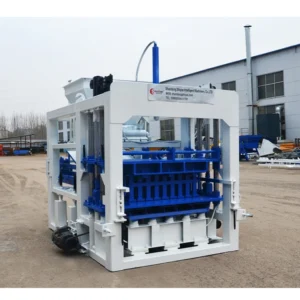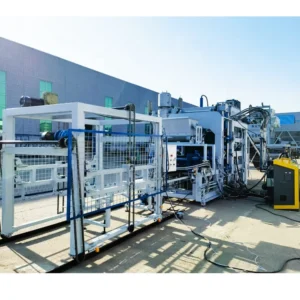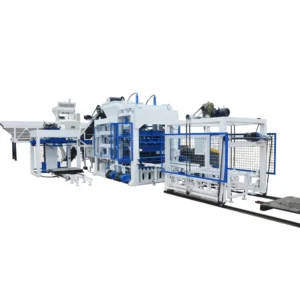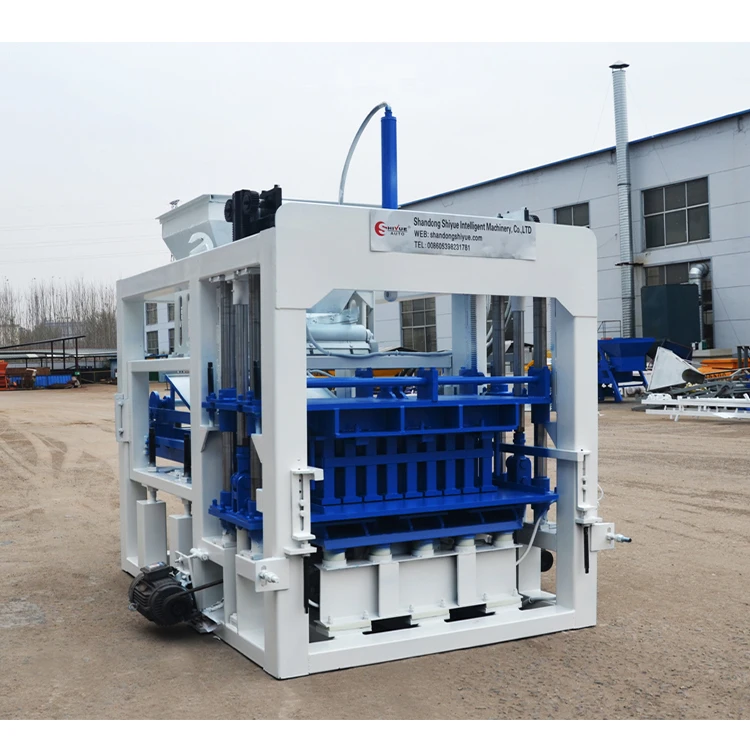
System-Matched Line Design — the QT5-15 block making machine production line is configured around your local aggregate, curing space, and existing forklift, not pulled from a catalogue default.
Technical Specifications
| Parameter | Value |
|---|---|
| Model | QT5-15 |
| Product Type | Interlocking Brick Making Machine |
| Overall Dimension | 7400 × 1950 × 2800 mm |
| Vibration Frequency | 0–60 Hz |
| Vibration Form | Platform Vibration |
| Vibration Force | 80 kN |
| Moulding Mode | Load automatically, vibration moulding |
| Pallet Size | 1100 × 550 mm |
| Molding Cycle | 15–20 s |
| Overall Power | 32 kW |
| Total Mass | 5000 kg |
| Demolding Method | Hydraulic |
| Factory Area | 1000 m² |
| Control System | PLC (Programmable Logic Controller) |
| Hydraulic System | Independent integrated hydraulic station |
| Raw Material Compatibility | Flyash (up to 70%), slag, gangue, sand, crushed stone, cement, water |
| Block Compressive Strength | More than 15 MPa |
| Output — Hollow Block 400×200×200 mm | 900–1200 pcs/hour, 7200–9600 pcs/8hr |
| Output — Hollow Block 400×150×200 mm | 1080–1440 pcs/hour, 8640–11520 pcs/8hr |
| Output — Solid Brick 240×115×53 mm | 5760–7680 pcs/hour, 46080–61440 pcs/8hr |
| Output — Rectangular Brick 200×100×60 mm | 3600–4500 pcs/hour, 28800–36000 pcs/8hr (basis: 20–25 s cycle) |
| Output — Zigzag Brick 225×112.5×60 mm | 2304–2880 pcs/hour, 18432–23040 pcs/8hr (basis: 20–25 s cycle) |
| Component List | Pallet feed machine, block making machine, storage hopper, conveyor, hydraulic unit, PLC control cabinet |
Application Suitability
| Application | Material or Output |
|---|---|
| Hollow block production | Flyash, slag, sand, crushed stone, cement |
| Solid brick production | Sand, crushed stone, cement with gangue or slag filler |
| Paving brick production | Dense aggregate mix with cement binder |
| Interlocking brick production | Local aggregate blended with cement, flyash up to 70% |
| On-site contractor production | Raw materials sourced near project location |
| Block and paver plant expansion | Multiple format switching on one line |
When the Mixer Cannot Keep Up With the Press
Cycle time coordination across every station prevents the press from idling while upstream or downstream bottlenecks accumulate.
I have stood in workshops where a block making machine production line sat half-productive because the storage hopper emptied faster than the conveyor could replenish it. The QT5-15 completes a molding cycle every 15 to 20 seconds, which means the raw material feeding system, pallet feeder, and stacking area must all match that rhythm. If the mixer delivers batch charges on a slower interval, the press waits and daily output drops well below the quoted figure. Buyers who focus only on press capacity overlook the supporting equipment that actually sets the line’s real throughput [NEED_CITE: production line bottleneck analysis in concrete block manufacturing].
Station-by-Station Material Flow
The QT5-15 block making machine production line begins at the storage hopper, where raw material is metered into the mixer and then delivered to the press via conveyor. The pallet feed machine positions each board precisely before the mold closes, and the independent hydraulic station drives demolding without manual intervention. Every station is specified to complete its task within the 15 to 20 second cycle window so the press never pauses mid-sequence. This coordinated material flow is what distinguishes a functioning line from a collection of individual machines.
Pallet Handling and Curing Area Alignment
The 1100 × 550 mm pallet size is the physical link between the press output and the curing area. Each loaded pallet exits the QT5-15 and must travel to a curing rack or open yard where blocks gain strength over several days. If the forklift in your yard is rated for a different pallet dimension, handlers spend extra time re-stacking or repositioning boards [NEED_CITE: pallet dimension standards in block curing operations]. The line specification therefore confirms pallet material, rack spacing, and forklift fork width before the order is finalized, so blocks move smoothly from press to curing without re-handling.
How Vibration and Hydraulic Pressure Shape Block Density
Platform vibration at 0 to 60 Hz combined with 80 kN of vibration force determines how tightly the aggregate particles compact inside the mold cavity. The independent integrated hydraulic station controls both the mold closing pressure and the demolding lift, ensuring the freshly formed block releases without cracking. When these two forces are balanced against the buyer’s actual mix design — whether high-flyash or crushed-stone dominant — the resulting blocks consistently exceed 15 MPa compressive strength. A mismatch between vibration frequency and aggregate gradation produces blocks that chip at corners or crumble during transport, a problem that only surfaces once full production begins.
The Cost of Ignoring Line Balance
A buyer once received a press and pallet feeder without a matching stacking solution, so freshly molded blocks piled up at the line exit and had to be moved by hand before the next cycle could start. Workers rotated between pressing and carrying, and the effective output fell far short of expectations. In another case, a line was wired for a voltage standard that did not match the local grid, delaying commissioning by weeks while transformers were sourced. These problems trace back to quoting the press alone and treating the block making machine production line as an afterthought [NEED_CITE: common commissioning delays in exported concrete machinery].
Why Procurement Here Covers the Full Line
Every supporting station — pallet feeder, storage hopper, conveyor, hydraulic unit, and PLC cabinet — is specified as part of one matched system rather than assembled from separate suppliers. The 1000 m² factory area figure accounts for the press, material staging, and curing rack footprint together. Mould change on the QT5-15 is designed for simple replacement, so format switching between hollow block, solid brick, and interlocking brick does not consume a full shift. Configuration is set against your local aggregate and target block format, not a catalogue default, and the automation level is selectable so you can start with manual pallet handling and add stacking later. Documentation covers the complete line, not just the press, giving you a clear reference for every station from raw material infeed to cured product outfeed.
Documentation & Verification
- Line layout showing station spacing and capacity per block format
- Pallet specification matched to your curing rack and forklift
- Hydraulic and electrical schematic covering the full line
- Voltage and PLC display language confirmed before production
- Factory test record on your target block format before dispatch
- Wear parts and mould list with replacement intervals
Installation, Commissioning & Support
- Foundation plan accounts for 7400 × 1950 mm press footprint and vibration isolation
- 32 kW total power requires dedicated circuit with confirmed voltage and frequency
- Machine ships dismantled for container loading, reassembled on-site with alignment checks
- PLC cabinet programmed in buyer’s language before commissioning begins
- Operator training covers mould change, pallet feed sequence, and cycle timing
- Hydraulic unit and vibration platform inspected at first scheduled maintenance interval
What to Share With Your Inquiry
To size the QT5-15 and its supporting equipment accurately, provide your target block formats, daily output goal, and the local aggregate you plan to use. Include the curing area dimensions and any forklift or pallet racking already on site. Confirm your grid voltage, frequency, and preferred PLC display language so the block making machine production line arrives ready to run.
Frequently Asked Questions
Q: How are cycle times matched across the press, pallet feeder, and stacking station?
A: The QT5-15 molding cycle of 15 to 20 seconds sets the pace. The pallet feeder is timed to deliver the next board before the press finishes demolding, and the conveyor replenishes material within the same window. If stacking is included, the stacker lift cycle is synchronized so the line runs continuously without the press waiting.
Q: What supporting equipment is included in the line quotation?
A: The standard quotation covers the pallet feed machine, storage hopper, conveyor, hydraulic unit, and PLC control cabinet alongside the QT5-15 press. Curing racks, forklifts, and yard paving are typically buyer-supplied, but their specifications are confirmed during the proposal stage to ensure compatibility.
Q: How does the 1100 × 550 mm pallet size affect my curing area?
A: This pallet dimension determines rack shelf width, spacing between pallet stacks, and the fork width your forklift must accommodate. Confirming these measurements before order prevents re-handling blocks after they leave the press and keeps the curing workflow uninterrupted.
Q: Can the line start semi-automatic and upgrade later?
A: Yes. The QT5-15 can begin with manual pallet handling at the line exit and add automatic stacking or cubing later. The PLC architecture supports these additions without replacing the main control cabinet, provided the electrical capacity and floor space were planned for the upgrade path during initial layout.
Q: What factory area and utility connections does the line require?
A: The QT5-15 press footprint plus material staging and curing racks fit within roughly 1000 m². The 32 kW power draw requires a stable supply at your local voltage and frequency, with the PLC language set before shipment to avoid commissioning delays.