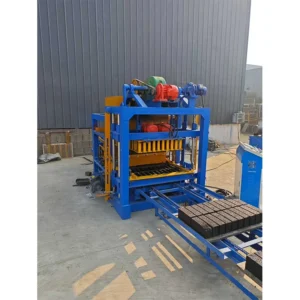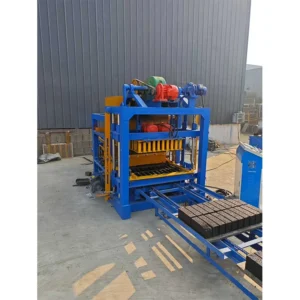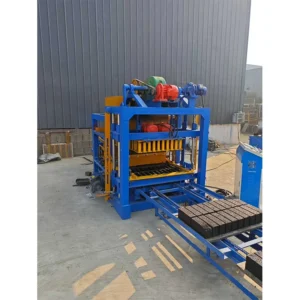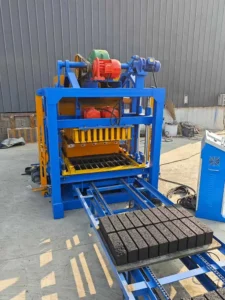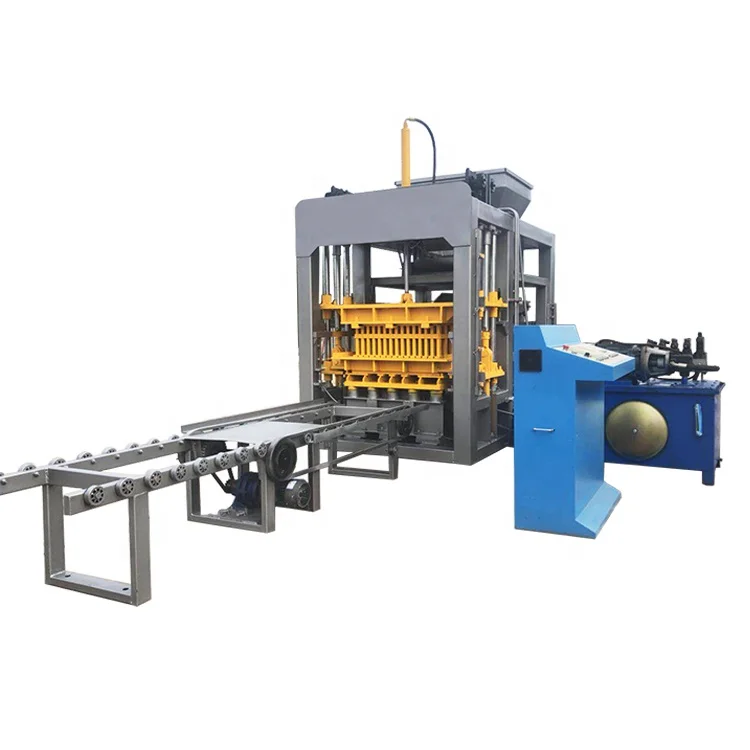
System-wide cycle synchronization — the QT5-15 press is timed against upstream batching and downstream pallet return so the 15–20 second moulding cycle is never interrupted by a waiting station.
Technical Specifications
| Parameter | Value |
|---|---|
| Model | QT5-15 |
| Product Type | Automatic Hydraulic Block Making Machine |
| Rated Power | 26.5 kW |
| Voltage & Frequency | According to buyer’s local standard (basis not stated in source — confirm voltage and frequency) |
| Control System | PLC Controller with electric and hydraulic interlock |
| Overall Dimensions | 7400 × 1950 × 2800 mm |
| Net Weight | 6000 kg |
| Hydraulic Pressure | 16–21 MPa |
| Vibration Force | 45 kN |
| Main Vibration Form | Platform Vibration |
| Moulding Cycle | 15–20 seconds |
| Pallet Size | 1100 × 550 mm |
| Automation Level | Automatic (hydraulic and electric system with procedural interlock) |
| Mould Change System | Mold box locked into vibration table via mold-releasing oil cylinder (source value — verify mould change time against manufacturer catalog) |
| Stacking Method | Blocks can be piled up immediately after demolding (basis not stated in source — confirm whether automatic stacking is included or manual) |
Application Suitability
| Application | Material or Output |
|---|---|
| Hollow block production for building walls | Crushed stone, sand, cement, fly ash |
| Solid block manufacturing for load-bearing structures | Gravel, slag, cement blends |
| Paving brick and interlocking block output | Sand, cement, colored pigments |
| Porous block production for insulation | Fly ash, industrial waste materials, cement |
| Curbstone and colored paver manufacturing | Crushed stone, dust, cement |
Why "7200 Blocks per Day" Means Nothing Without the Rest of the Line
A press cycle only sets the ceiling — the actual daily throughput is decided by whichever station around it runs slowest.
I once spent a night on the phone with a plant owner in Colombia because his new automatic block machine production line was sitting idle every third cycle. The press was finishing a mould every 18 seconds, but the pallet return conveyor could only feed a fresh pallet back every 24 seconds. The machine waited, the mixer kept running, and wet concrete sat in the hopper losing workability. That mismatch cost him roughly a third of his expected output before we reconfigured the pallet loop [NEED_CITE: cycle time reconciliation across block line stations].
The QT5-15 completes a moulding cycle in 15–20 seconds. That number is only meaningful when the raw material feeder, the pallet feeder, and the stacking station are each timed to deliver within the same window. If any one of those stations lags, the press becomes the most expensive idle machine on your floor.
Upstream Timing: Batching and Mixing Must Match the Press Hunger
The QT5-15 draws a fresh batch every 15–20 seconds. The mixer upstream must discharge a full charge into the hopper within that same interval, or the press starves. We size the mixer drum volume and the conveyor belt speed against the mould cavity count and the cycle time so material arrives just as the previous cycle ends. An undersized mixer forces the press to pause; an oversized one lets concrete sit and stiffen before it reaches the mould.
Downstream Timing: Pallet Return and Stacking Keep the Rhythm
Once the block is demolded, the wet pallet must travel to the stacking or curing station and an empty pallet must return before the next cycle begins. The 1100 × 550 mm pallet size defines how many pallets fit on the return conveyor and how the curing racks are spaced. If the automatic block machine production line uses a manual pallet return, the operator must clear and replace the pallet inside that same 15–20 second window — something that quickly becomes the bottleneck as shift fatigue sets in [NEED_CITE: pallet handling speed versus press cycle time].
Reading the Numbers Behind Hydraulic Pressure and Vibration
The 16–21 MPa hydraulic pressure and 45 kN vibration force work together to compact the mix into a high-density block. Pressure alone pushes particles together, while vibration settles fines into the voids between coarse aggregate. When both are matched to the buyer’s local aggregate gradation and cement ratio, the block leaves the mould with enough green strength to be stacked without cracking. If the mix is too dry for the vibration amplitude, the surface tears; too wet and the block slumps before curing. The PLC controller sequences pressure and vibration phases with an electric-hydraulic interlock so neither fires out of order.
The 7400 × 1950 × 2800 mm footprint and 6000 kg weight mean the press needs a level concrete pad with anchor bolts and a dedicated 26.5 kW power circuit. The mould-releasing oil cylinder locks the mould box to the vibration table, so changeover involves releasing the cylinder, lifting the old mould, and seating the new one — a process whose actual duration should be verified before the line is commissioned.
The Cost of Skipping the Line-Wide Timing Check
When a buyer orders the press alone and connects it to existing conveyors and stackers without verifying cycle compatibility, the result is a line that runs at the speed of its slowest legacy station. The press sits idle, energy is consumed without output, and half-cured concrete builds up in the mixer hopper. Over a production year, that mismatch quietly erodes the return the buyer was promised [NEED_CITE: hidden cost of uncoordinated block line stations].
Why Sourcing the Full Line from One Supplier Matters
Block machinery is our single focus, so the QT5-15 press, its moulds, pallets, and handling equipment are specified as one matched system. We configure each station against the buyer’s actual mix design and local aggregate rather than a catalogue default. Pallet dimensions are chosen with the buyer’s existing curing racks and forklift in mind. The automation level is selectable per station, so a plant can start with manual pallet handling and add automatic stacking later. Voltage, frequency, and PLC display language are confirmed before production starts, avoiding commissioning delays on arrival [NEED_CITE: voltage and frequency standards by export market].
Documentation & Verification
- Line layout and capacity calculation stating the block format assumed for each output figure
- Machine specification sheet covering hydraulic, electrical, and PLC parameters
- Mould drawing and format list for every block type the buyer intends to produce
- Pallet specification matched to curing rack spacing and forklift capacity
- Hydraulic and electrical schematic for on-site troubleshooting
- Voltage, frequency, and PLC language confirmation record signed before dispatch
Installation, Commissioning & Support
- Level concrete pad sized to the 7400 × 1950 × 2800 mm footprint with anchor bolt plan
- Dedicated 26.5 kW circuit at buyer-confirmed voltage and frequency with correct breaker rating
- Press arrives partially dismantled for container loading; reassembly supervised on site
- PLC parameters set against the buyer’s confirmed block format and cycle targets during commissioning
- Operator training covers mould change procedure, daily greasing points, and PLC fault codes
- Wear parts list and mould inventory provided for the first replacement cycle
What We Need to Configure Your Line
Send us the block formats your market buys most, the daily volume you need per format, and the raw materials available locally including aggregate gradation. Let us know your existing curing area dimensions, forklift capacity, and the voltage and frequency at your site so we can time every station around the QT5-15 before it ships.
Frequently Asked Questions
Q: How is daily output verified across the full line and not just the press?
A: We calculate throughput per block format using the 15–20 second cycle, then confirm that the mixer discharge rate, pallet feeder speed, and stacking station can each keep pace. The capacity document we provide states the assumed format for every output figure so you can compare it directly against your production plan.
Q: Which upstream and downstream stations must be included so the QT5-15 is never the bottleneck?
A: The raw material batcher, mixer, pallet feeder, and stacking or curing-rack handler must each complete their action within the 15–20 second press cycle. If any station is slower, we either upgrade that station or adjust the line sequence so the press is not left waiting between cycles.
Q: How is the 1100 × 550 mm pallet coordinated with existing curing racks and forklifts?
A: We ask for your curing rack shelf spacing and forklift fork dimensions before finalizing pallet specifications. The pallet thickness and runner profile are then set so loaded pallets seat correctly on your racks and the forklift can lift a full stack without modification.
Q: Can automation level differ between stations on the same line?
A: Yes. A buyer may run manual pallet feeding while using automatic stacking and cubing downstream. Each station’s automation is specified independently, and the PLC is programmed to handle the mixed-mode sequence so the overall line rhythm is maintained.
Q: What voltage, frequency, and PLC language details must be confirmed before shipping?
A: We need the site supply voltage and frequency, plus the preferred language for the PLC display and manual. These are recorded in a signed confirmation document before production begins so the electrical cabinet and control interface arrive ready for immediate commissioning.