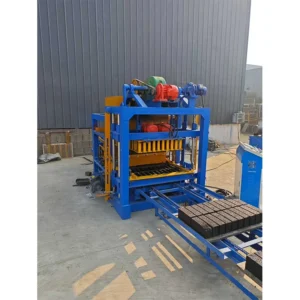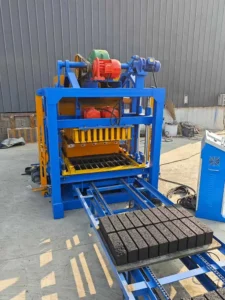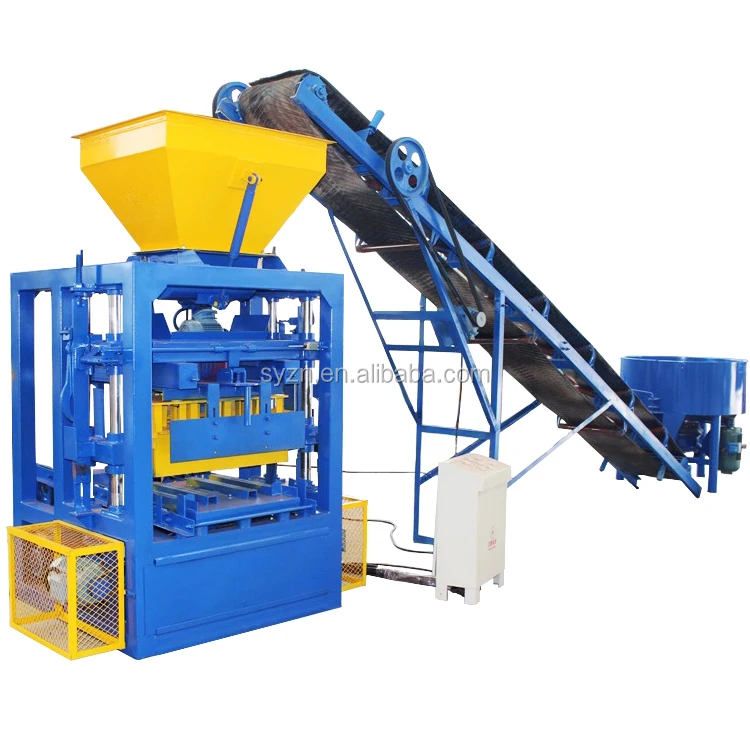
System-Matched Line Design — The Qt4-26 semi-automatic block machine is specified as one integrated station within a production line, where mixer batch size, pallet handling and curing flow are confirmed together before the press ships.
Technical Specifications
| Parameter | Value |
|---|---|
| Product Type | Semi-automatic Block Making Machine |
| Model | Qt4-26 |
| Overall Dimensions (L×W×H) | 2060×1730×2580 mm |
| Rated Pressure | 26 MPa |
| Main Vibration Form | Platform Vibration |
| Vibration Frequency | 4500 r/min |
| Vibration Force | 40 kN |
| Pallet Size | 880×480×25 mm |
| Molding Cycle | 15-20 s (basis not stated in source — confirm block format and material) |
| Total Power | 19.75 kW |
| Host Machine Power | 14.25 kW |
| Total Mass | 2 T |
| Demolding Method | Semi-automatic |
| Mixer Model | JQ350 |
| Applied Products | Concrete blocks, hollow/solid blocks, pavers, interlocking blocks, curbstone, colored pavers |
| Raw Materials | Crushed stone, sand, cement, dust, fly ash, gravel, slag |
| Voltage & Frequency | Configurable to target market (to be confirmed) |
| Control System | Available with PLC or relay logic (to be confirmed) |
| Standards | CE |
Application Suitability
| Application | Material or Output |
|---|---|
| Hollow block production for building walls | Crushed stone, sand, cement, fly ash |
| Solid block manufacturing for load-bearing structures | Gravel, sand, cement, slag |
| Interlocking paver production for driveways and walkways | Crushed stone, sand, cement, colored pigment |
| Curbstone forming for road and garden edging | Coarse aggregate, sand, cement |
| Colored paver runs for landscaping and squares | Fine aggregate, cement, oxide pigment |
What a "15-20 Second Cycle" Actually Means for Your Daily Output
The molding cycle only sets the press station tempo; real line throughput depends on which block format, pallet return speed and mixer batch timing are matched to it.
A semi-automatic block making machine production line rated at a certain cycle can still underperform if the JQ350 mixer takes longer to deliver a fresh batch than the press needs to complete a mold. On project sites in the Middle East, I have watched operators stand idle because the upstream mixer or downstream pallet handler was never sized against the press rhythm. Quoted cycle times rarely state whether the figure assumes a hollow block, a solid paver or a thin interlocking format — and each one changes the daily count substantially [NEED_CITE: block format assumptions behind quoted cycle times].
How Each Station in the Line Connects to the Press
The Qt4-26 operates as the forming station inside a semi-automatic block making machine production line. Raw material enters the JQ350 mixer, which must deliver a batch volume aligned with the number of blocks the 880×480 mm pallet can carry per cycle. Once the press completes its 15-20 second vibration and pressure sequence, the loaded pallet moves to the curing area while an empty pallet is fed back — a loop that determines whether the press runs continuously or pauses between cycles.
Where Line Bottlenecks Typically Appear
Bottlenecks in a semi-automatic block making machine production line rarely sit at the press itself. More often, the mixer batch size is too small to keep pace, or the pallet return path is too slow because curing racks are placed far from the machine. On several sites I visited, the curing area layout forced workers to carry pallets by hand across long distances, which cut actual daily output well below what the press was capable of producing [NEED_CITE: pallet handling layout impact on block plant throughput]. Confirming pallet flow, mixer timing and curing rack placement before the line ships prevents these delays.
Reading the Numbers That Matter for Production
The 26 MPa rated pressure and 40 kN vibration force work together to compact the mix into a dense block; if the vibration frequency of 4500 r/min is not matched to the buyer’s aggregate gradation and cement content, the resulting block may have inconsistent strength across the same batch. The 880×480×25 mm pallet size dictates how many blocks fit per cycle and what forklift capacity the curing area requires. Total power draw of 19.75 kW means the plant needs a dedicated supply circuit sized with starting current in mind, and the voltage and frequency must match the local grid before the control panel is wired at the factory.
The Cost of Skipping Line-Level Configuration
When a buyer orders the press alone and sources the mixer, pallets and handling equipment separately, stations often arrive with mismatched capacities. A mixer that delivers less volume per batch than the press mold requires forces the press to idle, while pallets that do not fit the buyer’s existing curing racks create handling problems on day one. I have seen plants where the voltage was confirmed only after the machine arrived, delaying commissioning by weeks while transformers and panels were reordered [NEED_CITE: voltage mismatch delays at commissioning stage]. These issues are avoidable when every station is specified against the same production target.
Why Sourcing the Full Line From One Supplier Matters
Block machinery is our single focus, which means the Qt4-26 press, JQ350 mixer, pallet specification and handling stations are configured as one matched system rather than assembled from unrelated vendors. We set the vibration and pressure parameters against your actual mix design and local aggregate, not a catalogue default. Pallet size and material are confirmed against your existing curing area and forklift before the line layout is finalized. Voltage, frequency and control language are documented and agreed before production begins, so the line is ready to run on arrival. Mould design covers the formats your market actually sells, with custom drawings available when standard moulds do not fit.
Documentation & Verification
- Line layout drawing showing station positions and pallet flow path for the Qt4-26
- Capacity calculation stating the block format assumed for the 15-20 s cycle
- Pallet specification sheet with size, material and load rating for 880×480×25 mm units
- Voltage, frequency and control language confirmation issued before production
- Factory test record with your selected mould and representative mix design
- Packing photographs and customs documentation support for shipment
Installation, Commissioning & Support
- Foundation plan matched to the 2060×1730 mm footprint and 2 T operating mass
- Electrical supply sized for 19.75 kW total draw with dedicated circuit for the host motor
- Machine arrives partially assembled; press frame, mixer and pallet feeder connected on site
- First-run commissioning includes vibration frequency and pressure adjustment to your mix
- Operator training covers mould change, pallet loading and daily maintenance routines
- Wear parts list and mould inventory provided for first replacement planning
Before You Request a Quote
To size the Qt4-26 semi-automatic block making machine production line correctly, share the block formats you plan to produce, your target daily output and the raw materials available locally. We also need your site voltage and frequency, the dimensions of your curing area, and whether you already have forklifts or pallet racks in place. If you are replacing an existing machine, let us know the current pallet size so the new line can integrate with your handling equipment.
Frequently Asked Questions
Q: How is the daily output of the full line calculated, and which block format is assumed?
A: Daily output is based on the molding cycle, the number of blocks per pallet and the number of productive hours in a shift. The 15-20 second cycle for the Qt4-26 must be tied to a specific block format — hollow, solid or paver — because each format changes the pieces-per-cycle count. We provide a written capacity calculation that names the assumed format before you place the order.
Q: How do I match the mixer batch cycle to the press cycle so the press is not left waiting?
A: The JQ350 mixer must deliver enough material per batch to fill the mould within the time the press takes to complete one cycle. We calculate the batch volume against the mould cavity count and the block format you choose. If your mix design requires longer blending time, a larger mixer model can be specified to maintain continuous press operation.
Q: What pallet size and material should I choose based on my existing curing area and forklift?
A: The standard 880×480×25 mm pallet must fit your curing rack spacing and your forklift tine width. We confirm these dimensions during line layout. Pallet material — wood, steel or composite — is selected based on your curing method and expected handling cycles so that pallets do not warp or wear prematurely under local conditions.
Q: Which supporting stations are included and which are optional in the line?
A: The core semi-automatic block making machine production line includes the Qt4-26 press, JQ350 mixer and pallet feeder. Raw material feeding systems, automatic stacking and curing rack handling can be added based on your automation preference and site layout. We specify each station’s cycle time so that no single point slows the rest of the line.