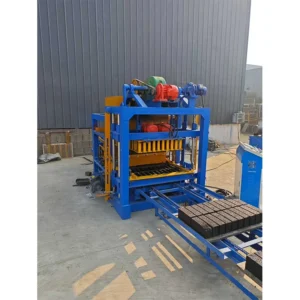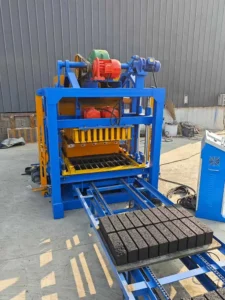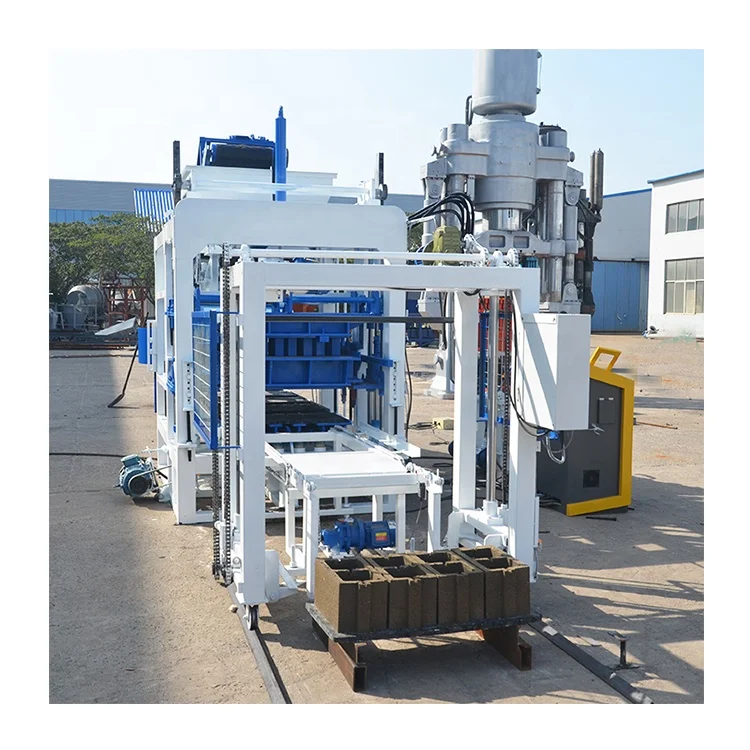
Synchronized line flow — the QT4-18 press is sized with upstream mixer and downstream conveyor so no station leaves the press idle during continuous runs.
Technical Specifications
| Parameter | Value |
|---|---|
| Product Type | Automatic Concrete Block Making Machine |
| Model | QT4-18 |
| Overall Dimensions (L×W×H) | 2500×1750×2200 mm |
| Rated Hydraulic Pressure | 16 MPa |
| Vibration Form | Platform Vibration |
| Pallet Size | 950×550 mm |
| Molding Cycle | 18–25 s (basis not stated in source — confirm block format, material and thickness) |
| Overall Power | 27.5 kW |
| Control System | PLC with frequency converter, Schneider electrical components |
| Automation Level | Automatic (mixer, pallet conveyor, molding machine, block conveyor, hydraulic station, PLC console) |
| Mould Lifting Mechanism | Double-sided synchronous gears |
| Material Feeder | Distribution belt hopper |
| Supporting Equipment Options | JQ500 concrete pan mixer, 8 m or 6 m belt conveyor, stacker, block clamper, cement silo, batching plant, extra moulds, trolley |
Application Suitability
| Application | Material or Output |
|---|---|
| Hollow block production for commercial and residential wall construction | Crushed stone, sand, cement, fly ash blends |
| Solid block manufacturing for load-bearing structures | Coarse aggregate with cement binder |
| Paver and interlocking brick runs for landscaping | Fine aggregate with pigment additives |
| On-site production for housing development projects | Locally sourced sand and gravel mixes |
Why "18 Seconds per Cycle" Is Not the Whole Story
The press cycle is only as fast as the slowest station feeding or clearing it.
I once stood next to a block line where the press cycled in under twenty seconds but the operator needed twice that long to carry the loaded pallet to the curing rack. The automatic block machine production line was technically capable, yet daily output fell well short of what the brochure implied. The missing piece was never the press itself — it was the pallet return conveyor and the stacker that were never quoted. [NEED_CITE: common causes of throughput loss in concrete block plants]
Matching Mixer Output to Press Hunger
A pan mixer like the JQ500 releases a batch every few minutes, and the distribution belt hopper on the QT4-18 must receive that batch before the next cycle starts. If the belt conveyor is too short or angled too steeply, material bridging starves the hopper and the press waits. In a balanced automatic block machine production line, the mixer discharge rate and the conveyor capacity are calculated against the same block format the press is running, so the press never idles between cycles.
Pallet Recycle and Stacking — Where Lines Actually Stall
The 950×550 mm pallet leaves the press carrying a wet layer of blocks. It must travel to the stacker or curing rack and then return empty before the next mould drops. When the return path is longer than the molding cycle, the press pauses. Sizing the conveyor length and the stacker speed against the 18–25 s molding window keeps pallets flowing. [NEED_CITE: pallet handling design guidelines for block production plants]
Reading the Specs That Actually Matter
The 16 MPa rated hydraulic pressure and platform vibration work together to compact the mix into the mould cavity. Higher pressure alone does not guarantee block density if the vibration frequency is mismatched to the aggregate size. The double-sided synchronous gear lifting mechanism keeps the mould aligned during the lift, reducing side-wall drag and shortening the change-over when switching between hollow and solid formats. With the PLC frequency converter, the vibration ramp can be adjusted per mix, which matters when a plant shifts from a fly ash blend to a pure sand recipe mid-week. The 27.5 kW total power draw includes the hydraulic pump and the vibration motor, so the electrical supply must sustain continuous peak load without voltage sag.
What Happens When Stations Are Specified Separately
Buying the press from one supplier and the stacker from another often means the pallet pitch does not match. A 950 mm pallet on a stacker designed for 850 mm causes misalignment, and the clamp damages block edges. The operator ends up pulling pallets by hand, erasing the automation the buyer paid for. These mismatches surface only after installation, when return shipping is not practical. [NEED_CITE: integration failures in multi-vendor block production lines]
Why Buyers Source the Full Line Here
Block machinery is our single focus, so the QT4-18, its moulds, pallets, and handling equipment are specified as one system rather than assembled from separate vendors. The line layout is drawn against your actual block format and local aggregate, not a catalogue default. Voltage, frequency, and PLC display language are confirmed before production begins, avoiding commissioning delays. Automation level is selectable — start with manual pallet return and add a stacker later as volume grows. Installation support includes operator training on the specific PLC menu and mould change sequence.
Documentation & Verification
- Line layout drawing with conveyor lengths and pallet flow path marked
- Capacity calculation stating the exact block format and pallet configuration assumed
- Hydraulic and electrical schematic matched to confirmed voltage and frequency
- Factory test record showing cycle times on buyer-specified mix and mould
- Operation manual with mould change steps and daily maintenance checklist
- Packing photographs of press, mixer, and conveyor before container loading
Installation, Commissioning & Support
- Foundation slab must be level within tolerance across the 2500×1750 mm press footprint
- Dedicated circuit rated for 27.5 kW continuous draw with voltage confirmed pre-shipment
- Press and mixer arrive dismantled; on-site assembly includes conveyor alignment
- PLC parameters set to buyer’s mix design during first-week commissioning
- Operator training covers mould lifting gear operation and pallet conveyor timing
- Wear parts list with hydraulic seal and gear teeth intervals for the first year
Before You Request a Quote
Send the block format you plan to run, the daily output target, and the raw materials available locally. Include your workshop length and height so the conveyor and curing rack can be laid out before the line ships. Confirm the site voltage and the language you need on the PLC display.
Frequently Asked Questions
Q: How is the 18–25 s molding cycle verified against a specific block format?
A: The cycle range depends on block height, wall thickness, and aggregate gradation. We run a factory test using your mix recipe and chosen mould, then document the actual cycle time in the test record. This number is what the capacity calculation uses, not a catalogue average.
Q: Which supporting stations are included and which are optional?
A: The QT4-18 package covers the press, PLC console, and hydraulic station. The JQ500 mixer, belt conveyor, stacker, and block clamper are listed as supporting options. Each is itemized in the quotation so you can see what is included and what you may already have on site.
Q: How do conveyor length and pallet return path affect throughput?
A: If the empty pallet takes longer to travel back than the molding cycle, the press waits. We calculate the pallet recycle distance against the 18–25 s window and recommend conveyor length and stacker speed accordingly, so the press runs without interruption.
Q: What installation area does the complete line require?
A: The press footprint is 2500×1750 mm, but the full line including mixer, conveyor, and curing rack needs a longer bay. The line layout drawing provided before order shows every station position and the total length required for your selected configuration.