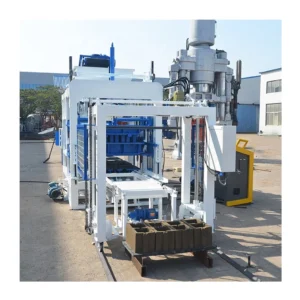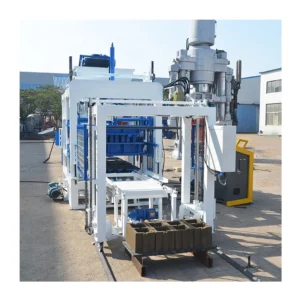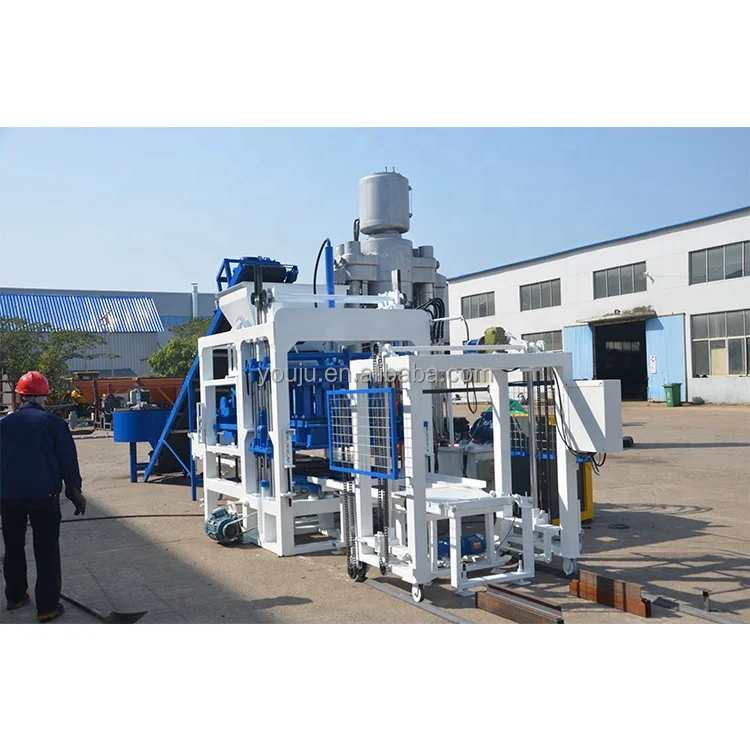
Matched System Design — the QT4-18 automatic concrete block making machine production line specifies mixer feed rate, pallet handling and stacking as one connected sequence so the press is never left waiting between cycles.
Technical Specifications
| Parameter | Value |
|---|---|
| Model | QT4-18 |
| Product Type | Automatic Concrete Block Making Machine |
| Overall Dimensions | 2500 × 1750 × 2200 mm |
| Rated Hydraulic Pressure | 16 MPa |
| Vibration Form | Platform Vibration |
| Pallet Size | 950 × 550 mm |
| Molding Cycle | 18–25 s (basis to be confirmed per block format) |
| Overall Power | 27.5 kW |
| Control System | PLC with frequency converter |
| Electrical Components | Schneider (basis not stated in source) |
| Mixer | JQ500 concrete pan mixer |
| Belt Conveyor | 8 m (6 m optional) |
| Mould Lifting Mechanism | Double-sided synchronous gears |
| Automation Level | Automatic pallet feeding, automatic product conveying |
| Supporting Equipment Included | Stacker, block clamper, trolley, extra moulds (customizable) |
| Optional Add-ons | Cement silo, batching plant |
Application Suitability
| Application | Material or Output |
|---|---|
| Hollow block production plants | Crushed stone, sand, cement and fly ash mixes |
| Solid block manufacturing for housing projects | Dense aggregate blends with standard cement ratios |
| Paving block and kerbstone yards | Fine aggregate with pigment dosing for coloured pavers |
| On-site production by development contractors | Locally sourced gravel and sand with portable curing setups |
| Format expansion for existing concrete product makers | Interlocking brick and porous brick via mould change |
What the Cycle Time Figure Hides About Your Daily Output
Molding cycle means nothing unless it names the block format and mix it was measured on.
When a quotation states an 18–25 second cycle for an automatic concrete block making machine production line without specifying whether that applies to a standard hollow block, a thin paver or a dense kerbstone, the daily output figure derived from it becomes unreliable. I have walked onto sites where the press cycled fast on paper, yet the real bottleneck was downstream — pallets piling up faster than workers could carry them to the curing yard because the stacker and trolley were never part of the deal [NEED_CITE: typical block plant output gaps between quoted cycle and actual daily production].
How the Stations Connect from Mixer to Curing Yard
The QT4-18 line treats every station as a linked chain rather than independent machines. The JQ500 pan mixer discharges into an 8 m belt conveyor sized to keep the press hopper charged across the 18–25 second molding window, preventing the common situation where the press idles while waiting for the next batch of wet mix.
Pallet Flow That Keeps the Press Running
A hydro-cylinder drives the pallet feeder, pushing a fresh pallet onto the vibrating platform and simultaneously transferring the finished block off the press onto the block receiver in one coordinated motion. This single-stroke action removes the manual pallet swap that otherwise forces the operator to pause the automatic concrete block making machine production line every cycle. The block receiver then carries the product via motor-driven idler wheels to the stacker, and the block clamper and trolley move stacked cubes toward the curing yard without hand labour interrupting the rhythm [NEED_CITE: pallet handling bottleneck in semi-automated block plants].
Reading the Specs That Actually Shape Your Output
Platform vibration paired with 16 MPa hydraulic pressure determines whether blocks leave the mould with consistent density or crack under their own weight. The two forces must be matched to the buyer’s mix design and local aggregate, not left at a catalogue default. The 950 × 550 mm pallet size defines the maximum mould footprint, which in turn limits the number of blocks per stroke; a buyer planning a curing yard needs to confirm that this pallet dimension fits the forklift tines and rack spacing already on site. Double-sided synchronous gears on the mould lift keep the mould box level during withdrawal, reducing edge chipping on hollow blocks — a detail that matters when block strength must meet local building codes.
When Line Stations Are Not Sized to Each Other
A mixer that empties too slowly starves the hopper, and a stacker that cannot keep pace forces the operator to stop the press and stack by hand. Either mismatch turns an automatic concrete block making machine production line into a semi-manual operation within the first week. I have seen curing yard congestion halt production entirely because the trolley and clamper were quoted as optional extras rather than included from day one [NEED_CITE: block line throughput loss from unmatched station speeds].
Why Buyers Source the Full Line Here
Block machinery is the single focus of this operation, so the mixer, conveyor, press, pallet feeder, stacker and trolley are specified together rather than assembled from separate suppliers. Each line configuration is set against the buyer’s actual mix design and target block format instead of a catalogue default. Mould design covers the formats the buyer’s market actually sells, with custom drawings available. Automation level is selectable, so a plant can begin with the included stacker and add a fully automatic cubing system later. Factory testing runs every station as a connected sequence, not individual dry runs, before the line is dismantled for shipment.
Documentation & Verification
- Line layout showing station spacing for the QT4-18 footprint and pallet flow path
- Capacity calculation naming the exact block format behind the 18–25 s cycle
- Hydraulic and electrical schematic with PLC I/O map for on-site troubleshooting
- Factory test record covering mixer, conveyor, press and stacker running together
- Pallet specification sheet with 950 × 550 mm dimensions and load rating
- Voltage, frequency and PLC display language confirmation before production starts
Installation, Commissioning & Support
- Foundation plan sized to the 2500 × 1750 mm machine footprint and vibration load
- Dedicated power circuit for the 27.5 kW total draw with confirmed voltage and frequency
- Station-by-station reassembly after container arrival, starting with the press frame
- First-run parameter setting on the PLC for cycle timing and vibration duration
- Operator training covering mould change, pallet feeder adjustment and daily greasing points
- Wear parts list including mould liners and hydraulic seals matched to the shipped configuration
Before You Request a Quote
Send the block formats you intend to produce, the daily volume you need and the raw materials available locally, including aggregate grading. Confirm your site voltage, frequency and preferred PLC display language. If you already own a forklift or curing racks, share the pallet dimensions they accept so the 950 × 550 mm pallet can be validated against your existing infrastructure.
Frequently Asked Questions
Q: How is line capacity calculated and which block format does the 18–25 s cycle assume?
A: Capacity is calculated per block format because mould cavity count and fill depth change the effective cycle. The 18–25 second range must be tied to a specific block — for example, a standard 400 × 200 × 200 mm hollow block — before a daily output figure is meaningful. Always request the format-specific capacity sheet.
Q: Does the mixer output match the press cycle so the hopper never starves?
A: The JQ500 pan mixer and 8 m belt conveyor are sized to discharge enough wet mix within the 18–25 second window. If your mix design uses a high proportion of fine aggregate that slows mixing time, the batch size may need adjustment to keep the press hopper continuously charged.
Q: Is the stacker, clamper and trolley included or quoted separately?
A: All three are included in the standard QT4-18 line package. The block clamper lifts stacked cubes onto the trolley for transport to the curing yard. Optional add-ons like a cement silo or batching plant are quoted separately based on site requirements.
Q: How does the 950 × 550 mm pallet align with my curing yard and forklift?
A: The pallet dimension dictates rack spacing and forklift tine width. Before production, cross-check this size against your existing curing racks and forklift capacity. If your yard uses a different standard, a pallet size adjustment must be made during the configuration stage.