
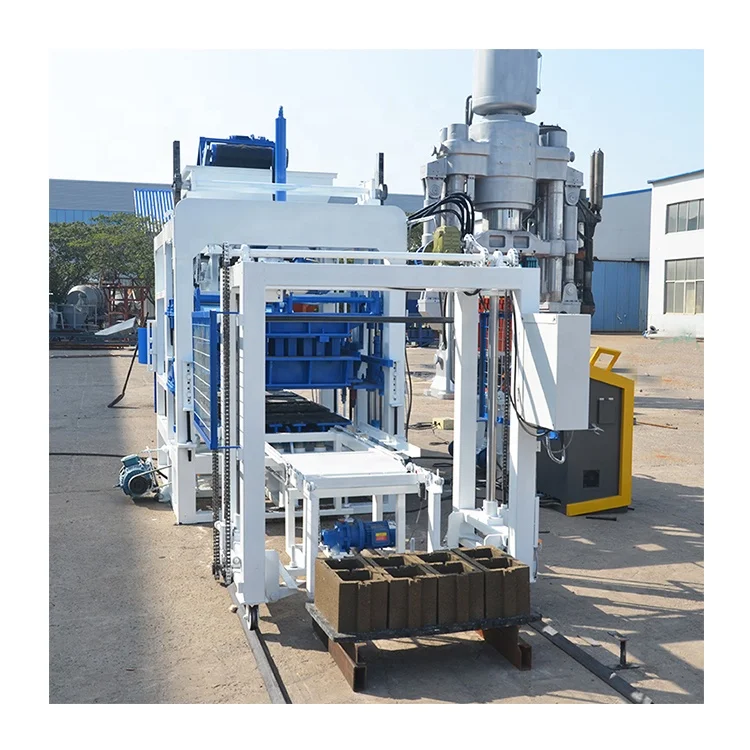
Matched Line Configuration — The QT4-15B is specified as the centre press of a complete stationary block line where every upstream and downstream station is timed to the press cycle, eliminating idle gaps between mixing and stacking.
Technical Specifications
| Parameter | Value |
|---|---|
| Model | QT4-15B |
| Product Type | Automatic Stationary Concrete Block Making Machine |
| Control System | Computer controlled, fully automatic (PLC brand and language options to be confirmed) |
| Vibration Mode | Multiaxis synchronizer vibration, vertically downward |
| Hydraulic System | High thermal efficiency, low heat productivity (pressure rating to be confirmed) |
| Guide Bearing | Long-period over-length guide bearing for upper mould and mould box alignment |
| Mixer System | Multiaxis forced mixer system |
| Rack Construction | High strength steel with special welding technique, vibration shock resistant |
| Output Capacity — 400×200×200mm hollow block | 900–1,200 pcs/h (4 pcs/mould, 15–20s cycle) |
| Output Capacity — 200×100×60mm paving block | 2,880–3,840 pcs/h (16 pcs/mould, 15–20s cycle) |
| Output Capacity — 240×115×53mm solid brick | 5,930–6,720 pcs/h (28 pcs/mould, 15–20s cycle) |
| Molding Cycle | 15–20s |
| Automation Level | Fully automatic, computer controlled, low labor intensity |
| Standards | CE (declaration availability to be confirmed) |
Application Suitability
| Application | Material or Output |
|---|---|
| Hollow block production | Crushed stone, sand, cement and fly ash mixes for load-bearing and partition walls |
| Solid brick production | Dense aggregate blends for structural masonry and foundation courses |
| Paving block production | Fine aggregate and pigment mixes for pedestrian and light-traffic pavements |
| Multicellular brick production | Lightweight aggregate or aerated mixes for thermal insulation walling |
| Stationary block plant setups | Fixed-plant installations with dedicated curing yards and pallet circulation |
| On-site contractor production | Project-site plants where blocks are pressed and cured adjacent to the build |
Why Quoted Press Capacity Means Little Without the Rest of the Line
A press rated at a given cycle time only delivers that output when the automatic stationary block machine production line around it keeps pace.
Too often a buyer receives a quotation for the press alone, with no mixer discharge rate, no pallet feeder speed and no stacking station listed. The result is a QT4-15B waiting for the next pallet or the next batch of mix while the cycle timer ticks. I once saw a line where the mixer discharged faster than the press could accept, so wet mix sat in the hopper losing workability, and on the same line the stacker was too slow, forcing operators to pull finished blocks off the conveyor by hand. Daily output ended up well below what the press spec sheet suggested. [NEED_CITE:]
Synchronising Every Station Around the Press
The QT4-15B automatic stationary block machine production line treats the press as one station in a chain. The multiaxis forced mixer is sized so its discharge volume per batch matches what the mould box consumes per cycle, and the pallet feeder advances a fresh pallet in the window between press open and mould descent. When these intervals align, the press never waits and never rushes.
Where Bottlenecks Typically Hide
In practice the bottleneck is rarely the press itself. It shows up at the mixer gate that opens too slowly, the pallet magazine that jams on warped boards, or the stacker that cannot lift a full cube before the next row arrives. Specifying every station as a matched set — with the QT4-15B cycle as the master clock — removes these hidden gaps. [NEED_CITE:]
Reading the Numbers That Matter
The multiaxis synchronizer vibration delivers force vertically downward, which compacts the mix uniformly across the mould cavity rather than pushing material to one side. Paired with the long-period over-length guide bearing, upper mould and mould box stay aligned over extended runs, so wall thickness on a 400×200×200mm hollow block stays consistent from the first cycle to the last. The hydraulic system is designed for low heat generation, meaning pressure does not drift downward during a long shift as oil temperature climbs — a common cause of weak blocks appearing only in the afternoon batch.
The Cost of Leaving Stations Off the Quotation
When pallet handling, stacking and curing rack movement are not in the supplier’s scope, the buyer fills those gaps with manual labour. Finished blocks sit on pallets at the end of the conveyor until someone carries them to the curing yard. Pallets pile up faster than they are returned, so the press stops. This is not a small efficiency loss — it rewrites the entire staffing plan and daily output expectation for the plant. [NEED_CITE:]
What a Matched-Line Supplier Does Differently
Block machinery is the single focus here, so the QT4-15B press, moulds, pallets and handling equipment are specified together rather than assembled from separate vendors. The line layout names the block format assumed for each capacity figure, so a buyer comparing a 400×200×200mm hollow block against a 200×100×60mm paver sees honest numbers. Mould design covers the formats the buyer’s market actually sells, including custom drawings. Pallet size and material are chosen against the curing area dimensions and the forklift the buyer already owns, not pulled from a default list. Voltage, frequency and PLC display language are confirmed before production starts, so commissioning is not delayed by a rewired panel or an unreadable screen.
Documentation & Verification
- Line layout drawing naming the block format behind every capacity figure
- Machine specification sheet with confirmed voltage and PLC language
- Mould drawing and format list for every block the buyer intends to produce
- Pallet specification matched to curing area and forklift capacity
- Factory test record on the buyer’s target block format before dispatch
- Packing photographs and customs documentation support
Installation, Commissioning & Support
- Foundation plan showing load points for the QT4-15B rack and vibration isolation requirements
- Power supply spec covering confirmed voltage, frequency and dedicated circuit rating
- Machine dismantling and container loading plan with arrival estimate quoted before production
- On-site assembly with PLC parameter setting to match the buyer’s actual mix design
- Operator training covering mould change sequence and daily maintenance checkpoints
- Wear parts and hydraulic seal list with recommended reorder intervals
Before You Send the Inquiry
To size the QT4-15B line correctly, share the target block formats with daily volume for each, the local aggregate type and source, and the curing area dimensions along with the forklift capacity already on site. Confirm the local voltage and frequency, the preferred PLC display language, and whether any upstream batching or downstream cubing equipment is already in place.
Frequently Asked Questions
Q: How is the cycle time of each line station matched to the QT4-15B press?
A: Each station — mixer discharge, pallet feed, press cycle, stacker lift — is timed against the 15–20 second moulding window. The PLC coordinates these intervals so no station idles. If the buyer changes block format, the cycle times are recalculated and the PLC program updated to keep the chain balanced.
Q: What supporting equipment is included versus what must be sourced separately?
A: The quotation lists the mixer, pallet feeder, stacker and curing rack handler alongside the QT4-15B press. Any item outside the scope, such as a silo or a separate curing chamber, is flagged before the order is placed so there are no surprise gaps on arrival.
Q: How is pallet size and material selected for this line?
A: Pallet dimensions are chosen to match the mould footprint and the buyer’s curing rack spacing. Material — bamboo, steel or composite — is selected based on the expected press tonnage and the forklift capacity already on site, so pallets are not too heavy for existing handling equipment.
Q: What must be confirmed about voltage and control language before shipment?
A: The buyer’s site voltage, frequency and phase are confirmed and the motor and control panel are wired to match. The PLC display language is set to the operator’s preference so the screen is readable from day one, avoiding commissioning delays caused by a language barrier at the control panel.


