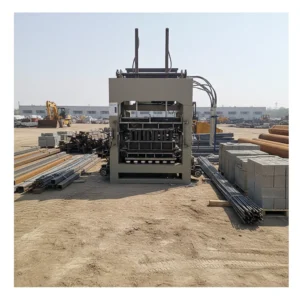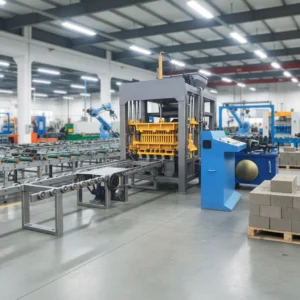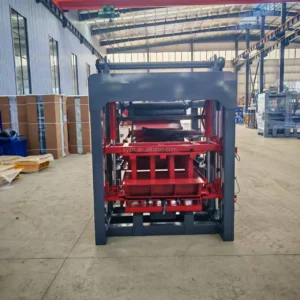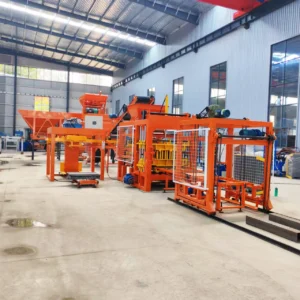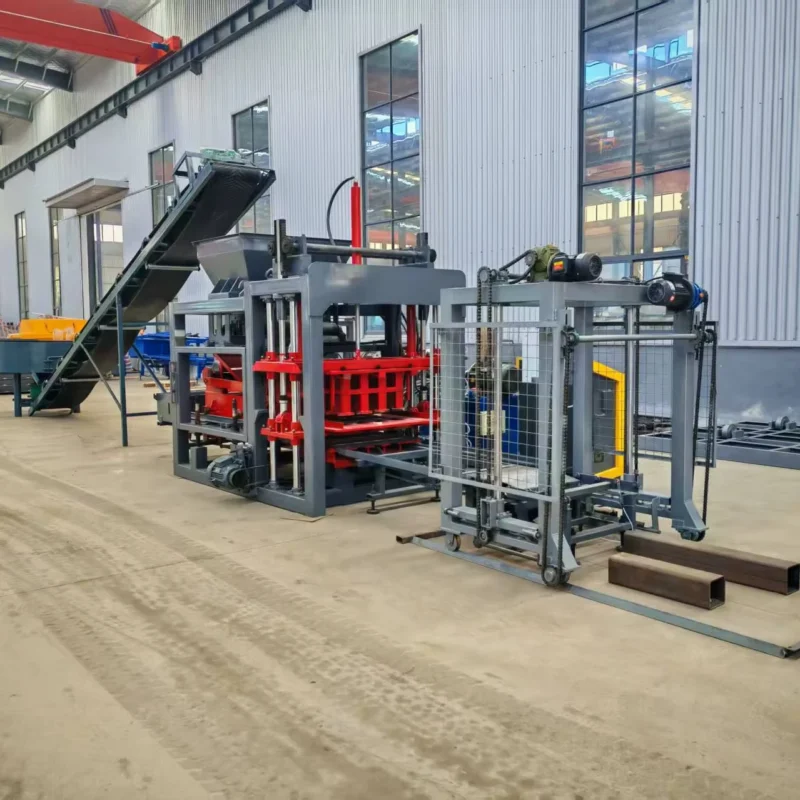
Synchronized Line Rhythm — Every upstream feeder and downstream pallet handler is timed to the QT4-15 press cycle, so throughput never stalls at a single station.
Technical Specifications
| Parameter | Value |
|---|---|
| Model | QT4-15 |
| Product Type | Full Automatic Hydraulic Block Making Machine |
| Overall Dimensions (L×W×H) | 7100×1600×2610 mm |
| Host Machine Dimensions (L×W×H) | 2800×1800×2550 mm |
| Rated Pressure | 16 MPa |
| Main Vibration Form | Platform Vibration |
| Vibration Frequency | 4600 r/min |
| Vibration Force | 40 kN |
| Pallet Size | 950×550×20/25 mm |
| Molding Cycle | 15–25 s |
| Overall Power | 27.5 kW |
| Host Machine Power | 19.2 kW |
| General Water Consumption | 4 T/day |
| Total Mass | 5 T |
| Motor Brand | Siemens or ABB (buyer selectable) |
| Control System | Siemens PLC with independently developed control program, customizable |
| Hydraulic System | Double proportional hydraulic valve (Calyca or Youken brand) |
| Output Capacity – Hollow Brick | 720–960 pcs/h (basis: 390×190×190 mm, 4 pcs/mold, 15–20 s cycle) |
| Output Capacity – Porous Brick | 2520–3360 pcs/h (basis: 240×115×90 mm, 14 pcs/mold, 15–20 s cycle) |
| Output Capacity – Standard Brick | 5930–6720 pcs/h (basis: 240×115×53 mm, 28 pcs/mold, 15–17 s cycle) |
| Automation Level | Full automatic |
| Warranty | 1 year for whole machine (excluding spare parts) |
Application Suitability
| Application | Material or Output |
|---|---|
| Hollow block production for commercial and residential walls | Crushed stone, sand, cement, fly ash aggregates |
| Standard solid brick manufacturing for load-bearing structures | River sand, stone dust, cement blends |
| Porous brick output for insulation and lightweight wall systems | Lightweight aggregate, perlite, cement mixes |
| Paving brick and road brick production for municipal projects | High-density aggregate, cement, pigment additives |
| On-site block production for housing and infrastructure contractors | Locally sourced aggregate matched to mix design |
Why the Mixer Starves the Press Before Anyone Notices
Capacity figures on the press nameplate mean nothing when the batching station cannot keep pace.
A QT4-15 block machine production line can complete a molding cycle in as little as 15 seconds, pulling a fresh pallet and fresh material each time. I once watched a plant in the Middle East run a QT4-15 where the mixer discharged every 90 seconds but the press needed a new batch every 45 seconds. The host sat idle for half of every minute, and the daily hollow block count dropped well below what the spec sheet promised. Nobody had calculated the mixer discharge interval against the press cycle when the line was first quoted. [NEED_CITE: batch mixer discharge intervals relative to block press cycle time]
Raw Material Feeding Sized to the Press Appetite
The QT4-15 block machine production line draws from a batching station that must deliver a consistent mix volume every 15–25 seconds depending on the block format. When the aggregate bins, conveyor belt, and mixer are specified together, the feeding rate is calculated backward from the press cycle rather than chosen from a catalogue default. This prevents the situation where the mixer becomes the bottleneck and the vibration table sits empty between cycles.
Pallet Circulation That Matches the Molding Rhythm
Downstream of the press, wet blocks ride on 950×550 mm pallets that must travel through the curing rack system and return to the feeding station before the next cycle fires. If the pallet return conveyor runs slower than the press discharge rate, the machine waits for an empty pallet and throughput collapses. The QT4-15 block machine production line addresses this by specifying pallet conveyor speed, curing rack capacity, and return elevator timing as one calculation, not three separate purchases. [NEED_CITE: pallet circulation requirements in automatic block production]
Reading the Numbers Behind the Cycle
The 16 MPa rated pressure and 40 kN vibration force work together — hydraulic compression removes air voids while platform vibration at 4600 r/min settles the aggregate into a dense matrix. Change either value and block compressive strength shifts. The double proportional hydraulic valve (Calyca or Youken) modulates pressure smoothly across the 15–25 second molding cycle, which matters when switching between a lightweight porous brick mix and a heavy paving brick mix. Pallet thickness at 20 or 25 mm is chosen based on the curing rack slot spacing and forklift tine capacity already on site, not picked from a standard list. Overall power draw of 27.5 kW across the full line means the electrical panel and dedicated circuit must be confirmed before production starts, especially where site voltage differs from the factory test bench.
What a Mismatched Line Costs After Installation
When the mixer, pallet handler, or stacking station is sourced separately and arrives with a different cycle expectation, the press spends a large part of each shift idle. Operators start pulling blocks off the press by hand because the automatic stacker cannot keep up, and the labour cost quietly erases the automation premium paid at purchase. Voltage and frequency mismatches discovered after the line is craned into place delay commissioning by weeks while transformers or variable-frequency drives are shipped in. [NEED_CITE: common commissioning delays in exported block production lines] Pallets ordered in the wrong thickness jam the curing rack slots, forcing a full re-order before the plant can reach target output.
Why Sourcing the Whole Line From One Supplier Matters
Block machinery is our single focus, so the QT4-15 press, its moulds, pallets, and every handling station are specified as one matched system rather than assembled from separate vendors. Configuration starts from your actual mix design and local aggregate, not a catalogue default, which means the batching station is sized to feed the exact material the press was tested on. Mould design covers the formats your market actually buys, with custom drawings available when standard formats do not fit. Automation level is selectable — a buyer can begin with semi-automatic pallet handling and upgrade to full automatic stacking and cubing later without replacing the press. Installation and commissioning support includes operator training on the full line, not just the host machine.
Documentation & Verification
- Line layout and capacity calculation stating which block format each hourly figure assumes
- Hydraulic and electrical schematic covering every station from feeder to stacker
- Voltage, frequency, and PLC display language confirmed in writing before production
- Factory test record run on your specified block format and mix design
- Pallet specification sheet matched to your curing rack spacing and forklift capacity
- Operation and maintenance manual with wear parts and mould replacement list
Installation, Commissioning & Support
- Foundation plan sized to the 7100×1600 mm overall footprint and 5 T operating mass
- Dedicated electrical circuit rated for 27.5 kW overall draw with confirmed voltage and frequency
- Machine shipped in agreed assembly state with dismantling notes for container loading
- On-site commissioning includes full line cycle synchronization across every station
- Operator training covers PLC program navigation in the confirmed display language
- Wear parts list with hydraulic seals and mould liner reorder references included
What We Need to Size Your Line Correctly
Send us your target block formats with dimensions, the daily output you need per format, and the raw materials available locally including aggregate type and cement grade. We also need your site voltage and frequency, the curing area dimensions you have available, and the forklift model that will handle loaded pallets. With those details, we can calculate the line station intervals and confirm whether the QT4-15 block machine production line fits your plant without any station left waiting.
Frequently Asked Questions
Q: How is the cycle time of each line station matched to the QT4-15 press so the machine is never left waiting for pallets or material?
A: We calculate backward from the press molding cycle of 15–25 seconds. The mixer discharge interval, pallet conveyor speed, and stacking station rate are each set so that a fresh pallet and fresh material arrive before the press completes its current cycle. The line layout document you receive before production shows every station interval against the press cycle.
Q: Which supporting equipment is included in the line quotation, and what is left for the buyer to source?
A: The quotation covers raw material feeding, mixing, pallet feeding, automatic stacking, curing rack handling, and cubing stations that connect directly to the QT4-15 press. Items left to the buyer typically include the curing yard slab, water supply connection, and the main electrical feed to the control panel. We list every included and excluded item in the line layout document.
Q: How do you confirm pallet size and curing rack layout against my existing site footprint and forklift before shipment?
A: We ask for your curing area dimensions, rack slot spacing, and forklift tine capacity. The 950×550×20/25 mm pallet is then specified to match those constraints. If your existing racks require a different pallet thickness, we adjust the spec before production so pallets slot in on the first day without modification.
Q: What documentation covers the full line, not just the press?
A: You receive a line layout with capacity calculations per block format, full hydraulic and electrical schematics covering every station, PLC program language confirmation, factory test records on your chosen format, and a wear parts list that includes mould liners and hydraulic seals for each machine in the line.
Q: Can the line be commissioned as semi-automatic now and upgraded to full automatic stacking and cubing later?
A: Yes. The QT4-15 press and its PLC control system are designed with an upgrade path. You can start with manual pallet handling and semi-automatic operation, then add the automatic stacker and cubing station later. The Siemens PLC program is updated to incorporate the new stations without replacing the existing control hardware.