
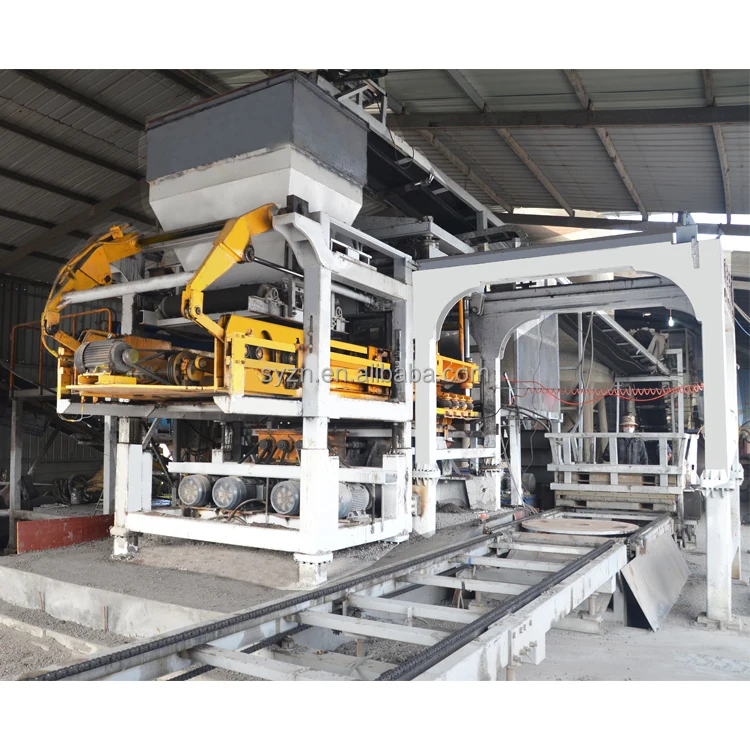
Matched system design — every station from raw material feeding to pallet-free stacking is timed against the QT18-15 press cycle so the line runs without bottlenecks.
Technical Specifications
| Parameter | Value |
|---|---|
| Model | QT18-15 |
| Product Type | Fully Automatic Block Brick Production Line |
| Brick Height Range | 50–300 mm |
| Stacking Height | 0–1200 mm (pallet-free) |
| Main Vibration Form | Platform vibration |
| Vibration Frequency | 2800–4500 r/min |
| Vibration Power | 60 kW |
| Hydraulic System Power | 59 kW |
| Diving Method | Hydraulic |
| Demolding Method | Vibration and hydraulic |
| Pallet Size | 1350 × 1350 × 120 mm |
| Molding Cycle | 15–25 s (basis not stated in source — confirm block format, material and thickness) |
| General Water Consumption | 8 T/day |
| Factory Area | 2000 m² |
| Control System | PLC with person-machine conversation interface |
| Pallet Requirement | Pallet-free (blocks stacked directly after moulding) |
| Automation Level | Fully automatic |
| Applied Products | Concrete blocks, hollow/solid blocks, pavers, interlocking blocks, curbstone, colored pavers |
| Raw Materials | Crushed stone, sand, cement, dust, fly ash, gravel, slag |
Application Suitability
| Application | Material or Output |
|---|---|
| Hollow block production for commercial and residential walls | Crushed stone, sand, cement, fly ash blends |
| Solid block manufacturing for load-bearing structures | Gravel, sand, cement mixes |
| Paver and interlocking block production for landscaping and roads | Colored concrete, slag, cement |
| Curbstone and kerb production for municipal infrastructure | High-density concrete with coarse aggregate |
| On-site block production for housing development projects | Locally sourced aggregate and cement |
What "15–25 Seconds per Cycle" Leaves Out in a Fully Automatic Block Production Line
Cycle time means nothing unless every upstream and downstream station matches it.
A press cycling at 15–25 seconds per mould demands that the mixer delivers a fresh batch within that same window, the feeder positions material without delay, and the stacker clears cured blocks before the next pallet arrives. When even one station falls behind, the press sits idle and daily output drops well below the quoted figure. I have walked into plants where a high-capacity press was starved by an undersized mixer, cutting actual production in half while the owner wondered why the line never hit its number [NEED_CITE: line balancing principles in concrete block manufacturing].
This is why the QT18-15 is specified as a complete fully automatic block production line rather than a standalone press — each station is sized and timed against the others during layout planning.
How Station-to-Station Timing Defines Real Output
The QT18-15 fully automatic block production line connects raw material batching, mixing, hydraulic pressing, and pallet-free stacking into a single coordinated sequence. The PLC with person-machine conversation interface monitors each station, pausing the press if the mixer or stacker is not ready rather than forcing a cycle that produces incomplete blocks. This coordination is what separates a line that runs at nameplate speed from one that constantly trips and restarts.
Where Pallet-Free Stacking Changes the Line Layout
Eliminating pallets from the circulation loop removes an entire subsystem — pallet return conveyors, pallet cleaning stations, and pallet storage racks — from the factory floor. The QT18-15 stacks blocks directly after moulding to a height of up to 1200 mm, which shifts the floor space requirement toward curing area rather than pallet handling corridors. For a plant owner planning a 2000 m² facility, this means more square metres available for block curing and less capital tied up in pallet inventory [NEED_CITE: pallet-free versus pallet-based block production layout comparison].
Reading the Specs That Actually Matter
The 60 kW vibration system paired with a 59 kW hydraulic press determines how densely the concrete is compacted in the mould. Vibration frequency adjustable between 2800 and 4500 r/min allows the operator to match the energy input to the block format — higher frequency for thin pavers that need surface finish, lower frequency with longer dwell for tall hollow blocks that need core strength. The hydraulic diving and demolding system provides controlled pressure during both compression and release, reducing edge cracking on demolding.
The 1350 × 1350 × 120 mm pallet size defines the maximum mould footprint and therefore the number of blocks per cycle. This dimension must align with the curing racks and forklift tine spacing already in the buyer’s yard. A mismatch here forces the buyer to replace handling equipment that was not part of the original budget.
The Hidden Cost of Ignoring Station Balance
When a buyer purchases a press alone and connects it to an existing mixer or stacker, the cycle times almost never align. The press waits for material, the mixer runs dry between batches, and the stacker jams because blocks arrive faster than it can clear them. These micro-stoppages accumulate across a shift, and the owner sees output well below the press rating without understanding why. Retrofitting matched equipment later costs more than specifying the full line from the start [NEED_CITE: hidden costs of mismatched production line stations].
Why Source the Complete Line Here
Block machinery is the single focus of this operation, so the press, moulds, pallets, and handling equipment are specified as one matched system rather than assembled from separate suppliers. The QT18-15 line layout is calculated against the buyer’s actual block format and local aggregate, not a catalogue default. Automation level is selectable, allowing a buyer to start with semi-automatic pallet handling and upgrade to full stacking and cubing later. Installation includes on-site commissioning with operator training, and mould design covers the specific formats the buyer’s market requires, including custom drawings. Documentation packages include hydraulic and electrical schematics, factory test records, and wear parts lists specific to the configuration shipped.
Documentation & Verification
- Line layout with capacity calculation stating the block format assumed for each output figure
- Station-to-station cycle time matching document for mixer, press, and stacker
- Voltage, frequency, and PLC display language confirmation before production begins
- Hydraulic and electrical schematic specific to the QT18-15 configuration shipped
- Factory test record on the buyer’s target block format before dispatch
- Wear parts list and mould drawing set included with shipment
Installation, Commissioning & Support
- Foundation plan sized for the 2000 m² factory area with press and stacker load points marked
- Electrical supply requirements for the combined 60 kW vibration and 59 kW hydraulic circuits confirmed before shipment
- Machine dismantled for container loading with reassembly sequence documented for on-site crew
- PLC language and person-machine interface set to operator preference during commissioning
- On-site operator training covering mould change, cycle adjustment, and daily maintenance routines
- Wear parts and mould replacement schedule provided with first shipment
Before You Request a Quote
To size the QT18-15 line correctly, share the block formats you plan to produce with dimensions and target daily output per format. Include your local raw material source and aggregate gradation, the voltage and frequency at your site, and the PLC display language your operators need. If you have existing mixers, curing racks, or forklifts, provide their specifications so the line layout can be built around them rather than requiring replacement.
Frequently Asked Questions
Q: How is line capacity verified, and which block format does each output figure assume?
A: Capacity is calculated per block format using the mould cavity count, molding cycle time, and operating hours. The QT18-15 molding cycle ranges from 15 to 25 seconds depending on block format, material, and thickness, so each output figure*umed. No single daily output number applies across all formats.
Q: How do upstream and downstream station cycle times match the press to prevent bottlenecks?
A: The mixer batch size, feeder travel speed, and stacker lift cycle are all calculated against the press molding cycle during line layout. The PLC coordinates station handoffs and pauses the press if any station is not ready, preventing incomplete blocks and micro-stoppages that silently reduce daily output.
Q: What voltage, frequency, and PLC language options are confirmed before shipment?
A: Voltage and frequency are confirmed to match the buyer’s local grid before production begins. The PLC person-machine conversation interface language is set to the operator’s preference. Confirming these details upfront avoids commissioning delays and rewiring costs after the line arrives at the site.
Q: What is included in the line scope, and what remains buyer-supplied?
A: The QT18-15 line includes raw material feeding, mixing, pressing, and pallet-free stacking with automatic cubing. Curing racks, forklifts, water supply to the 8 T/day requirement, and the 2000 m² factory building with foundation remain buyer-supplied. The proposal clearly separates included equipment from buyer-scope items.
Q: How does the pallet-free stacking system work, and what factory floor area is required?
A: Blocks are demolded and stacked directly without pallets to a height of up to 1200 mm, eliminating pallet return conveyors and pallet storage from the line. The stated 2000 m² factory area covers press, mixer, feeder, and stacker zones, with additional space needed for block curing and finished goods storage.


