
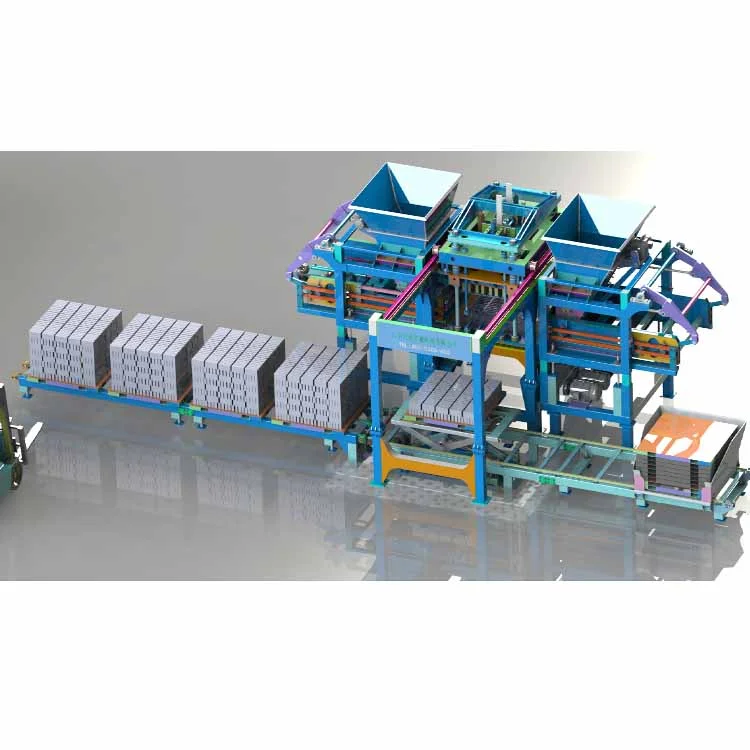
Stationary block machine — the QT18-25 line is specified from raw material intake to finished block stacking as one matched sequence, eliminating timing gaps between the mixer, press, and handling stations that typically throttle actual daily output.
Technical Specifications
| Parameter | Value |
|---|---|
| Model | QT18-25 |
| Product Type | Fully Automatic Pallet-free Hollow Block Production Line |
| Brick Height Range | 50-300mm |
| Stacking Height | 0-1200mm |
| Main Vibration Form | Platform Vibration |
| Vibration Frequency | 2800~4500 r/min |
| Pallet Size | 1350×1350×120mm (basis not stated in source — confirm block format / material / thickness) |
| Molding Cycle | 15-25 s (basis not stated in source — confirm block format / material / thickness) |
| Vibration Power | 60kW (rated or peak not specified in source) |
| Hydraulic System Power | 59kW (rated or peak not specified in source) |
| Driving Method | Hydraulic |
| Demolding Method | Vibration and Hydraulic |
| General Water Consumption | 8T/Day |
| Factory Area Requirement | 2000m² |
| Control System | PLC with person-machine conversation interface |
| Automation Level | Fully automatic, blocks stacked directly after moulding (pallet-free) |
| Applied Products | Concrete blocks, hollow/solid blocks, pavers, interlocking blocks, curbstone, colored pavers |
| Raw Materials | Crushed stone, sand, cement, dust, fly ash, gravel, slag, and other raw materials |
Application Suitability
| Application | Material or Output |
|---|---|
| Hollow block production | Crushed stone, sand, cement, fly ash |
| Solid block manufacturing | Gravel, cement, dust, slag |
| Paver and interlocking brick output | Colored concrete mixes with fine aggregates |
| Curbstone forming | High-strength concrete with coarse aggregate |
Why "Cycles Per Hour" Rarely Matches the Daily Tally
A press rate only matters when every upstream and downstream station keeps the same tempo.
Many buyers sign off on a pallet-free block production line based on a cycle time printed on the first page of a quotation, then watch the actual daily tally fall short once the mixer cannot feed fast enough or the stacker lags behind the press. [NEED_CITE: Typical discrepancies between quoted cycle times and realized daily output in block plants] I have seen plants where the host machine sat idle for seconds at a stretch, waiting for the next pallet or the next batch, because the supporting equipment was sourced separately and never timed to the press. This turnkey block making line addresses that gap by matching the batching, mixing, and stacking stations to the QT18-25 cycle before the layout is finalized.
Matching the Mixer to the Press Cycle
The QT18-25 runs a molding cycle between 15 and 25 seconds, depending on block format and mix design. A pallet-free block production line configured around this tempo needs a mixer that delivers a fresh batch within that same window, including the seconds lost to discharge and drum cleaning. When the mixer is undersized, the press waits; when it is oversized, the mix sits and begins to hydrate before it reaches the mould. Sizing the mixer to the press is the single most consequential decision in the line layout.
Removing the Pallet Loop from the Floor Plan
A conventional line requires thousands of wooden or steel pallets, a return conveyor, and a dedicated cleaning station. The pallet-free block production line eliminates that entire loop. Blocks are stacked directly from the mould to a height of up to 1200mm, then transferred to the curing area on their own base. This simplifies the factory area requirement, which sits around 2000m² for a full setup, and removes the ongoing cost of pallet replacement. [NEED_CITE: Pallet inventory and maintenance costs in conventional block plants]
Reading the Numbers Behind the Vibration and Pressure
Platform vibration at 2800 to 4500 r/min works in tandem with a dedicated 59kW hydraulic system to compact the mix from below while the head applies downward pressure. The vibration frequency determines how thoroughly the aggregate rearranges itself inside the mould cavity; the hydraulic pressure locks that arrangement in place before demolding. If the frequency is too low for a coarse aggregate, voids remain; if the pressure is too high for a dry mix, the block cracks on release. The adjustable range lets the operator dial both variables to the specific crushed stone, sand, or fly ash available locally. The 60kW vibration motor provides the force necessary for dense products like curbstone, while the lower end of the range suits lighter hollow blocks where wall thickness is limited.
When Stations Are Priced Separately, Timing Gaps Follow
A buyer who sources the press from one supplier and the stacker from another often discovers during commissioning that the two machines speak different languages, both in voltage and in signal timing. The result is a line that physically exists but runs at a fraction of its potential. [NEED_CITE: Risks of multi-vendor block line integration without unified timing control] A turnkey block making line that includes every station in one quotation places the responsibility for matching cycle times on a single engineering team, removing the finger-pointing that follows an underperforming first week.
Why Buyers Source the Complete Line Here
Block machinery is our single focus, so the QT18-25 is never shipped as a standalone press; the raw material feeding, mixing, stacking, and curing handling are specified together. Configuration is set against the buyer’s actual mix design and local aggregate, not a catalogue default. Mould design covers the formats the buyer’s market actually sells, including custom drawings when a standard mould does not match. Automation level is selectable, so a plant can start semi-automatic and add stacking or cubing modules later. Installation includes on-site commissioning and operator training, typically completed within a week of the line arriving on the floor.
Documentation & Verification
- Line layout and capacity calculation stating the block format assumed for every output figure.
- Machine specification sheet with hydraulic and electrical schematics matched to the supplied stations.
- Mould drawing and format list for every block type included in the quotation.
- Factory test record on the buyer’s target block format before dispatch.
- Voltage, frequency, and PLC display language confirmation signed off before production.
Installation, Commissioning & Support
- Factory area of approximately 2000m² must be leveled and cured before the 59kW hydraulic unit is positioned.
- Dedicated power circuit sized to the combined 60kW vibration and 59kW hydraulic loads plus mixer and conveyor motors.
- Machine arrives dismantled for container loading; reassembly on-site aligns the press, stacker, and curing transfer.
- Commissioning includes setting the PLC person-machine conversation interface to the operator’s language.
- Operator training covers mould change procedure, vibration frequency adjustment, and daily maintenance points.
- First-year free spare parts cover hydraulic and electrical components, excluding quick-wear mould surfaces.
Before You Request a Quotation
Provide the block format and dimensions your market actually buys, along with the daily output target tied to that specific format. Confirm the raw materials available locally, including aggregate grading and cement type, so the mixer and mould can be matched before the line is built. State your site voltage, frequency, and the PLC language your operators need.
Frequently Asked Questions
Q: How is line capacity calculated, and which block format is each output figure based on?
A: Every capacity figure on our line layout names the exact block format — length, width, height, and wall thickness — used to derive it. The QT18-25 molding cycle ranges from 15 to 25 seconds depending on the format and mix, so a hollow block and a solid paver will show different hourly outputs on the same machine. We provide a separate calculation for every product in your range.
Q: Which upstream and downstream stations are included in the line quotation?
A: The quotation covers raw material feeding, mixing, the QT18-25 press, and the pallet-free stacking station up to 1200mm. If a curing rack handling or cubing module is required, it is added to the same document with its own cycle time matched to the press. Every station is priced in one scope, so timing gaps have nowhere to hide.
Q: How does the pallet-free stacking system affect curing area layout?
A: Without pallets circulating through the line, the curing yard only needs to receive stacked blocks on their own base. This removes the pallet return conveyor, pallet storage, and pallet cleaning station from the floor plan, freeing space for additional curing area or a second production line within the same 2000m² footprint.
Q: What raw material feed configuration is available, and how is the mixer sized?
A: The feeding system is configured to match the number of raw materials in your mix — cement, sand, crushed stone, fly ash, or other additions. The mixer is sized so that discharge completes within the QT18-25 molding cycle, preventing the press from waiting. We confirm the batch weight and mixing time against your specific recipe before finalizing the layout.
Q: What voltage, frequency, and PLC language options are confirmed before shipment?
A: Voltage and frequency are confirmed in writing before production begins, and the PLC person-machine conversation interface is set to the language your operators use. The QT18-25 electrical schematic is included in the documentation package so your local electrician can prepare the dedicated circuit before the containers arrive.


